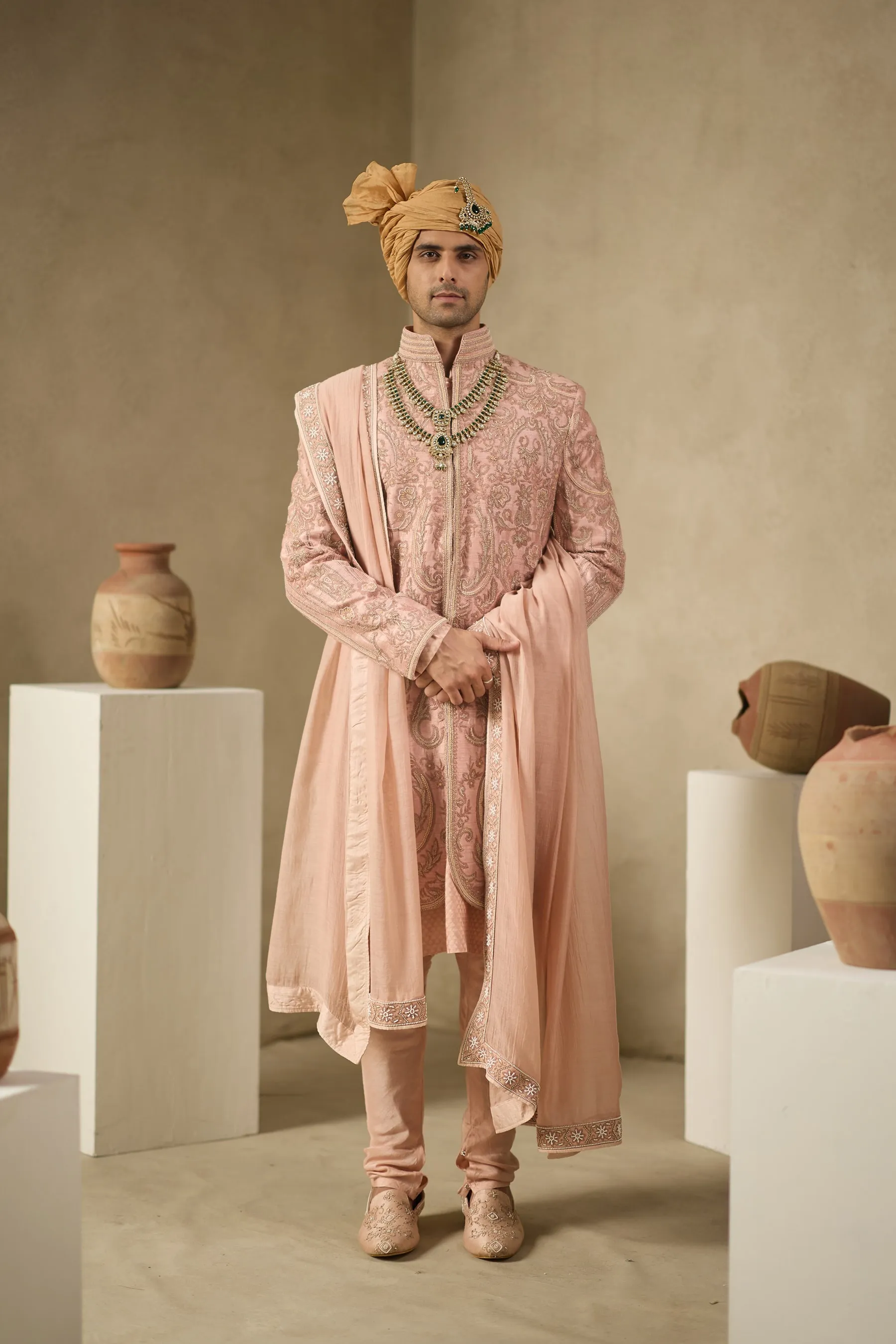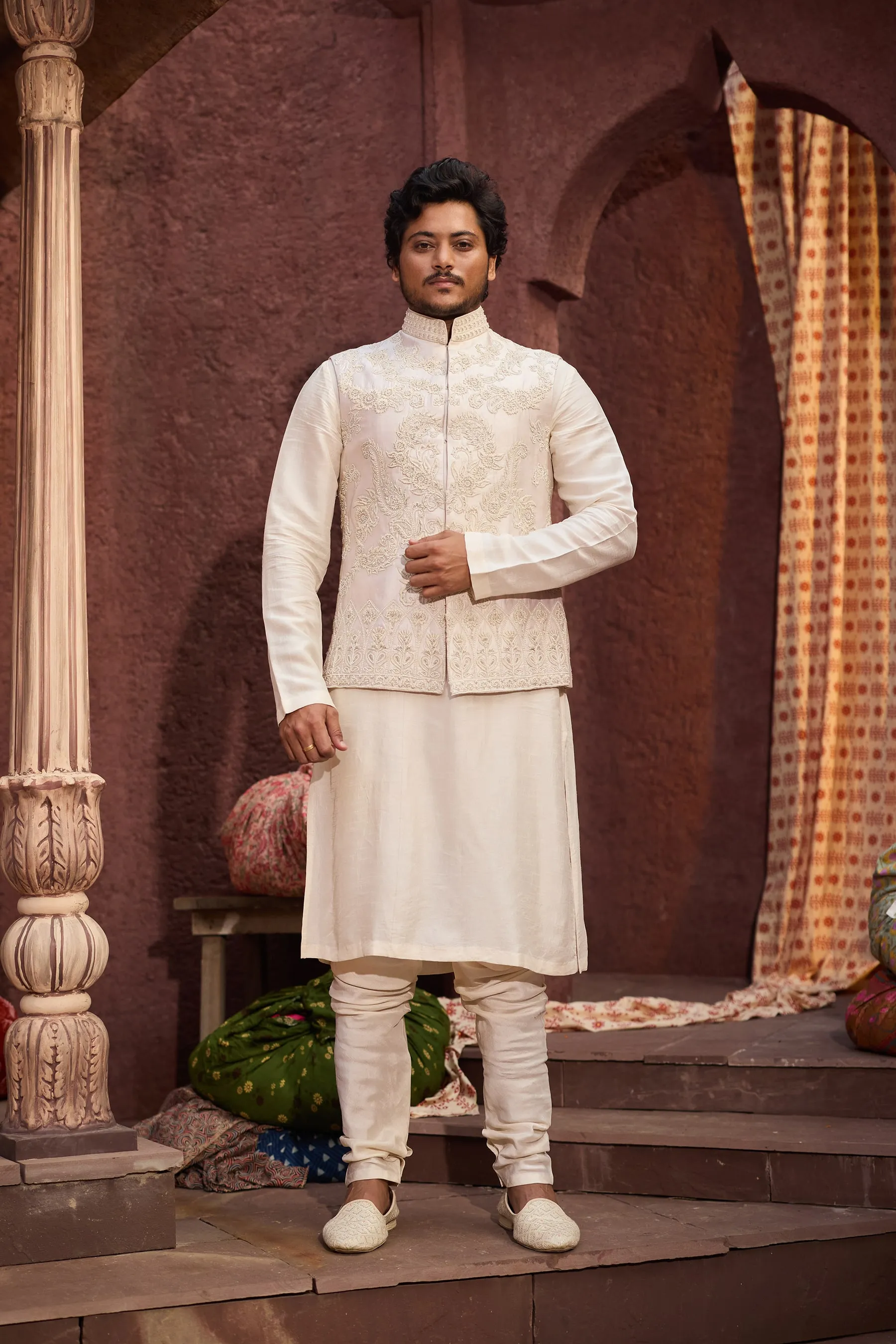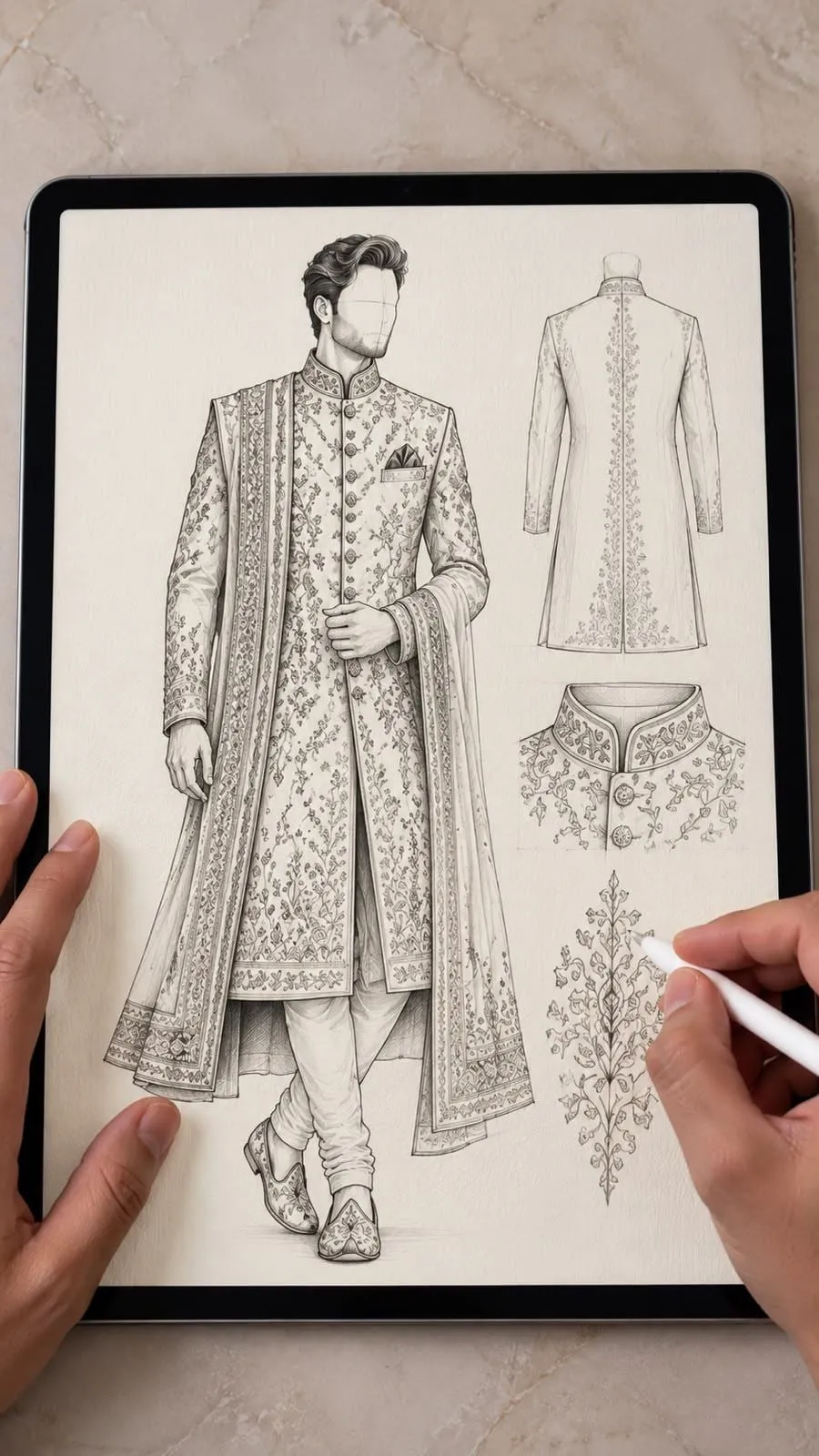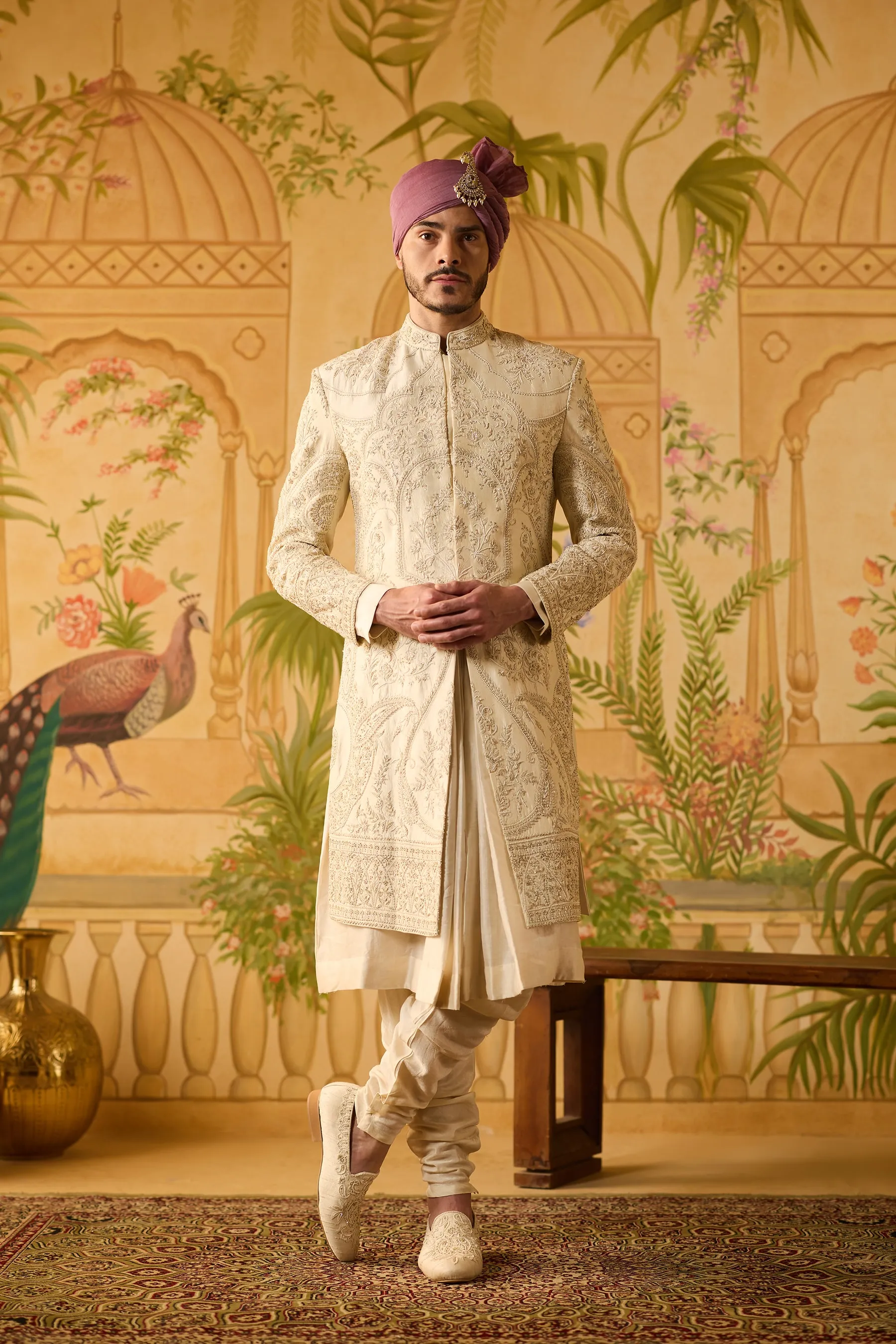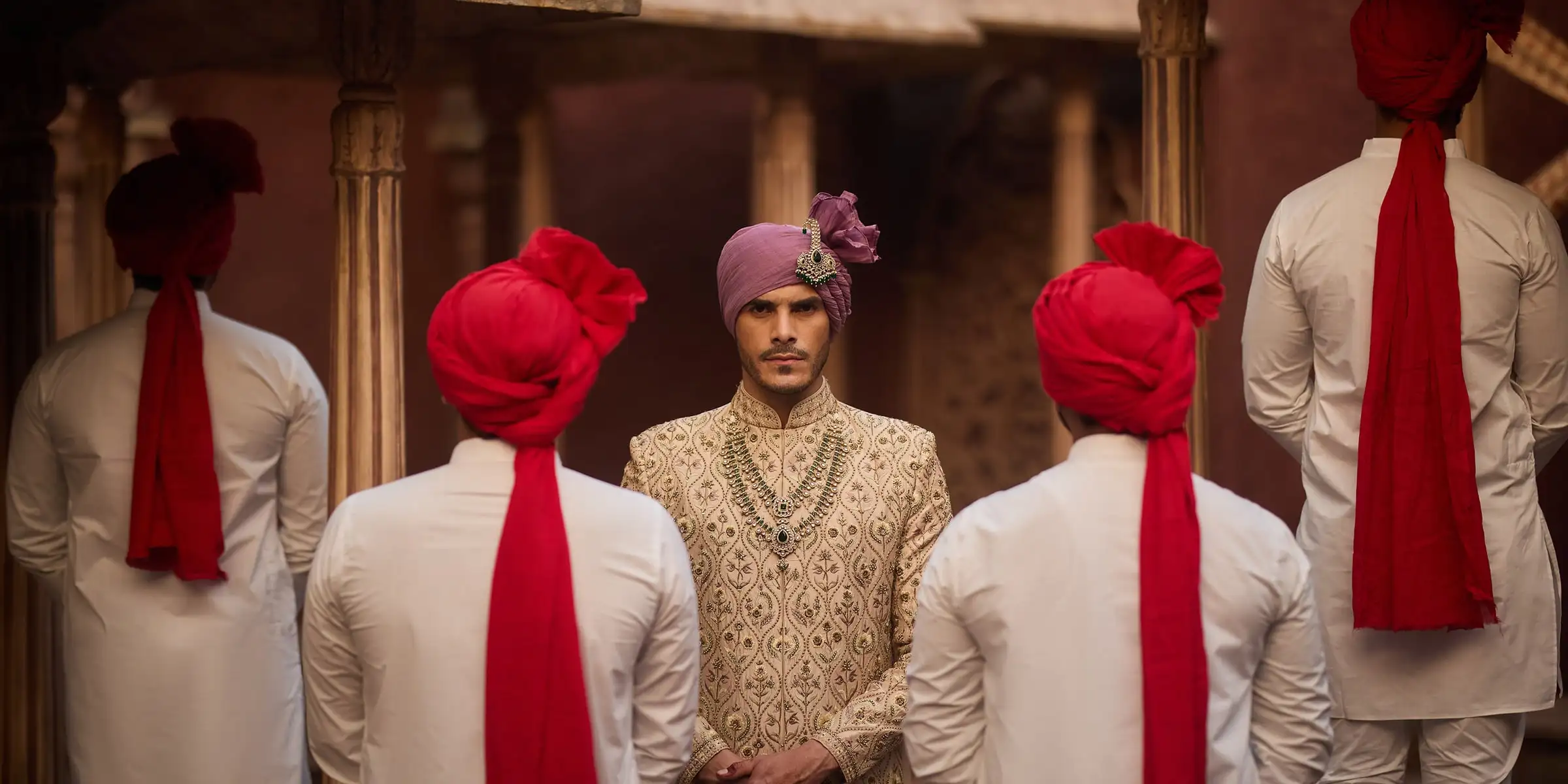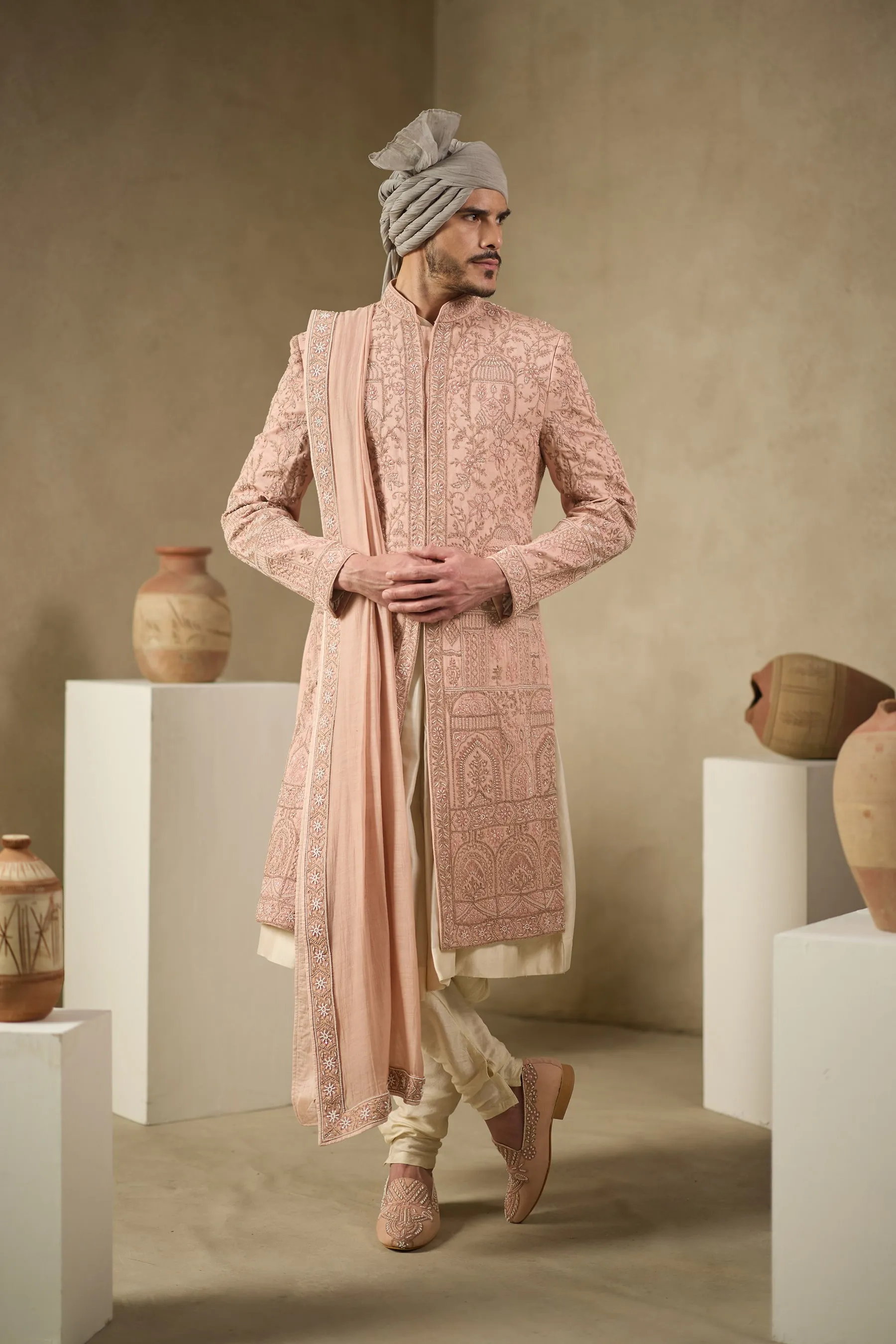
A groom’s colour is one of the first decisions of the wedding wardrobe, and one of the hardest to undo. Fabric can be changed and embroidery can be adjusted, but a colour, once chosen, sets the whole mood. It appears in every photograph, interacts with the bride’s lehenga and the venue’s flowers, and decides whether you look luminous or washed out. This guide explains how to choose wedding colours for the groom in India, with advice by skin tone, bride, ceremony, season, time of day and community, plus tested pairings for stoles, safas and accessories.
It complements our guides to the ivory sherwani, what the groom wears at each ceremony and sherwani vs achkan vs bandhgala.
The five factors that decide your colour
Rather than chasing trends, choose colour by five factors.
- Your skin tone and undertone, which decide what flatters you.
- The bride’s outfit and the couple’s palette, which decide what works together.
- The ceremony and its mood, which decide how bright, soft or formal the colour should be.
- The season and the time of day, which decide the fabric, the weight and how the colour appears in light.
- The community and family customs, which decide what is auspicious and what is best avoided.
If you consider all five, the answer is often obvious, and the confusion falls away.
Factor one: your skin tone and undertone
Skin tone is the colour of your skin; undertone is the hue beneath it: warm (golden, olive), cool (pink, red) or neutral. Most Indian skin tones have warm or neutral undertones, though cool undertones exist.
How to find your undertone
- Look at your wrists in daylight. Green veins suggest warm, blue or purple veins suggest cool, and a mix suggests neutral.
- Hold gold and silver foil near your face. If gold looks better, you are likely warm; if silver, cool.
- Try ivory and pure white. If ivory flatters and white looks stark, you are likely warm or neutral.
Colours for fair skin
- Jewel tones (navy, emerald, burgundy, deep teal) give striking contrast.
- Rich neutrals (charcoal, midnight blue) look sharp.
- Soft pastels (powder blue, blush) are gentle and fresh.
- Avoid very pale shades such as pure white or pale grey, which can wash out the complexion.
Colours for wheatish and medium skin
- Ivory, cream, champagne and gold glow against warm skin.
- Rose, peach and coral add warmth.
- Emerald, teal and sapphire give contrast.
- Mustard and saffron suit a festive, traditional look.
- Avoid colours very close to your skin tone, such as beige or tan without contrast.
Colours for deep and dark skin
- Ivory, gold and champagne are striking and luminous.
- Rose, pink, blush and peach look fresh and modern.
- Jewel tones such as emerald, sapphire, fuchsia and burgundy glow.
- Pastels in mint, lavender and powder blue are elegant.
- Avoid dull, muddy shades such as grey-brown and khaki that lack contrast.
A good test is to hold swatches against your face in daylight and see which make your skin look warm and alive and which make it look tired.
Factor two: the bride’s outfit and the shared palette
The bride’s lehenga, saree or gown dominates the photographs, and your outfit should sit beside it, not fight it.
- Ask for a swatch or a photograph of her outfit as early as possible.
- Choose a shared accent, such as the colour of the embroidery thread, the stone in the brooch or the stole, so you are visibly connected.
- Avoid exact matching. Identical colours flatten the photographs, and a groom in the same red as the bride disappears.
- Balance the intensity. If the bride wears a bold red, the groom’s ivory or gold keeps balance; if she wears a pastel, a deeper groom’s colour gives contrast.
- Think about the couple’s silhouette. A deep sherwani and a pale lehenga, or the reverse, create an elegant visual rhythm.
Pairings that work
| Bride’s outfit | Groom’s sherwani | Accent in safa or stole |
|---|---|---|
| Red or maroon | Ivory, cream, gold | Maroon, gold |
| Pink or rose | Ivory, champagne, sage | Rose, gold |
| Pastel (blush, mint, powder blue) | Ivory, navy, charcoal | Matching pastel |
| Green or teal | Ivory, gold, rose | Emerald |
| Ivory or champagne | Navy, emerald, burgundy | Gold, rose |
| Gold or metallic | Ivory, navy, deep green | Gold |
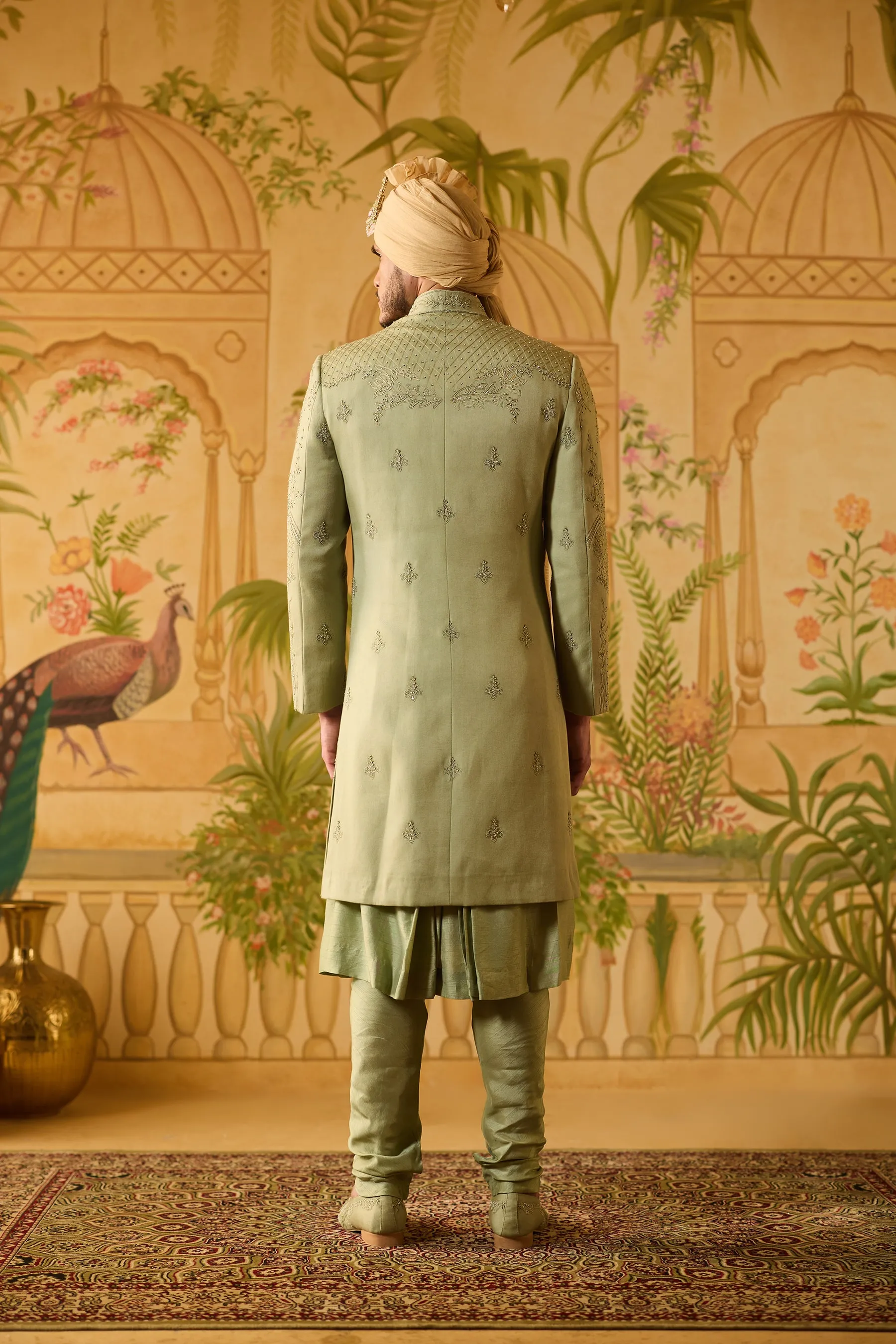
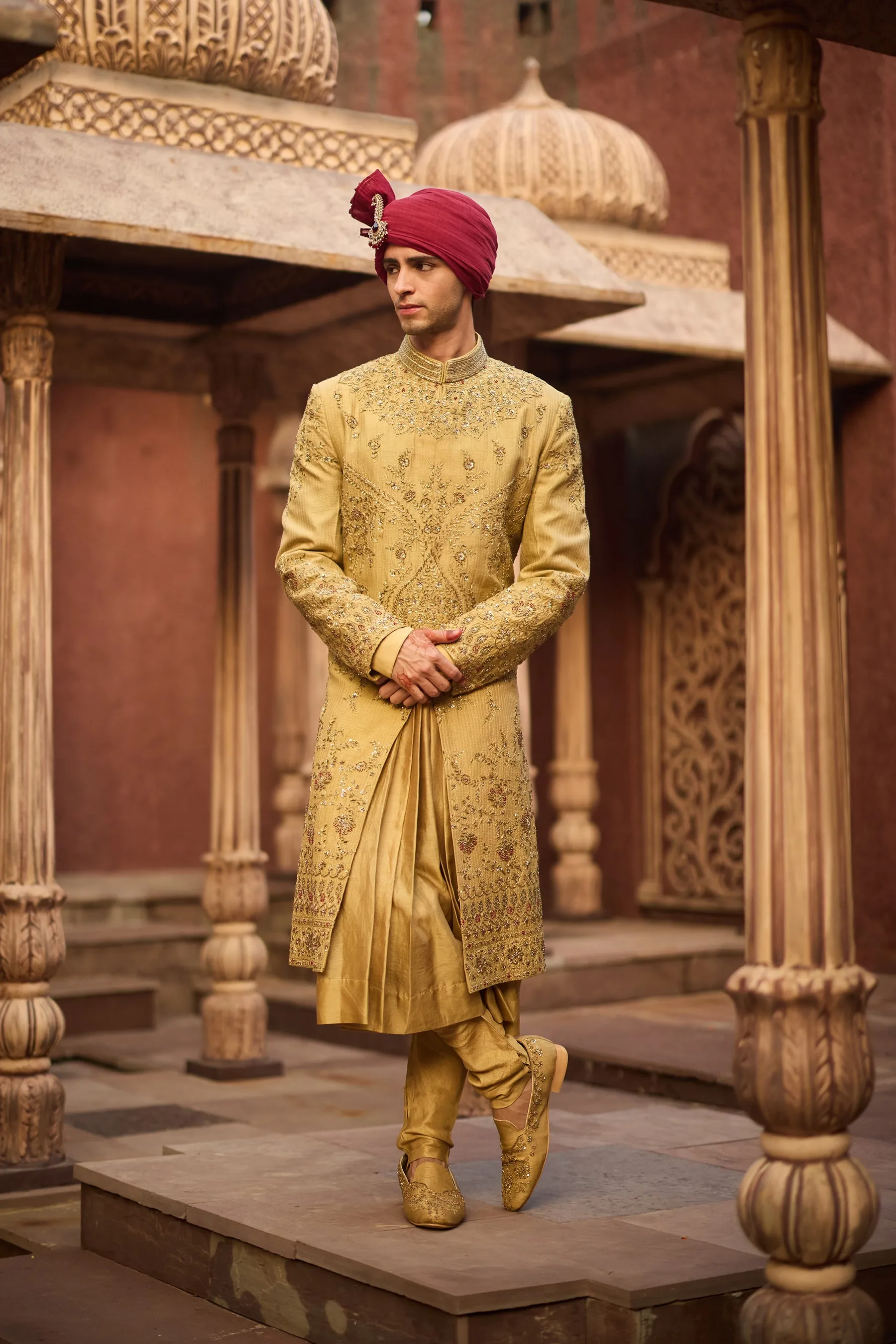
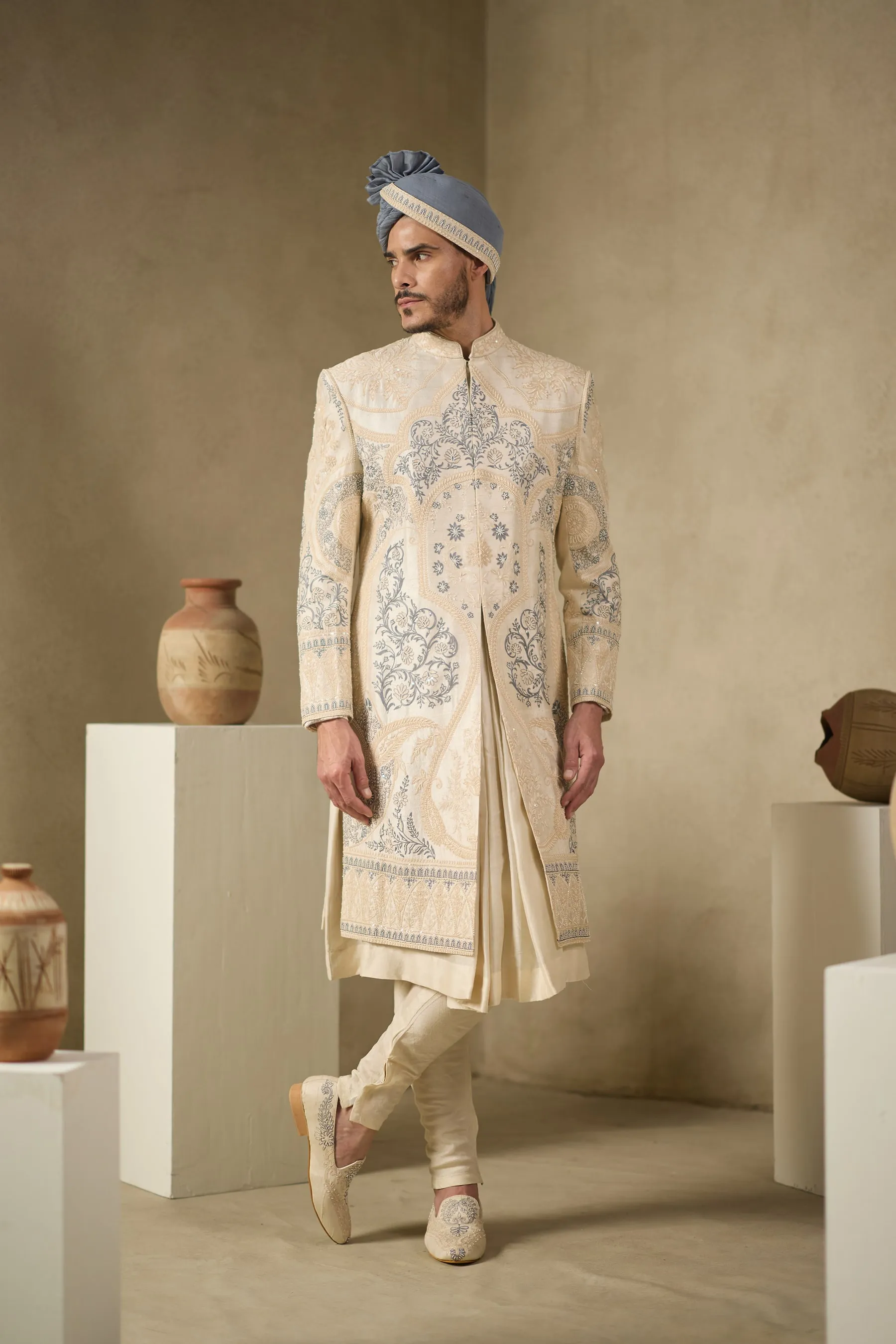
Our sherwani collection includes pieces in many of these colours, such as the Aabha in rose, the Pallav in pistachio, the Sarson in mustard gold and the Megh in ivory and blue.
Factor three: the ceremony and its mood
Each ceremony has its own colour language.
Roka, sagai and engagement
Soft, optimistic colours: powder blue, sage, blush, champagne and ivory. See the roka outfit guide and the engagement outfit guide.
Haldi
Yellow and its neighbours: butter, mustard, ivory, cream and pastel. Avoid black and very dark colours. See the haldi outfit guide.
Mehendi
Greens, pastels and earthy tones: mint, pistachio, sage and terracotta. See the mehendi outfit guide.
Sangeet and cocktail
Rich evening colours: navy, black velvet, emerald, burgundy and plum. See the sangeet outfit guide and the cocktail party outfit guide.
Baraat and pheras
Traditional, auspicious colours: ivory, gold, champagne, saffron, maroon and rose. See the baraat outfit guide and the pheras outfit guide.
Reception
Formal evening colours: midnight navy, black, charcoal, deep green and burgundy. See the reception outfit guide.
Factor four: season and time of day
Colour behaves differently in different light and climate.
- Summer: light colours (ivory, pastels, sand) reflect heat and look fresh. See the summer wedding groom outfit guide.
- Winter: deep, rich colours (navy, emerald, burgundy, black) glow in soft light and suit velvet and wool. See the winter wedding groom outfit guide.
- Daytime: pastels, ivory and gold look clean and bright in daylight.
- Evening: jewel tones and darks look dramatic under lamps and stage lights.
- Outdoors: consider the backdrop. A sage sherwani blends into a green lawn; a navy or ivory one stands out.
- Indoors: consider the lighting. Warm lamplight turns white to cream and deepens golds.
Always view fabric in the same light as the event, if possible. A swatch in a shop can look entirely different at dusk.
Factor five: community, family and auspiciousness
Colour carries meaning in India, and customs differ.
- Red is traditionally the bride’s colour in many communities; grooms often avoid bright red.
- Saffron and orange are auspicious in many Hindu and Sikh traditions, especially for safas.
- White and cream are common for the nikah, for Bengali and South Indian grooms, and are associated with purity.
- Green has special significance in many Muslim communities, and can also suit mehendi.
- Black is widely accepted for receptions and evening events but is avoided in some families for ceremonies.
- Yellow is associated with the haldi and with auspicious beginnings.
For community-specific guidance, see our guides to the Sikh wedding outfit, nikah and walima outfit, Bengali wedding outfit and South Indian wedding attire. If you are unsure, ask the elders.
Colour families explained
Ivory, cream, champagne and gold
The classic groom’s family. Ivory is versatile; cream is warm; champagne and gold are festive. See the ivory sherwani guide.
Pastels
Blush, rose, mint, pistachio, powder blue, lavender and peach. Fresh and modern, ideal for daytime, spring and contemporary weddings. The Gul in peach and the Pallav in pistachio are examples.
Jewel tones
Emerald, sapphire, ruby, amethyst and deep teal. Rich and regal, good for evening and winter.
Navy and midnight
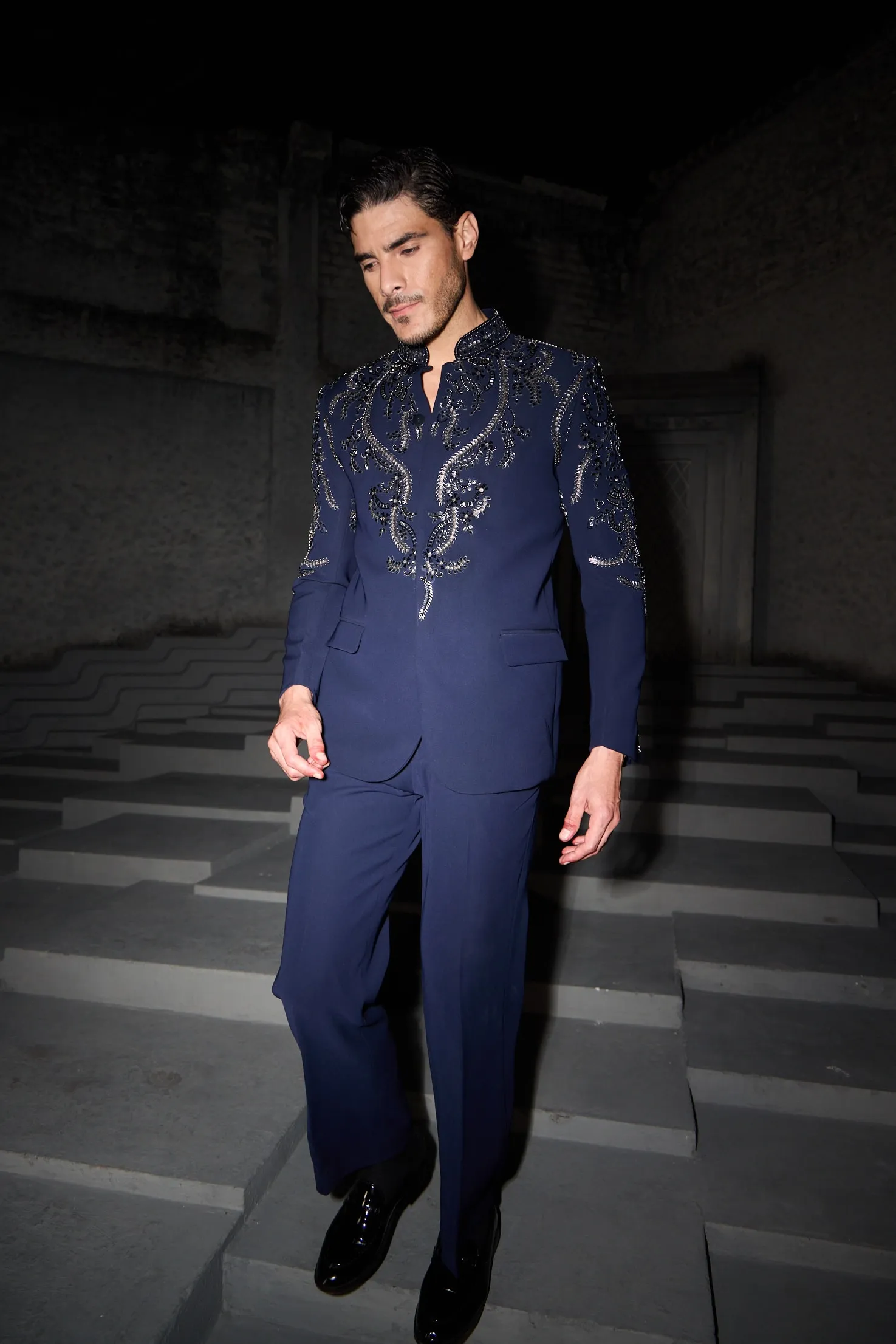
Sharp, modern and flattering, with a sophisticated feel. The Samundar in navy shows how elegant a deep blue can be. See the bandhgala collection.
Black and charcoal
Elegant and formal, mostly for evening and reception, with velvet or satin. See the tuxedo collection.
Earth tones
Terracotta, olive, mustard and rust. Warm and contemporary, good for outdoor and destination weddings.
Accents: safa, stole, brooch and shoes
A groom’s colour is not just the sherwani. The accessories distribute colour across the look.
- Safa or turban: the best place for a bold colour.
- Stole: adds a second tone and texture.
- Brooch and kalgi: a small, bright spot of gold or stone.
- Shoes: mojaris in gold, tan or a coordinating tone.
- Pocket square or buttons: quiet details that tie the look together.
A reliable rule: one main colour, one accent and one metal. For example, ivory, maroon and gold.
Eight ready-made palettes for the groom
If you prefer a starting point, these eight palettes have worked for many of our grooms. Adapt them to your skin tone and the bride’s outfit.
- Ivory, gold and maroon. The traditional baraat palette. An ivory sherwani with gold zardozi, a maroon safa and a gold stole. Warm, regal and universally flattering.
- Champagne, rose and pearl. A soft, romantic palette for daytime and spring. A champagne sherwani with rose thread work, a rose safa and a pearl mala.
- Navy, gold and ivory. A sharp, modern palette for a reception or winter wedding. A navy bandhgala or sherwani, a gold brooch and an ivory pocket square.
- Emerald, ivory and gold. A rich, jewel-toned palette. An ivory sherwani with an emerald safa and stole, and gold mojaris.
- Sage, ivory and blush. A contemporary garden palette. A sage sherwani or bandhgala, an ivory kurta and a blush stole.
- Black velvet, silver and white. A cocktail or reception palette. A black velvet jacket, a white shirt, a silver brooch and black loafers.
- Mustard, ivory and terracotta. A warm, earthy palette for haldi, mehendi or a destination wedding. A mustard kurta, an ivory jacket and terracotta accents.
- Powder blue, cream and silver. A cool, gentle palette for an engagement or a day wedding. A powder blue sherwani, a cream kurta and a silver brooch.
Each palette follows the same logic: one main colour, one accent and one metal.
Colour by backdrop: what the camera sees
The venue’s backdrop changes how your colour reads.
- Marble and stone palaces suit rich, saturated colours and gold. Ivory against white marble can blend, so add a deep safa or stole.
- Green gardens and lawns make reds, golds and ivory pop, and swallow sage and olive.
- Beaches and skies favour pastels and ivory, and make navy look crisp. Sand-coloured outfits disappear.
- Dark ballrooms and stages reward light colours and metallics, and swallow black.
- Temples and gurdwaras have warm, lamp-lit interiors where ivory, gold and saffron glow.
- Floral mandaps in orange and yellow call for ivory, cream or deep colours that do not compete.
Visit the venue or ask for photographs, and picture yourself standing in the space.
Colour and budget: choosing pieces you will wear again
Colour affects how often you can wear an outfit again.
- Neutral and deep colours (ivory, navy, charcoal, black, champagne) are the most re-wearable. A bandhgala in midnight navy serves for years.
- Pastels are re-wearable for daytime and spring events, though more seasonal.
- Bright and bold colours are the most memorable but the least re-wearable; they are best for a single, special event.
If your budget is limited, choose one neutral piece with high re-wear value and add colour through accessories such as the safa, stole and brooch. If you are investing in several outfits, mix neutrals and statement colours, so that your wardrobe works as a whole. See made-to-measure timelines for planning guidance.
Coordinating the wedding party
Once the groom’s colour is settled, the rest of the party can follow.
- Groomsmen wear colours that echo the groom’s palette in deeper or lighter tones. See our guide to groomsmen outfits.
- The father and brother choose complementary colours. See the guides to the father of the groom’s outfit and groom’s brother’s outfit.
- Guests are advised to avoid the groom’s and bride’s colours. See our male guest guide.
A shared palette communicated early prevents last-minute clashes and creates harmonious photographs.
Colour trends versus lasting choices
Each season brings fashionable colours: dusty pastels one year, jewel tones the next, earthy neutrals after that. Trends are pleasant, but a wedding outfit will be looked at for decades. A sensible approach is to let a trend guide the accent, not the foundation. Choose a lasting main colour, such as ivory, champagne, navy or deep green, and let the safa, stole or embroidery thread carry the fashionable shade. In ten years, the accent will date gracefully, and the main colour will still look right in the album.
When two colours seem equally right, choose the one that makes you stand taller when you see yourself in the mirror. A groom who feels confident in his colour carries it better than one who chose it by committee, and the camera notices.
Testing colours before you commit
A few simple tests reduce the risk of a wrong choice.
- See the fabric in daylight, near a window, and in the evening under warm light.
- Hold swatches to your face and take photographs with your phone.
- Place the swatch beside the bride’s fabric.
- Check with the venue’s décor and flowers.
- Ask someone you trust, who will be honest.
- Sleep on it. Colours that still excite you after a day are the right ones.
Our atelier encourages clients to bring swatches of the bride’s outfit and the décor, so we can compare them with the fabrics in different lights.
Common mistakes to avoid
- Matching the bride exactly.
- Choosing colour from a screen. Screens distort; see the fabric.
- Ignoring the venue. A sage sherwani at a green lawn disappears.
- Following a trend that does not suit you.
- Forgetting the evening light.
- Not checking family customs.
Frequently asked questions
What colour should a groom wear?
Ivory, gold and champagne for the main ceremony; pastels for daytime; jewel tones and darks for evening.
What suits my skin tone?
Test swatches near your face in daylight; warm undertones glow in ivory and gold, and jewel tones suit most.
Should I match the bride?
Coordinate through an accent, not an exact match.
Which colours should I avoid?
Bright red and, for some ceremonies, black; check customs.
Final thoughts
The right colour is the one that suits you, complements the bride and respects the occasion. Take your time, test in the light, and choose with confidence. If you would like to see fabrics side by side with the bride’s swatches, book an appointment and we will build the palette with you.
Shop the looks
Browse the sherwani collection, the bandhgala collection, the Nehru jacket collection and the haldi and mehendi edit, or the sangeet and cocktail edit.