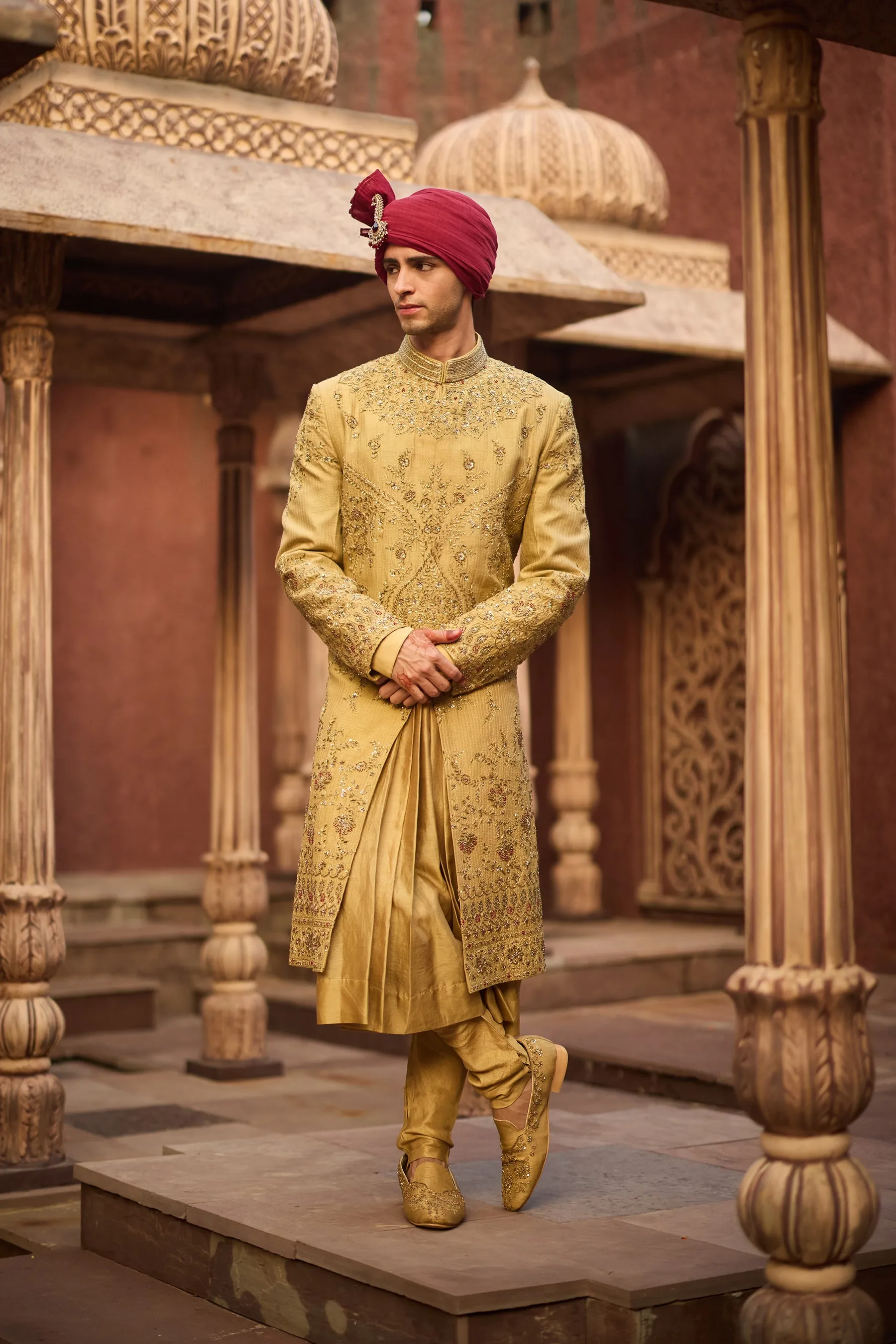
A Sikh wedding is one of the most joyful and colourful in the world. The baraat arrives with drums and dancing, the families meet at the milni, and the couple are joined in the Anand Karaj, the “blissful union” performed in the presence of the Guru Granth Sahib. For the groom, the clothing is both a celebration and an act of respect. He must be comfortable enough to sit on the floor in a gurdwara, dignified enough for a sacred ceremony and striking enough for the baraat, the photographs and the party that follows. This guide explains what a Sikh groom wears to the Anand Karaj and the functions around it, covering sherwanis and achkans, the pagri, kalgi and sehra, colours, fabrics, etiquette and planning.
Customs differ across families, regions and sects, and our advice is from the perspective of tailoring, not theology. When in doubt, ask your family’s elders, your granthi or the gurdwara committee. For the whole wedding week, see our overview of what the groom wears at each ceremony.
The structure of a Sikh wedding
A Punjabi Sikh wedding typically unfolds over several days. The exact programme varies, but the pattern is familiar.
- Roka and sagai: the families formalise the match. Smart festive wear.
- Jaggo, mehendi and sangeet: evenings of music, dancing, henna and fun. Colourful, comfortable and ready to dance.
- Maiyan, vatna and haldi: pre-wedding rituals with turmeric and oils. Light, easy clothing.
- Baraat and milni: the groom’s procession to the venue and the meeting of the families. This is the moment of greatest show, with a sherwani, safa or pagri, and a horse or car.
- Anand Karaj: the wedding ceremony in the gurdwara, usually in the morning.
- Reception and doli (or vidaai): the evening celebration and the bride’s farewell.
Each function needs its own outfit, and the sherwani or achkan is the centre of the wedding day. For the earlier functions, see our guides to the roka outfit, haldi outfit and sangeet outfit.
The core outfit: sherwani or achkan with churidar
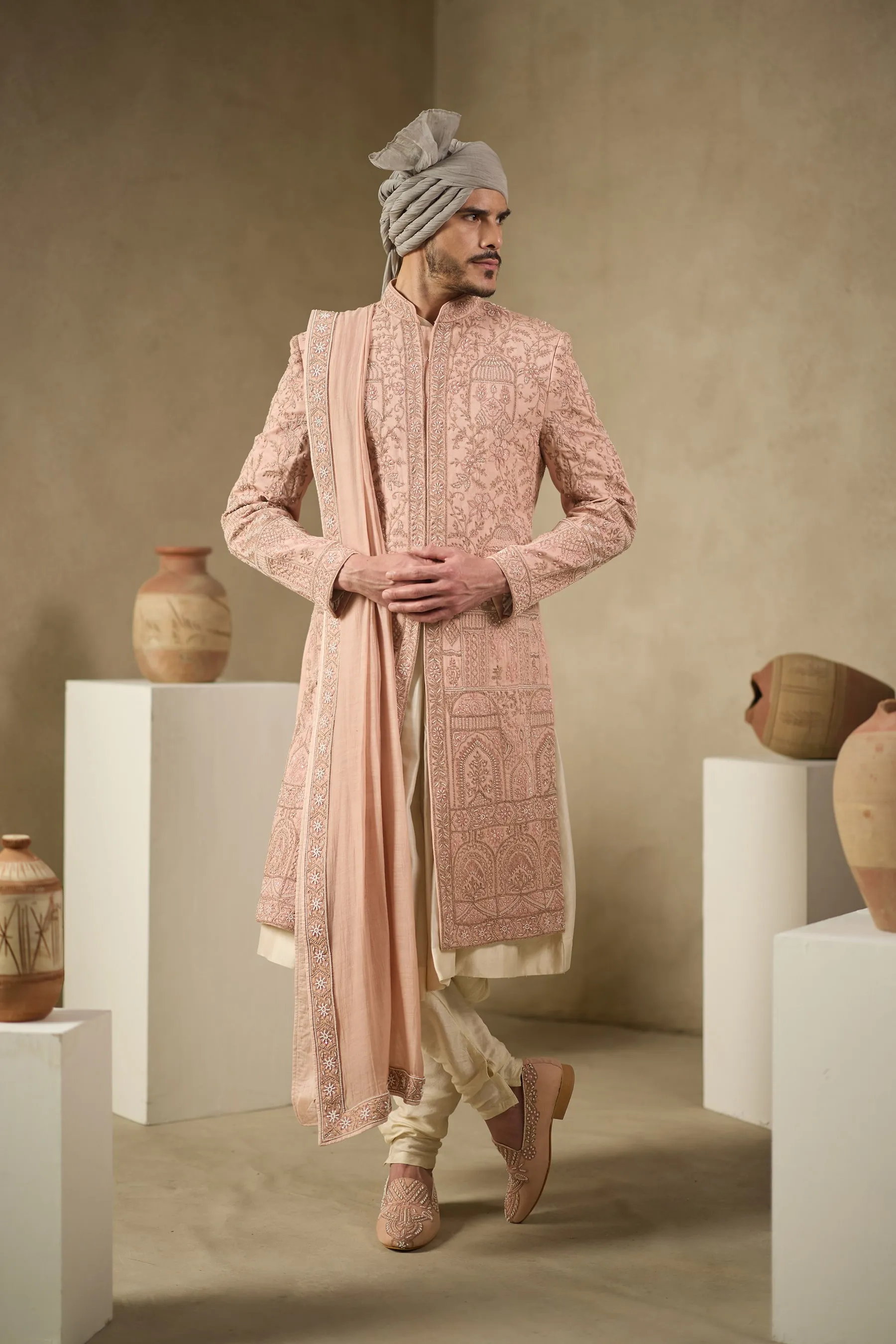
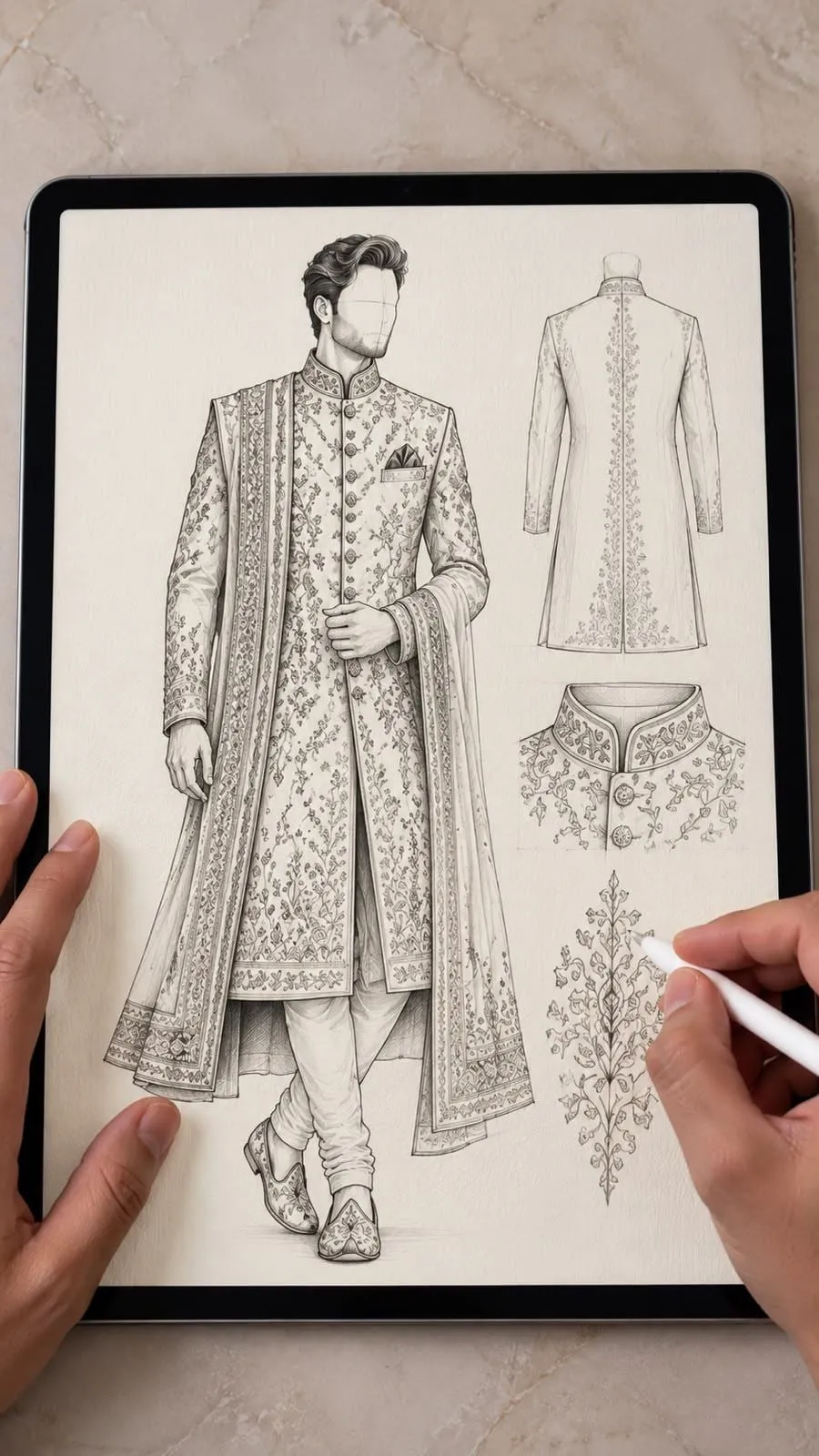
The traditional Sikh groom’s outfit is a sherwani or achkan, a long coat with a fitted body, buttoned at the front, worn over a kurta with a churidar or fitted trousers. The look is regal, and the lines flatter the shoulders and waist.
Sherwani
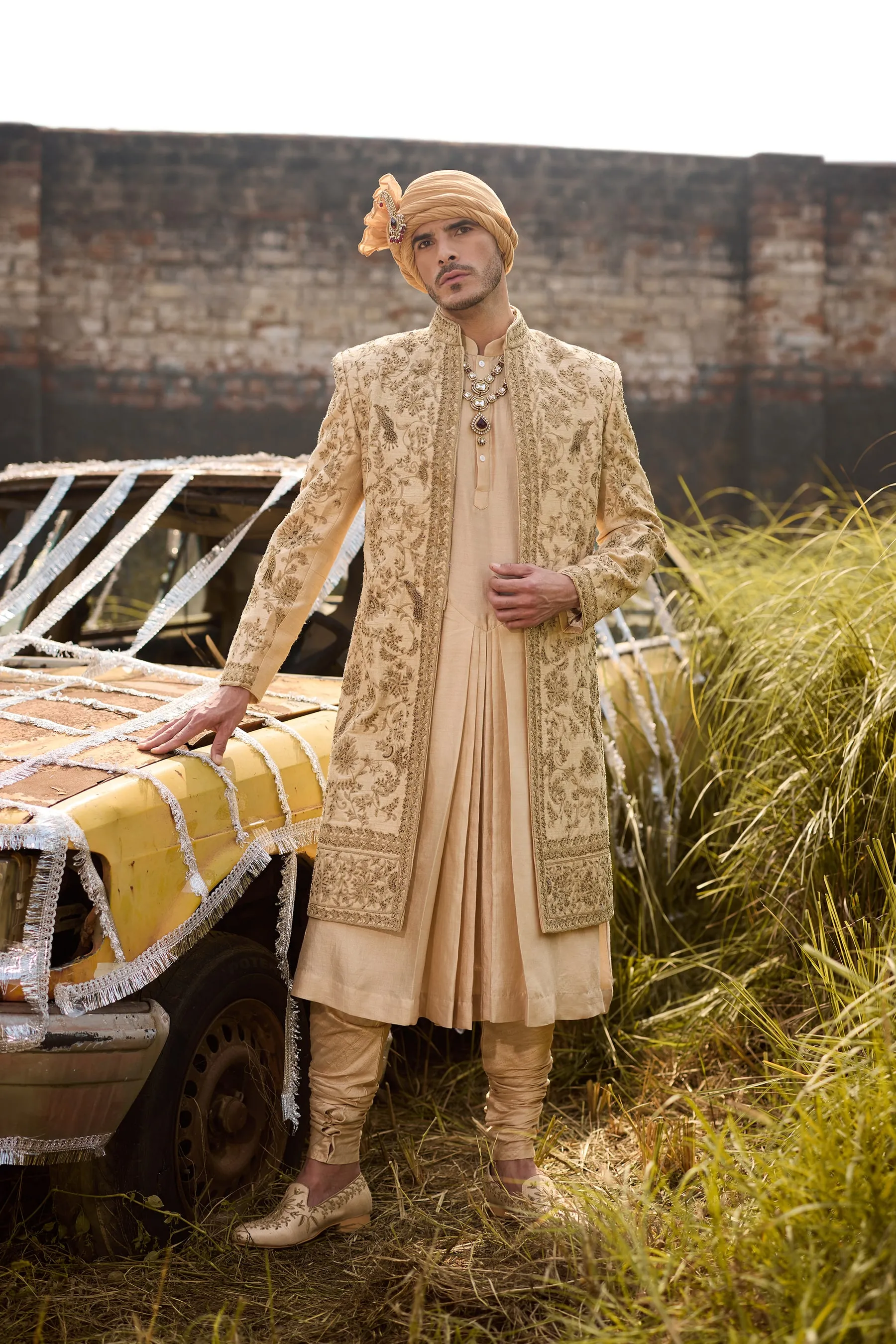
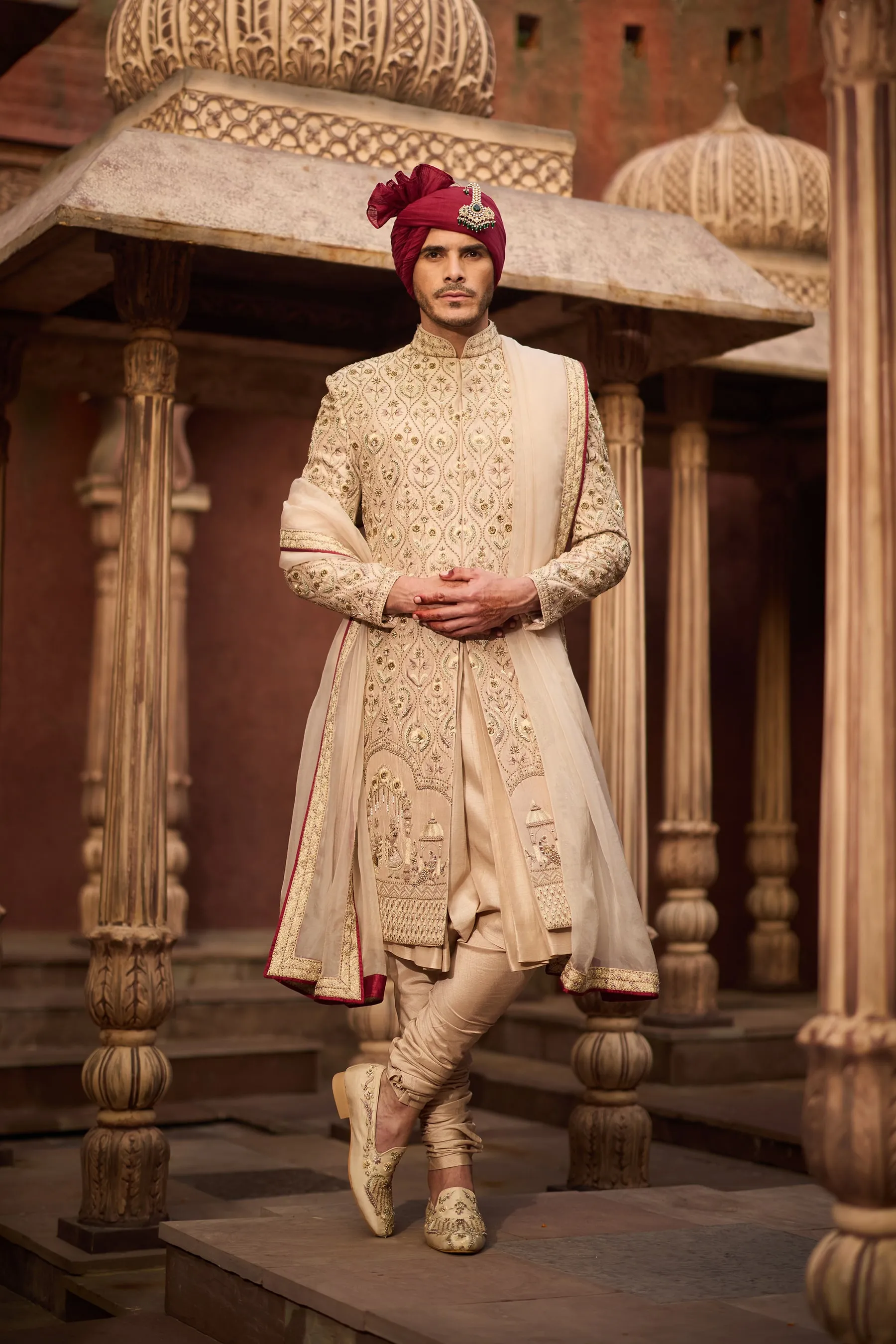
The sherwani is the more ornate option: richer fabric, heavier embroidery, often with zardozi, thread work or sequins. It suits the baraat and the milni, where the groom is on show. Our sherwani collection includes pieces such as the Sarson in mustard gold, the Suvarn in champagne gold and the Bahar in sand gold, which pair well with the bright colours of a pagri.
Achkan
The achkan is a more tailored, understated coat, often with a button-through front and a simpler surface. It suits a groom who prefers restraint or who is wearing the outfit for a long, seated ceremony. See the achkan collection.
Choosing between them
If you are unsure, our guide to sherwani vs achkan vs bandhgala explains the differences in detail. A useful rule: a sherwani for the baraat and the milni, and a lighter or simpler piece if you want to change before the Anand Karaj. Many families keep a single outfit for the day to avoid a rushed change.
The pagri (turban): the crown of the look
For a Sikh groom, the pagri is part of identity and often the most important accessory. It must be well tied, comfortable and appropriate to the occasion.
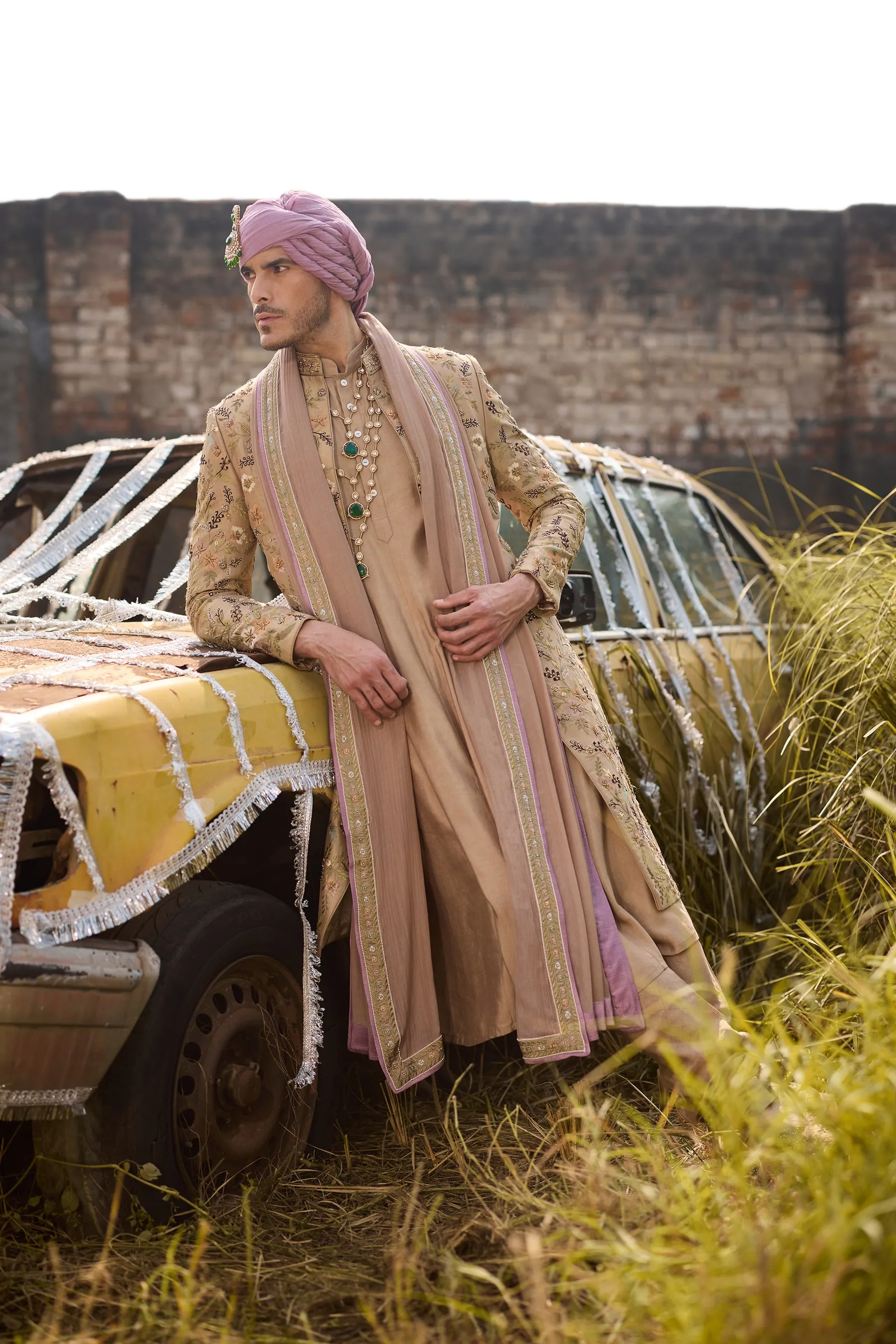
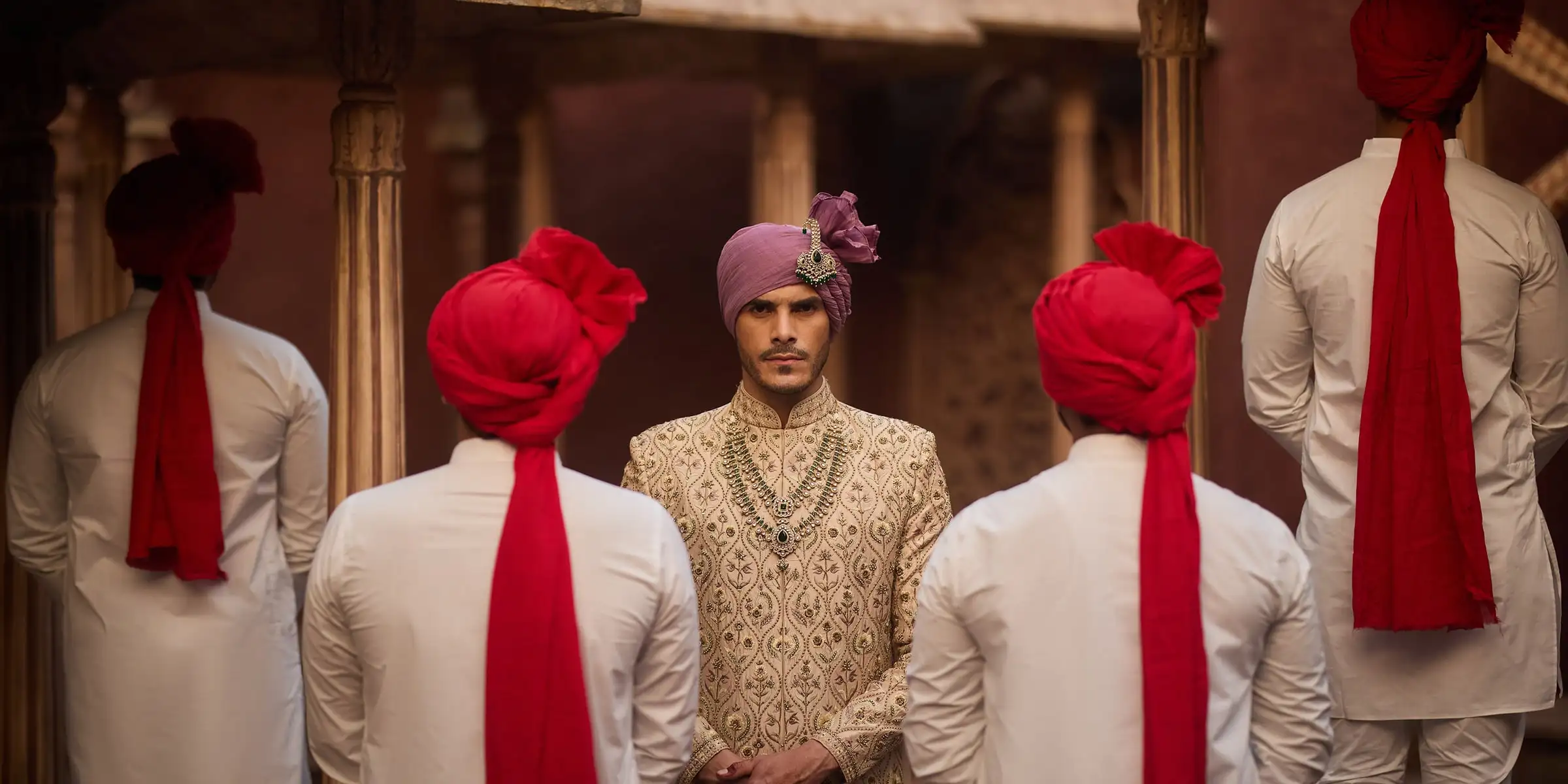
- Colour. The pagri usually complements, rather than matches, the sherwani. Popular choices are saffron, pink, mustard, maroon, cream and gold. A pagri in a deeper shade of the sherwani’s colour looks deliberate; a bright contrasting colour, such as a saffron pagri on a cream sherwani, makes a classic pairing.
- Fabric. Light cotton or voile in a plain colour is common for the Anand Karaj; richer silk or a pre-tied safa is often chosen for the baraat.
- Style. The tie varies by region and family. Some groom’s pagris are tied in the classic Patiala shahi style, which is wide and flat, others in a more modern, neat style. Choose one that suits your face and head shape, and practise.
- The kalgi and brooch. A kalgi (a decorative plume or brooch pinned at the front of the pagri) is traditional for the groom and adds ceremony. Keep it in proportion to the pagri.
- The sehra. Many grooms wear a sehra, a veil of flowers, beads or tinsel that hangs from the pagri over the face during the baraat and sometimes until just before the ceremony. It is worn out of tradition and tradition-minded families, so ask your elders.
If you do not tie your own pagri, book a turban tier well in advance and schedule a trial. The pagri should feel secure and comfortable for several hours, particularly through the ceremony.
Kirpan and the five Ks
Amritdhari Sikhs, who have taken amrit, wear the five Ks (kesh, kangha, kara, kachera and kirpan) as part of their faith. For them, the kirpan is a religious article that is worn as an expression of faith, usually on a gatra (strap) under or over the sherwani. Many Sikh grooms also carry a ceremonial sword (a talwar) for the baraat, which is a different object and is held rather than worn. Follow your family’s tradition and the gurdwara’s guidance. The outfit should be cut to allow the kirpan strap to sit comfortably, so mention it at your first fitting.
Colours for a Sikh groom
Colour choices at a Punjabi wedding tend to be generous and joyful.
- Cream, ivory and gold: timeless, classic and photogenic. Pair with a bright pagri for contrast.
- Saffron, mustard and marigold: auspicious and festive.
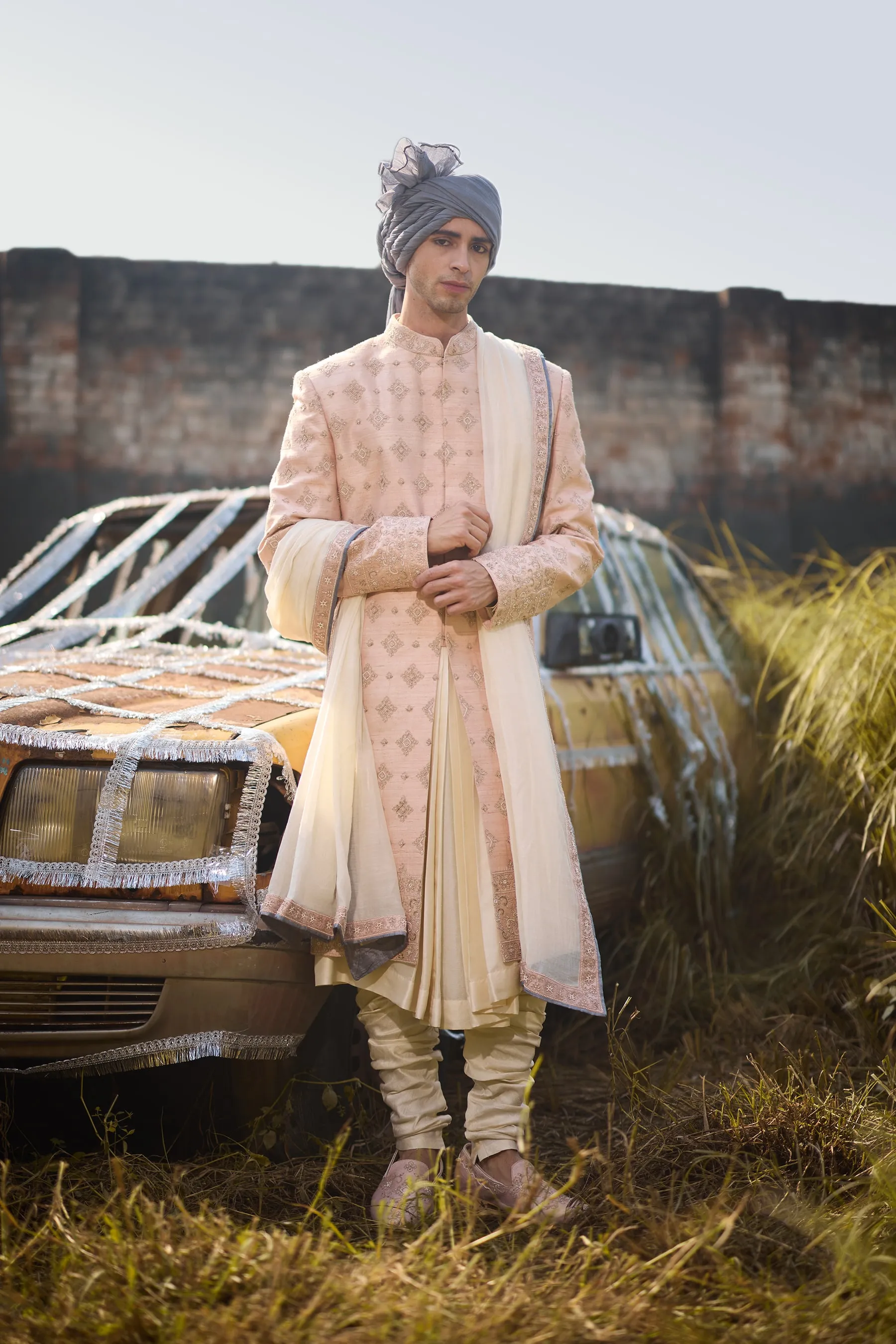
- Pastel pink, rose and blush: a modern favourite, especially for a day wedding. The Aabha sherwani in rose and the Kusum in blush are examples.
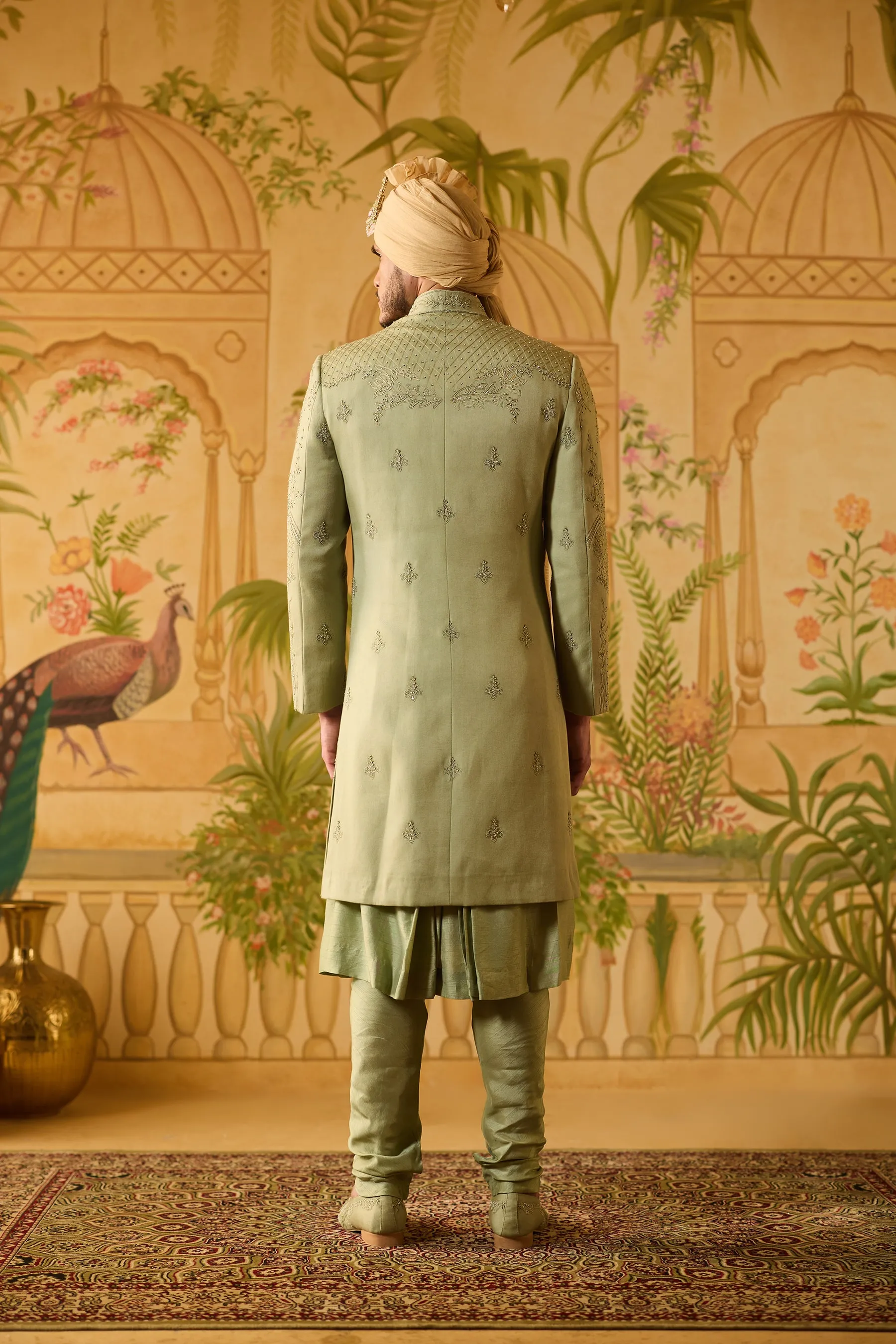
- Pistachio and sage: a gentle, contemporary option; see the Pallav.
- Maroon and burgundy: rich, regal and traditional.
- Navy and deep teal: modern and elegant, particularly for a reception.
Avoid black for the Anand Karaj, as many families regard it as inauspicious for the ceremony, and avoid pure white if the family prefers otherwise. When in doubt, ask.
Fabric and comfort in the gurdwara
The Anand Karaj is held in the gurdwara, where everyone sits on the floor, shoes off and head covered. This shapes fabric and fit.
- Choose breathable fabrics: raw silk, cotton-silk and fine wool in winter.
- Allow ease at the seat and thighs so that you can sit cross-legged for an hour without discomfort. Ask your tailor to add a little room.
- Ask for a soft, breathable lining. The gurdwara is warm and full.
- Prefer a fitted but not tight churidar. Check that it does not dig in when you sit.
- Avoid fabrics that crease badly in a seated position, or that are very heavy.
- Plan the shoes. You will remove them at the entrance, so choose mojaris or juttis that are comfortable and easy to slip off, and carry clean socks.
If the wedding is in winter, a stole or shawl in a coordinated colour adds warmth and style. See our winter wedding groom outfit guide, and for summer, the summer wedding groom outfit guide.
Gurdwara etiquette for the groom and the party
Observing simple etiquette shows respect and makes the day go smoothly.
- Cover your head with a pagri, a rumal or a clean cloth. The groom’s pagri serves this purpose.
- Remove your shoes and wash or sanitise your hands before entering.
- Bow before the Guru Granth Sahib and sit on the floor, with the men and women seated as the family directs.
- Avoid tobacco and alcohol before and during the ceremony, and respect the premises.
- Walk behind the bride in the lavan, taking the four rounds around the Guru Granth Sahib as the granthi recites each verse; the groom leads, with the bride following, holding the end of his pallu or palla.
- Be mindful of photography. Follow the gurdwara’s guidance.
The groom holds one end of a scarf (the palla) while the bride holds the other, and this scarf, often a coordinated stole, is part of the ritual. Choose a palla that complements the outfit, and keep it clean.
The milni and baraat
Before the Anand Karaj, the two families meet in the milni, exchanging garlands and greetings. The groom’s party arrives in a baraat: drums, dancing and a horse or a decorated car. This is the moment for the sherwani, safa or pagri and sehra to shine. Practical points:
- Check the weather and the route. A long baraat in summer needs lighter fabric and shade.
- Choose shoes you can dance in.
- Keep the sword, sehra and accessories with a trusted relative.
- Plan a quick touch-up before the milni, with a comb, a mirror and a lint roller.
Our guide to the baraat outfit for the groom goes into more detail on silhouette, safa and styling, and applies equally to a Sikh baraat.
The reception: a second outfit
After the Anand Karaj and the lunch, the reception is a separate celebration, usually in the evening. Many Sikh grooms change into a bandhgala, a tuxedo or a richly coloured sherwani. If you choose a turban at the reception, a plain pagri in a coordinated colour is common. See the reception outfit for the groom guide for ideas, and the bandhgala collection and tuxedo collection for pieces.
Family: father, brother and guests
The father of the groom, brothers and uncles also wear turbans and sherwanis or kurtas. A coordinated palette looks elegant in photographs. Our guides to the father of the groom’s outfit and the groom’s brother’s outfit show how to match without matching exactly. For friends, see groomsmen outfits, and for guests, our male guest guide, which covers gurdwara etiquette for visitors.
Planning and timeline
| When | What to do |
|---|---|
| 12 weeks before | Choose silhouette, colour and fabric; discuss the pagri colour. |
| 10 weeks before | Measurements; book the turban tier if needed. |
| 8 weeks before | Order; confirm accessories. |
| 4 to 5 weeks before | First fitting; test sitting and the kirpan strap. |
| 2 weeks before | Second fitting; trial of the pagri with the sherwani. |
| 1 week before | Final fitting; steam and pack. |
For a full explanation, see made-to-measure timelines. If you are travelling to a destination wedding, read our guide to the destination wedding groom outfit for packing and care.
Pre-wedding functions: dressing for the Punjabi celebrations
A Punjabi wedding is famous for its build-up, and the groom is expected to look the part at each function.
- Roka and sagai. A kurta with a Nehru jacket or a light achkan in cream, powder blue or sage. The mood is relaxed and family-centred, so a comfortable, smart outfit suffices.
- Maiyan and vatna. In many families the groom wears simple, older clothes for the turmeric and oil ritual, often in yellow, as the outfit will be marked. Choose something you do not mind staining.
- Jaggo and mehendi. Brightly coloured kurtas, often in mustard, pink or green, with a printed stole or a phulkari-inspired dupatta. Comfort for dancing matters.
- Sangeet and cocktail. A bandhgala, an Indo-Western set or a velvet jacket in a deep colour. Our sangeet and cocktail edit gathers pieces made for this.
- Chooda and kalire. These are the bride’s rituals, but the groom’s family often attends in festive wear. A kurta with a jacket is appropriate.
Planning the sequence in advance means you do not repeat outfits in photographs and you can allocate budget where it matters most: the baraat and the Anand Karaj.
The phulkari, stoles and Punjabi details
Punjabi wedding wear has distinctive details that can lift a groom’s outfit without overpowering it.
- Phulkari embroidery is a bright floral thread work on a stole or on the cuffs of a jacket. It carries the culture of the region and looks beautiful against cream or navy.
- A stole or dupatta with a woven border, draped over one shoulder, adds elegance and warmth. Silk or pashmina blends are popular in winter.
- Embroidered mojaris or juttis in gold, tan or maroon complement a sherwani. Choose a pair with a cushioned sole.
- A brooch or a layered mala (garland of pearls or stones) adds polish. Keep it in proportion to the outfit.
- The sword (kirpan or talwar) and the sehra are held by a relative until needed, so the groom can move freely.
- Safas for the family. The groom’s father and brothers often wear safas in coordinated colours, and it is a lovely detail when the family’s turbans echo the groom’s palette.
Looking after the outfit on a long, joyful day
A Punjabi wedding day is long: the baraat, the milni, the ceremony, lunch, photographs and the reception. A few habits keep the outfit looking fresh.
- Dress late, as close as possible to the start of the baraat, so the outfit has not been sitting and creasing for hours.
- Sit carefully in the car, lifting the sherwani at the back so it does not crush.
- Keep a small kit with safety pins, a lint roller and a stain pen with a trusted cousin.
- Drink water, and eat something before the baraat; fainting groom stories are not uncommon.
- Check the pagri at each break, and ask your turban tier to be on hand for a quick adjustment.
- Let the outfit breathe after the day. Hang it in a cool, airy place before packing it away, and have it cleaned by a specialist.
Common mistakes to avoid
- Matching the pagri exactly to the sherwani, which looks flat. Complement instead.
- Choosing a pagri you cannot tie or wear comfortably. Practise.
- A tight sherwani for floor seating. Test sitting at your fitting.
- Black at the Anand Karaj. Many families avoid it.
- Heavy fabric in warm weather. Choose by climate.
- Leaving the reception outfit to chance. Plan both.
Frequently asked questions
What does a Sikh groom wear?
A sherwani or achkan with churidar, a coordinated pagri, a kalgi and often a sehra.
What colour pagri should I choose?
A colour that complements the sherwani: saffron, pink, maroon, mustard or cream.
Can I wear a suit?
For the reception, yes. For the Anand Karaj, a sherwani or achkan is more traditional.
How early should I order?
Eight to ten weeks before, with two fittings.
Final thoughts
A Sikh groom’s outfit is a collaboration between tailor, family and faith. It should be beautiful and comfortable, and it should let you focus on the ceremony. Choose a colour that feels like you, a pagri that feels right, and a fit that lets you sit and dance. If you would like to see fabrics and pagri colours together, book an appointment and we will build the look with you.
Shop the looks
Browse the sherwani collection and achkan collection, or start with the baraat and pheras edit and the haldi and mehendi edit.