The baraat is the groom’s moment of arrival. Family and friends dance in the street, the dhol drums, the horse or car waits and the whole party moves towards the wedding venue with the groom at its centre. It is public, loud, photographed from every angle and long: processions can last from twenty minutes to three hours. The outfit has to look magnificent from a distance, hold up under sun, dust and movement and let the groom sit, stand and dance without worry. This guide sets out how to choose the baraat outfit, from sherwani colour to footwear.
For the whole wedding schedule, see our guide to what the groom wears at each ceremony. The baraat and pheras collection gathers the wedding-day pieces we make.
What the baraat is, and what it asks of the outfit
The baraat is the groom’s wedding procession, in which he travels, often on a decorated mare, in a car or on foot, with his family and friends to the wedding venue, where the bride’s family receives him in the milni. The tradition is strongest in North India, but similar processions occur in many communities.
That context drives the outfit in four ways:
- Visibility. You are seen from afar and in motion. Colour, silhouette and shine matter more than fine detail.
- Duration. You may be dressed and moving for hours before the pheras. Comfort is a necessity.
- Weather and setting. Many baraats are outdoors, in sun, dust, wind or cold, depending on the season.
- Photography and video. The baraat is filmed constantly. The outfit has to look good in motion.
Choosing the sherwani for the baraat
Colour
The baraat is outdoors and often in daylight or at dusk, so the sherwani’s colour should be bold enough to be seen and warm enough to flatter.
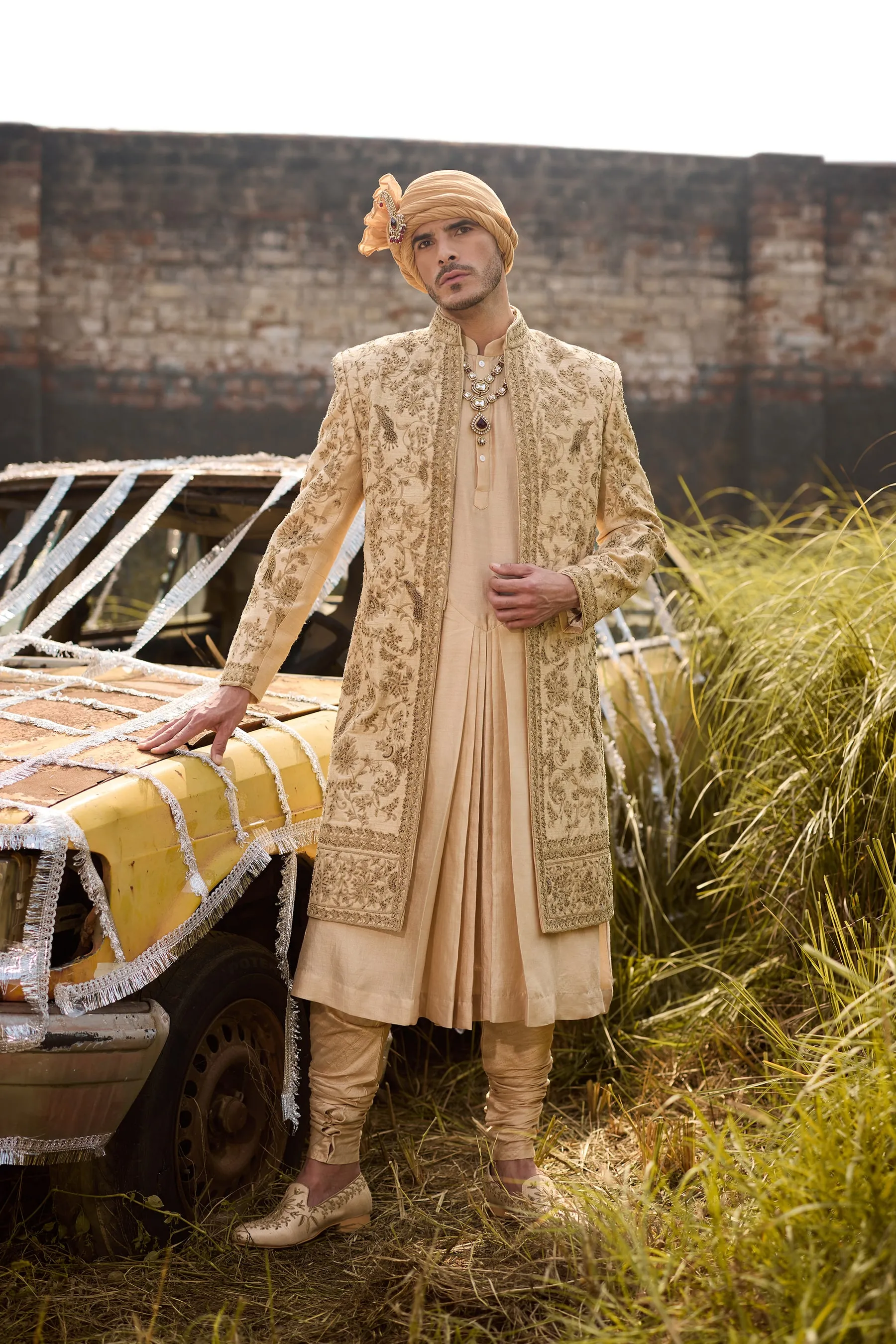
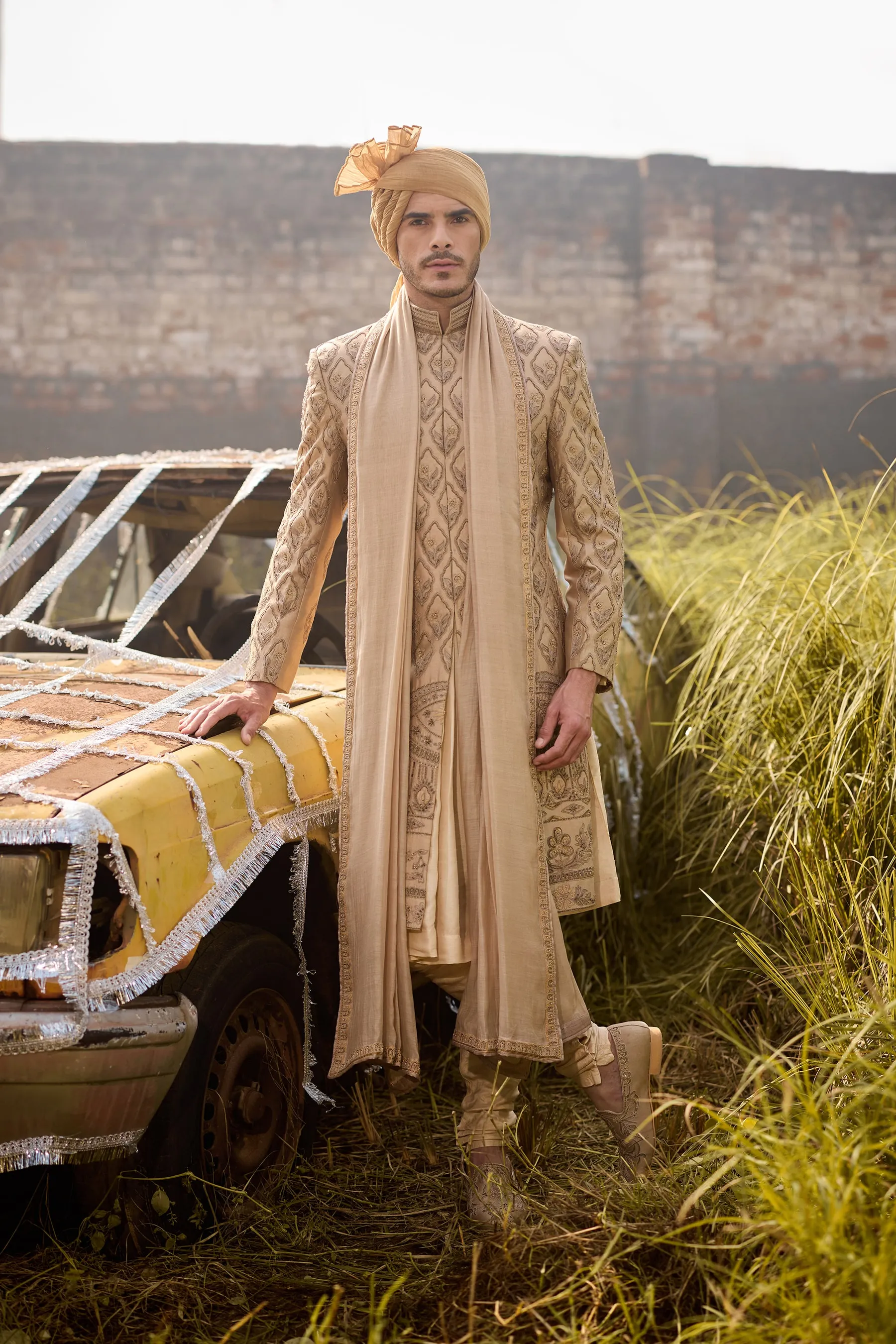
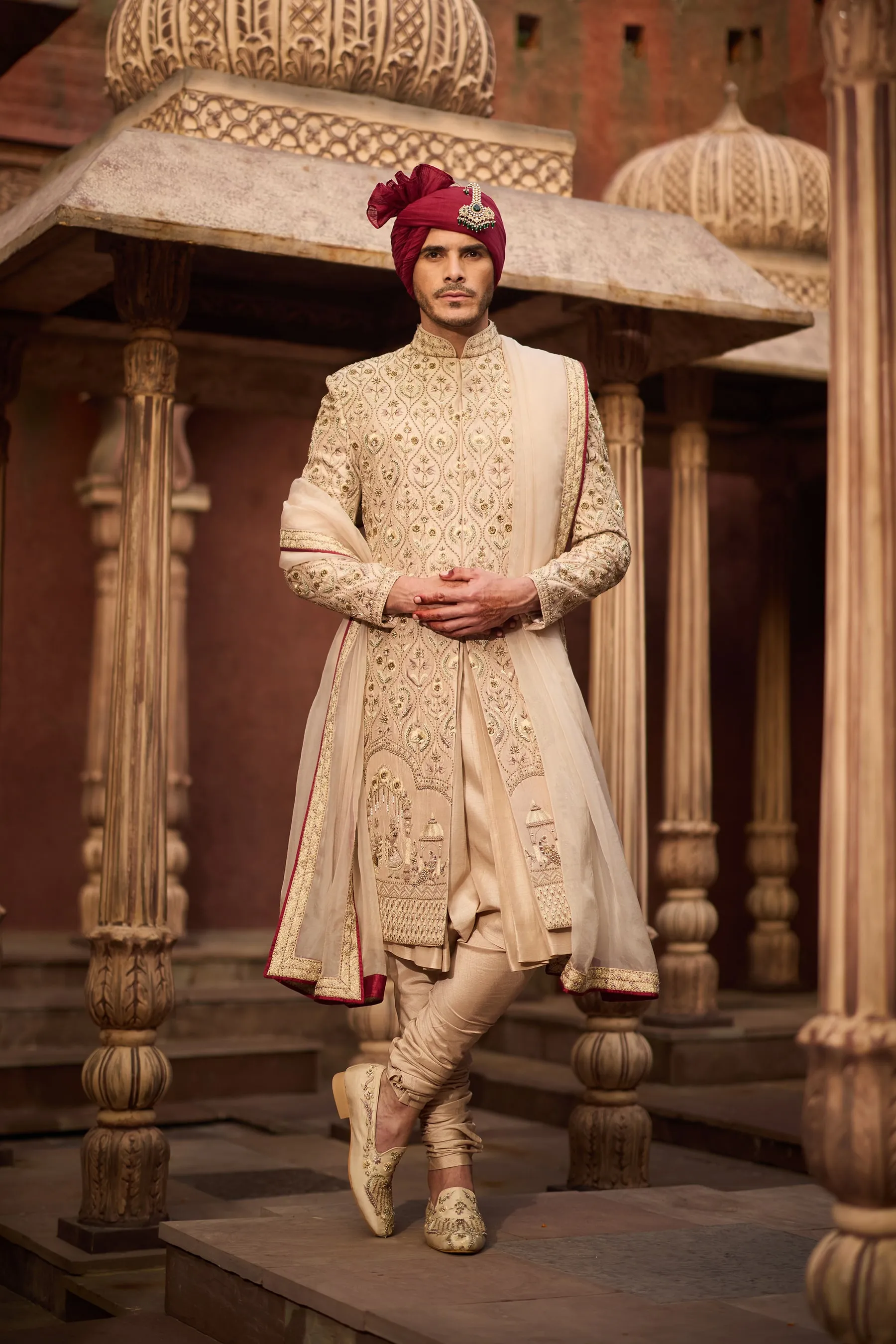
- Gold, champagne and sand gold. Classic and luminous. They catch the light and look regal in every setting. Our Suvarn in champagne gold, Bahar in sand gold and Zarbaft in gold beige are examples.
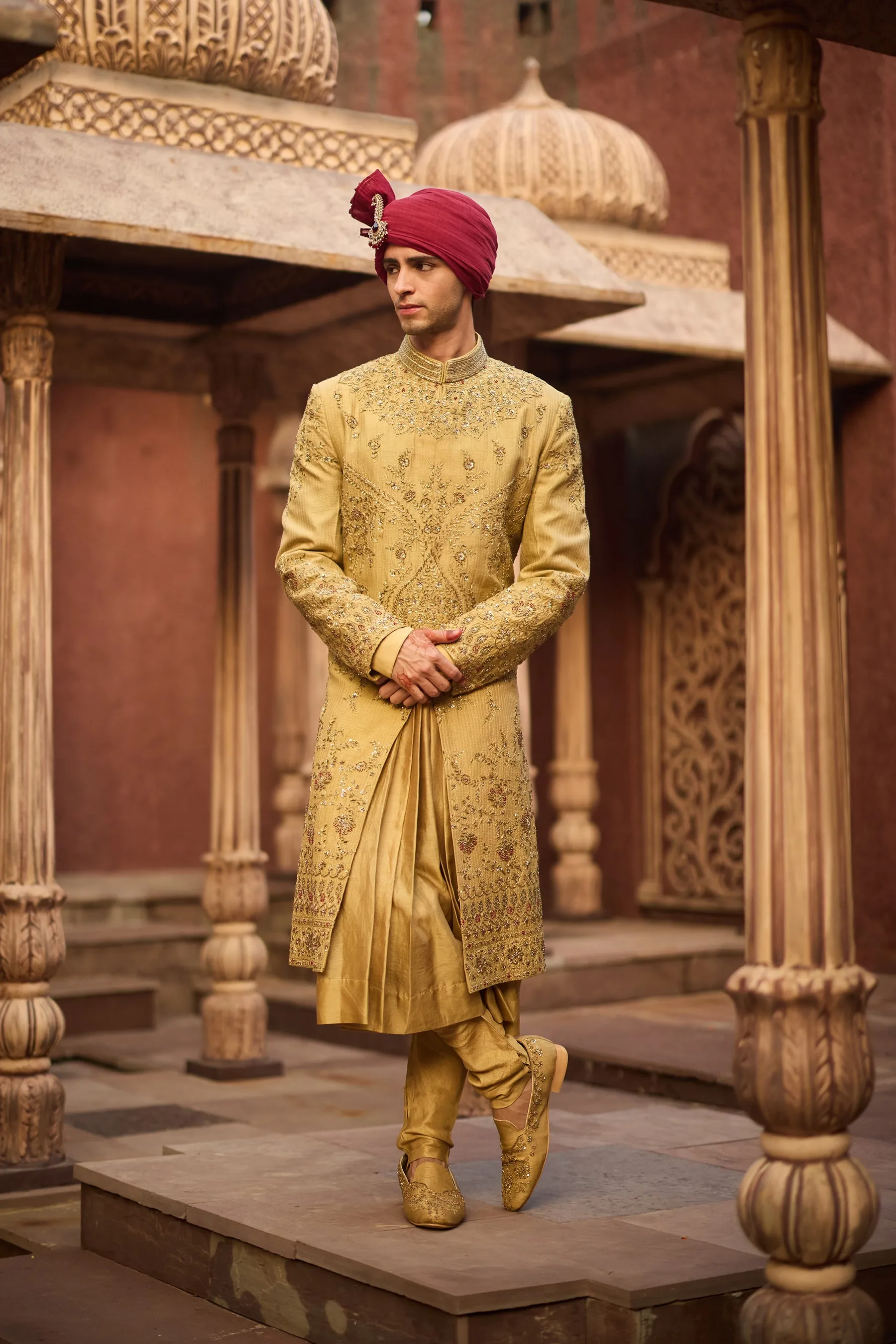
- Mustard and saffron. Warm, joyful and distinctive. Our Sarson in mustard gold is a strong choice for a daytime baraat.
- Ivory and cream. Elegant and photogenic, particularly in an evening baraat. See our guide to the ivory sherwani for the groom.
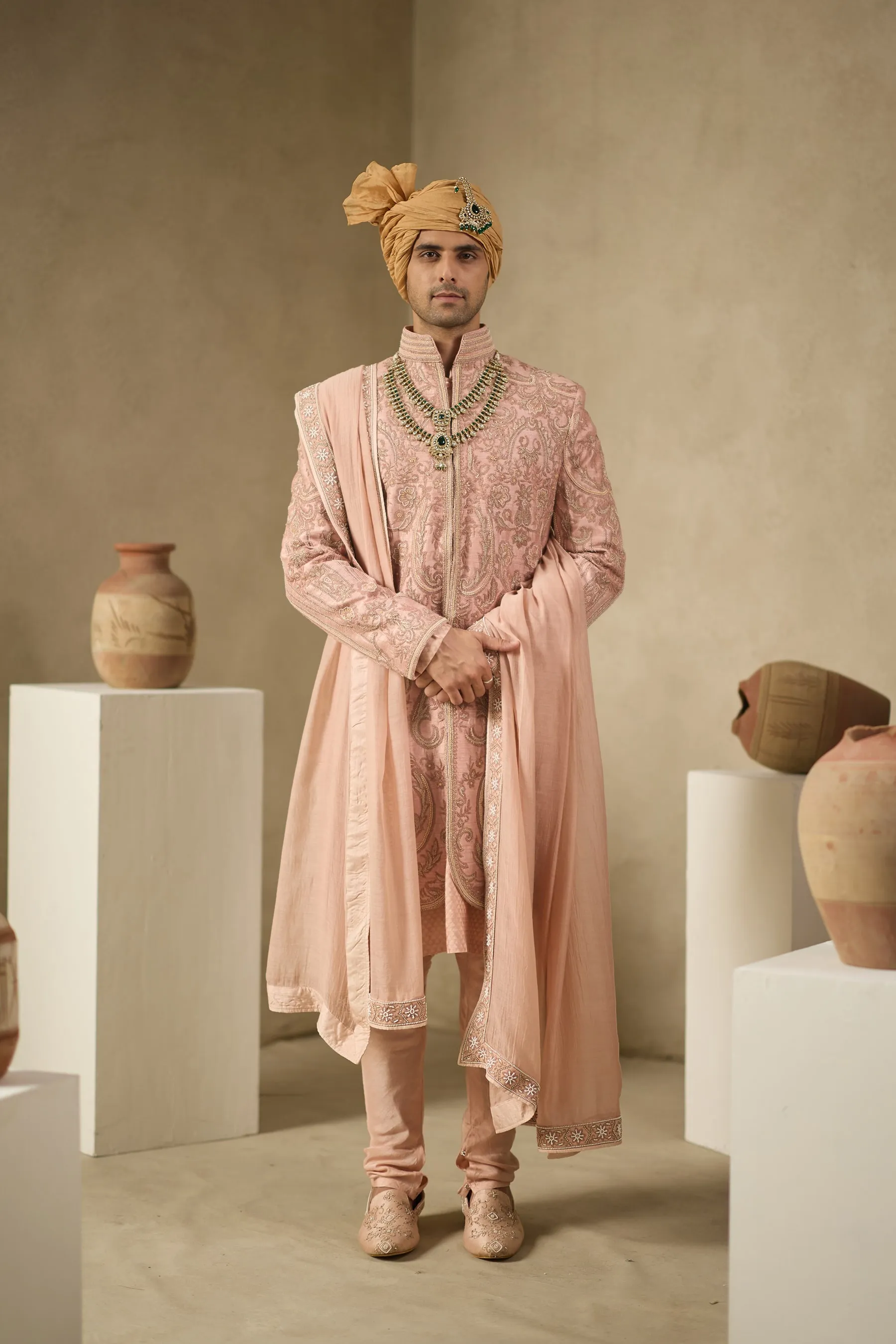
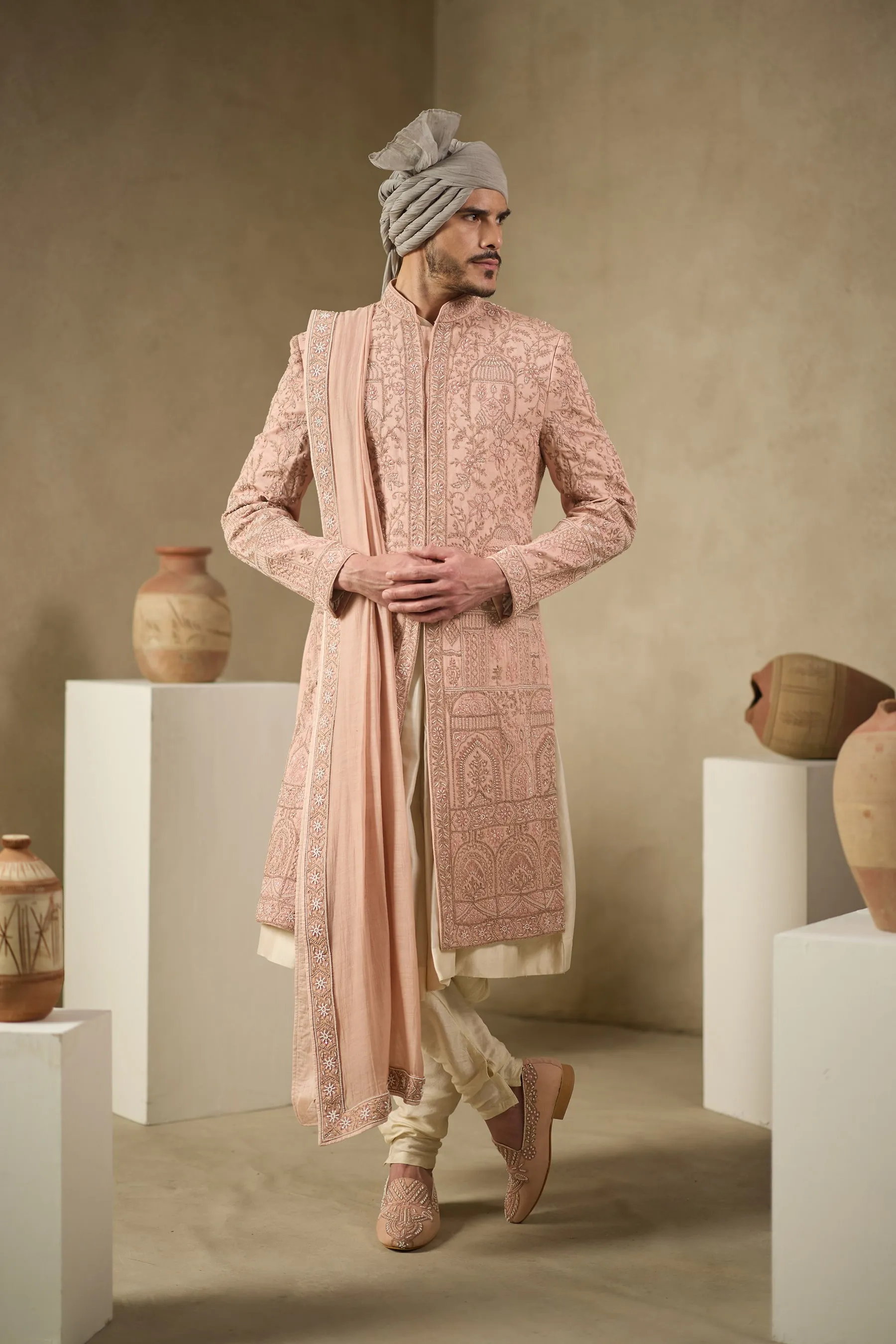
- Peach, blush and rose. Soft, modern and warm. Our Gul in peach and Aabha in rose bring colour without heaviness.
- Deep jewel tones. Maroon, bottle green and royal blue suit an evening baraat and winter weddings.
Embroidery and detail
Baraat embroidery should read from a distance: bold patterns on the chest, shoulders and hem, rather than fine detail that disappears. Zardozi, resham and tone-on-tone work in gold look rich in sun. If the sherwani will be photographed in evening light, a small amount of metallic detail helps it stand out.
Fabric
Raw silk, silk brocade, jacquard and silk blends are classic. For hot weather, choose a lighter silk or a silk-cotton blend with a breathable lining. For cold weather, a velvet or wool-blend sherwani, or a layer such as a shawl, adds warmth. For the fabric advice by season, see our guides to the summer wedding groom outfit and the winter wedding groom outfit.
Fit and length
A baraat sherwani should be cut for movement: room in the shoulders for dancing, a skirt that does not tangle when you mount a horse or sit in a car, and a length that falls cleanly to the knee or just below. Try sitting, mounting and lifting your arms in the fitting. Our made-to-measure process includes two fittings so that these adjustments can be made. See our guide to planning a made-to-measure wedding outfit.
The safa, turban and sehra
The safa
A safa (a pleated turban) adds height, regality and a coordinated finish. It is traditional in many North Indian and Rajasthani weddings, particularly for riding a mare. Choose a colour that contrasts or complements the sherwani: a crimson safa on an ivory sherwani, a peach safa on an ivory one, an ivory or gold safa on a deep-coloured sherwani. Have the safa tied by a professional on the morning of the wedding, and have it fitted at the same time as your sherwani if possible.
The turban for Sikh grooms
A Sikh groom wears his dastar in a colour chosen with care, often matching or complementing the outfit. For more on Sikh wedding attire, see our guide to the Sikh wedding groom outfit for the Anand Karaj.
The sehra and kalgi
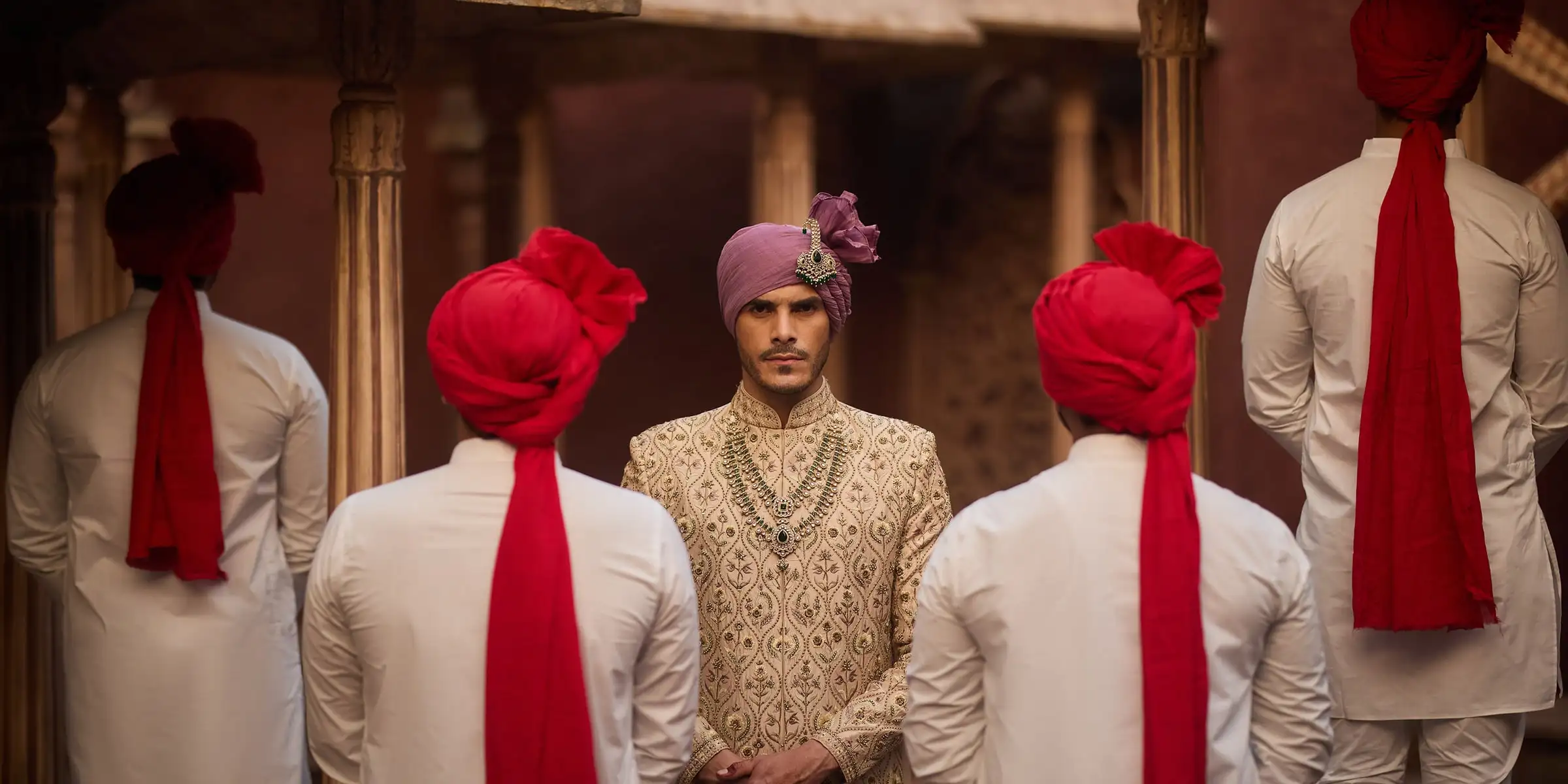
A sehra (a veil of flowers or beads that hangs from the safa) and a kalgi (a decorative brooch on the safa) are traditional accessories in some families. They are removed at the right moment in the ceremony. Ask your family whether they are expected.
Skipping the safa
Some modern grooms skip the safa and wear a simple stole, a sehra on its own or nothing on the head. That is fine if your family agrees. The sherwani will carry the look.
Stole, mala and jewellery
The stole or dupatta
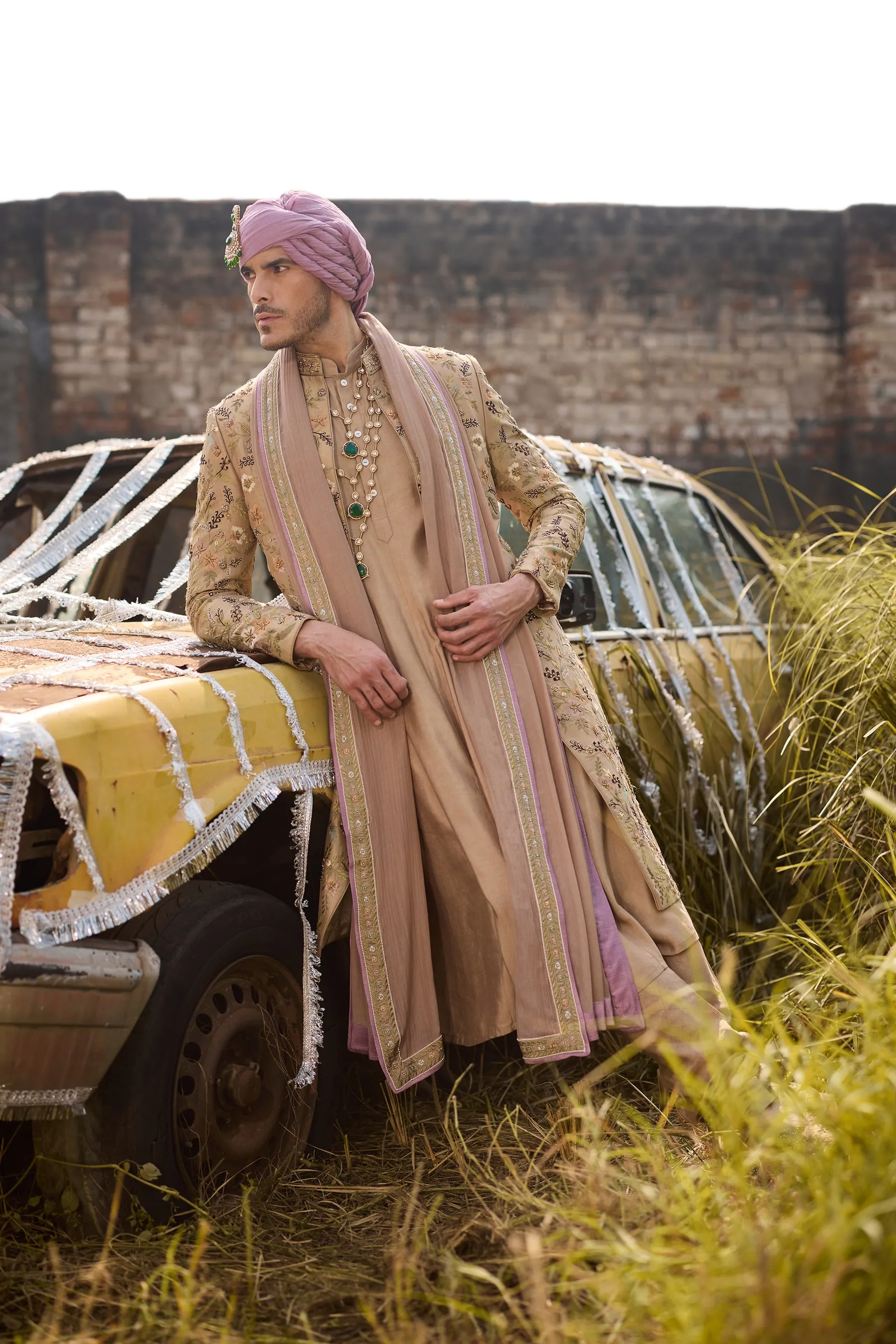
A stole (a shawl or dupatta) draped over one shoulder or both finishes a sherwani and adds colour and movement. Choose a colour that contrasts with the sherwani without clashing: crimson on ivory, ivory on mustard, peach on gold. A stole also keeps you warm in the evening.
Malas and necklaces
A pearl or kundan mala adds richness. Choose one or two, not many, and ensure they do not catch on the sherwani’s embroidery. Our guide to the ivory sherwani suggests matching accessory colours.
Brooches and kalgis
A kalgi, a brooch on the safa, and a smaller brooch on the sherwani collar add polish. Keep metals consistent (gold with gold, silver with silver).
Watch and ring
A simple watch and a ring are usually enough. Avoid any accessory that you will worry about in a crowd.
Footwear for the baraat
You may walk, dance and mount a horse, so footwear matters.
- Juttis and mojaris in a colour that complements the sherwani (gold, ivory, tan or maroon). Choose a pair with a cushioned insole and break them in beforehand.
- Leather oxfords or loafers if the family or the outfit leans Western. Make sure the soles grip.
- Spare socks and a lightweight pair of sandals for changes during the day.
Avoid new, stiff shoes. Blisters on a wedding day are a cruel surprise.
Planning for the weather
Hot weather
Choose a lighter fabric, a breathable lining and a lighter colour. Dress as late as you can, and keep the sherwani in an air-conditioned room until you leave. Carry water and a small cloth for sweat.
Rain and humidity
Silk and brocade can mark with water. Choose a darker colour if rain is likely and have an umbrella ready. Carry a spare stole.
Cold weather
A shawl, a velvet sherwani or a layer under the sherwani keeps you warm. Choose warmer lining and consider thermal underlayers in a thin fabric.
Dust and wind
Outdoor baraats can be dusty. A safa protects your hair; a stole protects the sherwani. Have a soft brush and a lint roller on hand.
Riding a horse or sitting in a car
If you will ride a mare, your sherwani should allow you to sit comfortably with your legs apart. Ask your tailor to check the skirt length, the width of the churidar and the room in the seat. A very tight churidar or a stiff skirt makes mounting awkward. Practise in the outfit if you can.
If you will sit in a car or a decorated vehicle, the sherwani’s skirt can crease, so choose a fabric that recovers. Sit forward, not back, and hold the skirt gently when you step in and out.
Dressing on the day: a practical timeline
- Three hours before: shower, groom and eat a light meal.
- Two hours before: dress in the churidar and sherwani, with help from a family member or stylist.
- Ninety minutes before: the safa is tied, and the stole, mala and accessories are added.
- Sixty minutes before: photographs with the family at home.
- Thirty minutes before: final check of shoes, handkerchief, phone and anything you plan to carry.
- Departure: a calm exit, with a friend nominated to hold the sherwani skirt when you sit.
Allow more time than you think you need. A rushed groom looks rushed.
Matching with the family
The baraat photographs include the whole party, so coordination helps.
- Father and brothers. Tonal outfits in a lighter colour: see our guides to the father of the groom’s outfit and the groom’s brother’s outfit.
- Groomsmen and friends. A common colour family, or a shared accessory such as a stole or pocket square, ties the group together. See groomsmen outfits for an Indian wedding.
- The bride’s outfit. Ask for her palette so that your sherwani complements it at the milni and in the first photographs.
Baraat outfit ideas by style
The traditional groom
A gold or champagne sherwani with embroidered panels, a crimson safa, a pearl mala and gold juttis. Regal and classic.
The warm modernist
A peach, rose or blush sherwani with a coordinated stole and ivory safa. Softer, more contemporary, very photogenic.
The bold groom
A mustard or saffron sherwani with a contrasting stole and a statement safa. Joyful and unmistakable in a crowd.
The minimal groom
An ivory sherwani with tone-on-tone embroidery, an ivory stole and a simple safa. Elegant and calm.
Mistakes to avoid
- Choosing a colour that disappears outdoors. Very pale colours can wash out in strong sun.
- Skipping a lining check. A scratchy or non-breathable lining is a long-hour problem.
- Overloading with accessories. Too many malas, brooches and stoles clutter the look.
- Wearing new shoes. Break them in.
- Ignoring the horse. If you will ride, rehearse mounting.
- Forgetting the safa fitting. A poorly tied safa slips and tilts.
- Not planning a quick change. A fresh, lighter outfit can be a relief after the procession.
After the baraat: the transition to the pheras
If your baraat and pheras are separated by a break, you can refresh: touch up the stole, adjust the safa, change the footwear if needed and sip water. Some grooms change into a second sherwani for the pheras, particularly if the baraat is in the afternoon and the pheras are at night. For that look, see our guide to the pheras outfit for the groom.
Baraat customs that shape the outfit
The baraat is not one tradition but many, and a few customs have a direct effect on what you wear.
Ghodi chadhna: riding the mare
In many North Indian families the groom rides a decorated mare (ghodi), led by a relative, while the family dances in front. The sherwani should allow you to mount, sit with your legs apart and stay comfortable for the whole route. A churidar that is snug at the ankle but roomy at the thigh and seat works well. Ask the tailor to check that the skirt does not bunch beneath you, and practise mounting in your fitting if the family has a mare available.
Milni and the arrival
When the baraat reaches the venue, the families meet in the milni: relatives exchange garlands and embraces, and the groom is welcomed by the bride’s family. You will be standing and greeting for several minutes, so a collar that does not scratch and a stole that stays in place matter. Garlands are heavy and can snag embroidery; choose an outfit whose embroidery is securely worked, and ask the family to place garlands gently.
Aarti and tilak
The bride’s mother often performs an aarti and applies a tilak. A little kumkum or sandalwood can land on the collar. Choose a collar in a colour that forgives a small mark, or keep a damp cloth ready.
Dhol, dancing and fireworks
A baraat has music, dancing and often fireworks. A fitted but flexible sherwani, shoes with grip and a safa that is securely tied let you enjoy it. Avoid loose stoles that could catch a spark; tie or pin the stole at the shoulder.
Cooling down and staying hydrated
A long procession in a heavy sherwani is physically demanding. A few practical measures keep you well:
- Drink water before and during. Ask a friend to carry a bottle and hand it to you at intervals.
- Eat a light meal first. An empty stomach and a long walk lead to dizziness.
- Choose a breathable lining. Cotton or cupro lining feels cooler than polyester.
- Pause in the shade when you can. The procession often stops at points; use them.
- Carry a handkerchief or small towel to blot sweat before photographs.
- Wear a light cotton undershirt that wicks moisture and protects the sherwani lining.
If you are marrying in summer, consider a lighter-coloured sherwani and ask for a half lining. For more on warm weather outfits, see our guide to the summer wedding groom outfit.
Photography and video at the baraat
The baraat is one of the most filmed parts of the wedding, and the cameras move with you. A few outfit details help:
- Movement. A longer sherwani and a stole create graceful movement in video. Check how they move when you walk and dance.
- Contrast with the surroundings. Streets and lawns can be busy. A saturated colour such as mustard, rose or deep gold stands out better than a mid-tone that matches the background.
- Sparkle in light. Metallic thread catches daylight and flash; do not overdo it, because very reflective fabric can glare on camera.
- Clean lines. A well-pressed collar and cuffs look sharp even in a fast clip.
- Headwear shadow. A safa can cast a shadow on the face in strong sun; the photographer may ask you to tilt your head slightly.
A grooming timeline for the days before
Looking relaxed on the baraat depends on the days before it.
- One week before: haircut, trim and any facial treatment. Avoid anything new or aggressive.
- Three days before: a gentle exfoliation and a moisturising routine; start drinking more water.
- The day before: try on the complete outfit with accessories and shoes, and hang the sherwani somewhere it will not crease.
- The morning of: shower, light moisturiser, sunscreen if the baraat is in daylight, and a light cologne.
- An hour before: final grooming touches, a lint roll of the sherwani and a quick check of the safa.
Questions grooms ask about the baraat outfit
Do I need to ride a horse?
No. Many modern grooms arrive by car, vintage vehicle or on foot. Your outfit works for all; just check the skirt and churidar for the way you will travel.
Can I wear a bandhgala to the baraat?
You can, particularly at a modern or destination wedding. A sherwani is more traditional and more visible in a procession; see our guide to sherwani vs achkan vs bandhgala.
What if I am wearing glasses?
Wear them if you need them, or switch to contact lenses for the day. Choose frames that are not distracting, and clean them before the procession.
What if it rains?
Have a plan: an umbrella held by a family member, a spare stole and a quick-dry change if needed. Silk marks with water, so a darker colour is more forgiving.
Should my groomsmen wear the same colour?
Coordinated rather than identical looks best. See groomsmen outfits for an Indian wedding.
Shop the baraat look
- Sarson, a mustard gold sherwani for a bright, joyful entrance.
- Suvarn, a champagne gold sherwani with detailed embroidery.
- Bahar, a sand gold sherwani with a warm, classic palette.
- Zarbaft, a gold beige sherwani with rich texture.
- Gul, a peach sherwani with a soft, modern feel.
- Aabha, a rose sherwani for a warmer palette.
Browse the full sherwani collection. Every piece is made to measure, with two fittings and hand finishing, and an 8 to 10 week timeline from your first fitting.
Final thoughts
The baraat outfit should make you look like the person everyone has come to celebrate and let you enjoy the procession. Choose a sherwani in a colour that carries outdoors, a fabric that breathes, a safa and stole that frame it and shoes you can dance in. Plan for the weather, the horse and the length of the day, and let the details follow. When you are ready, book a fitting and we will help you shape the baraat look and the rest of the wedding wardrobe.