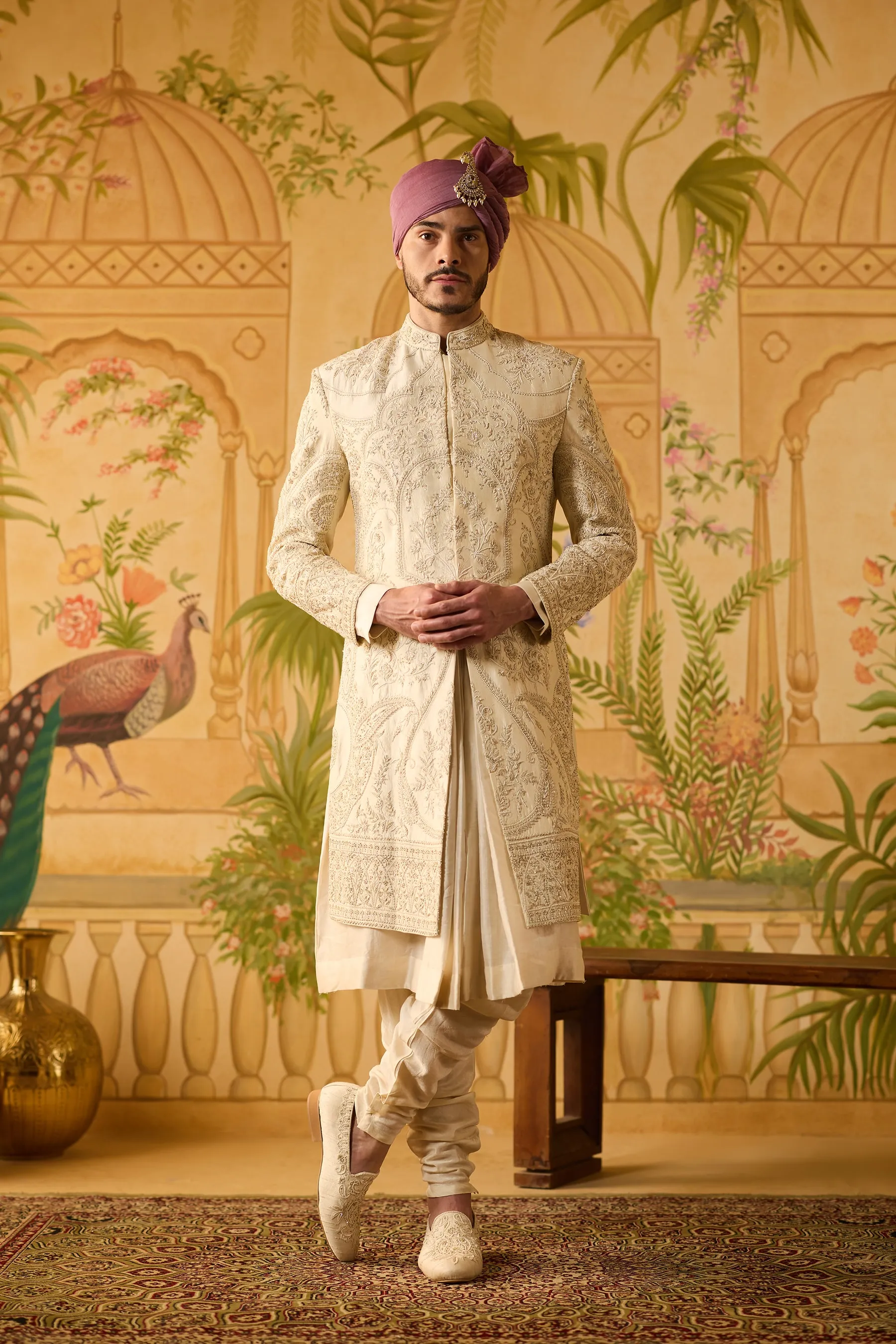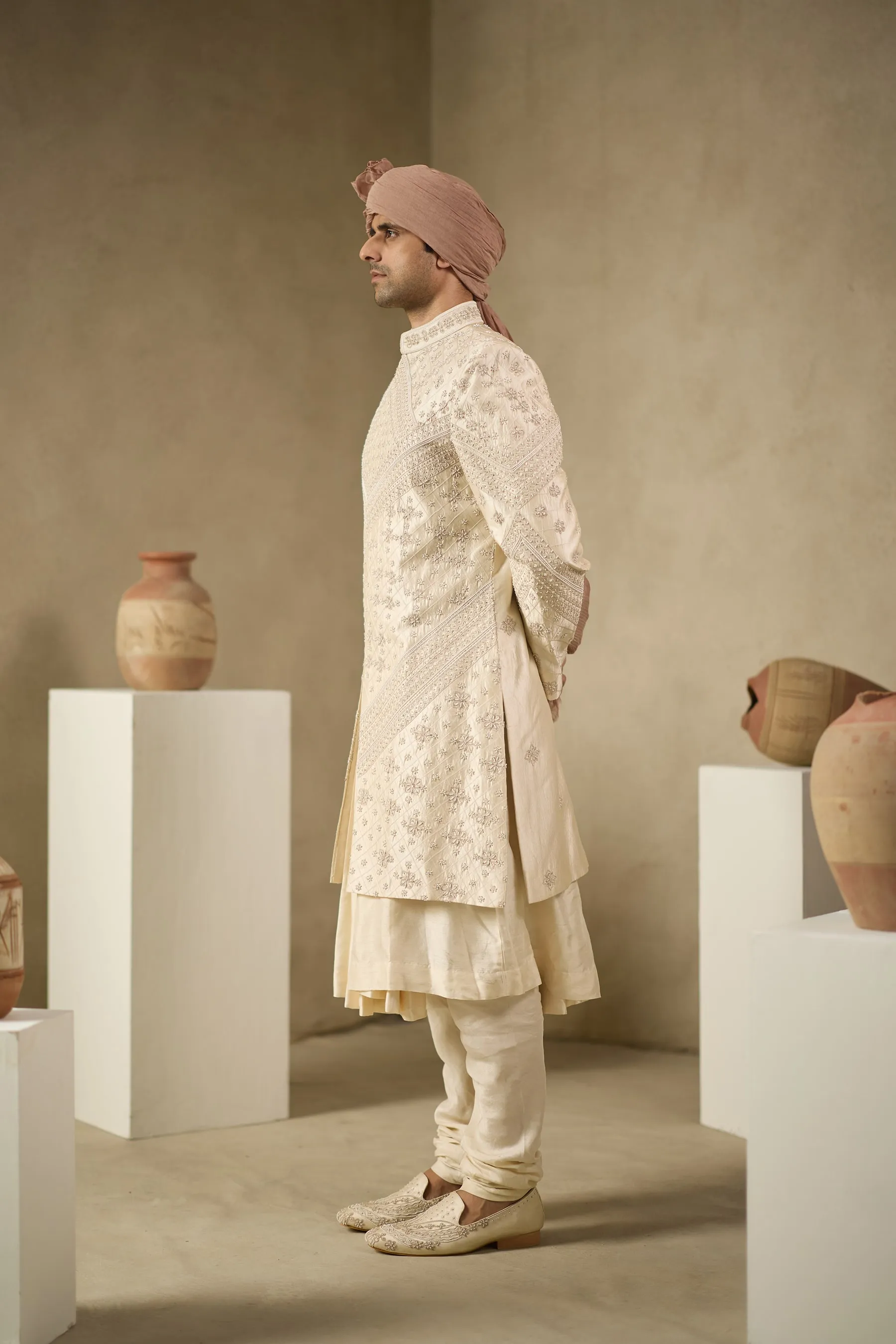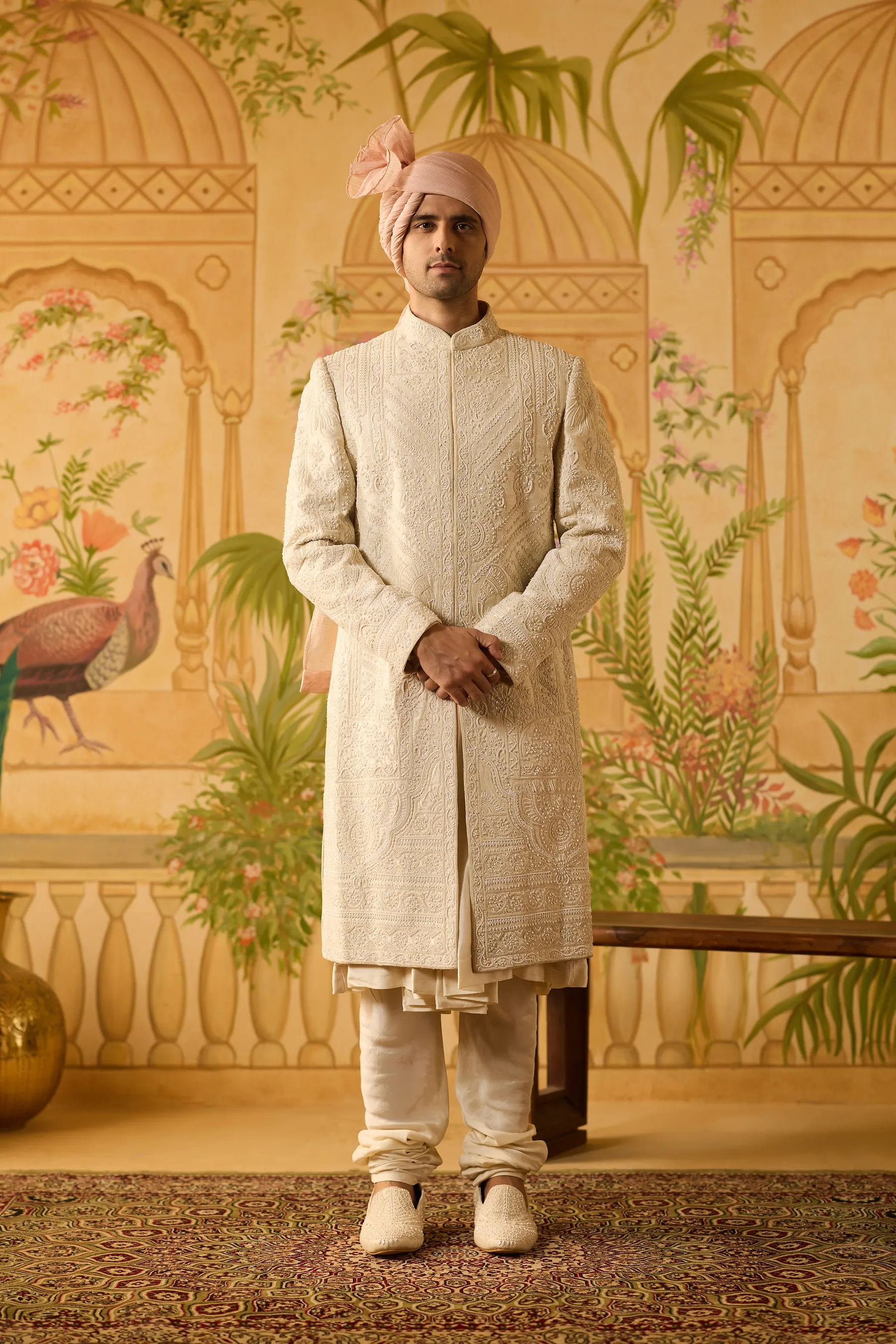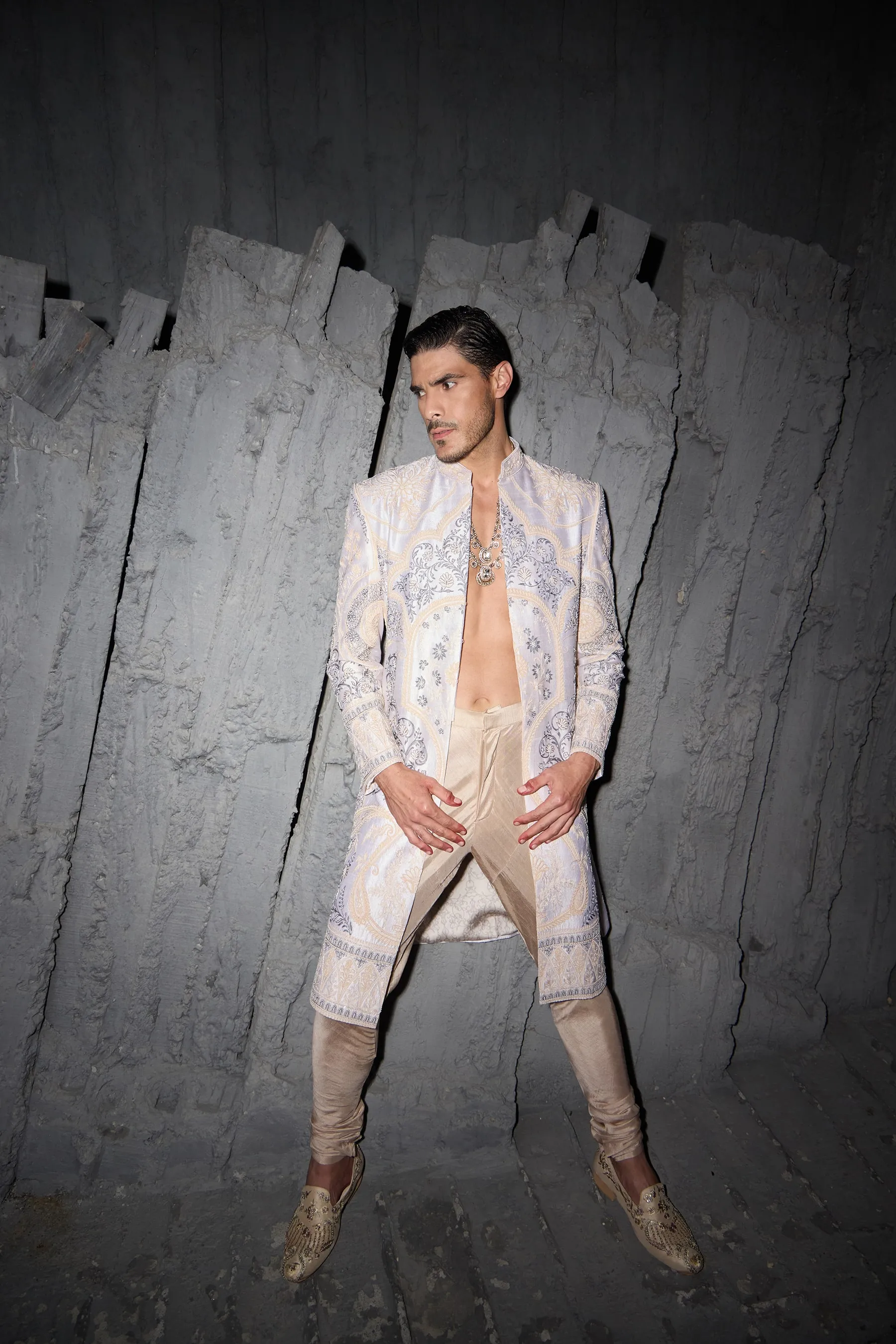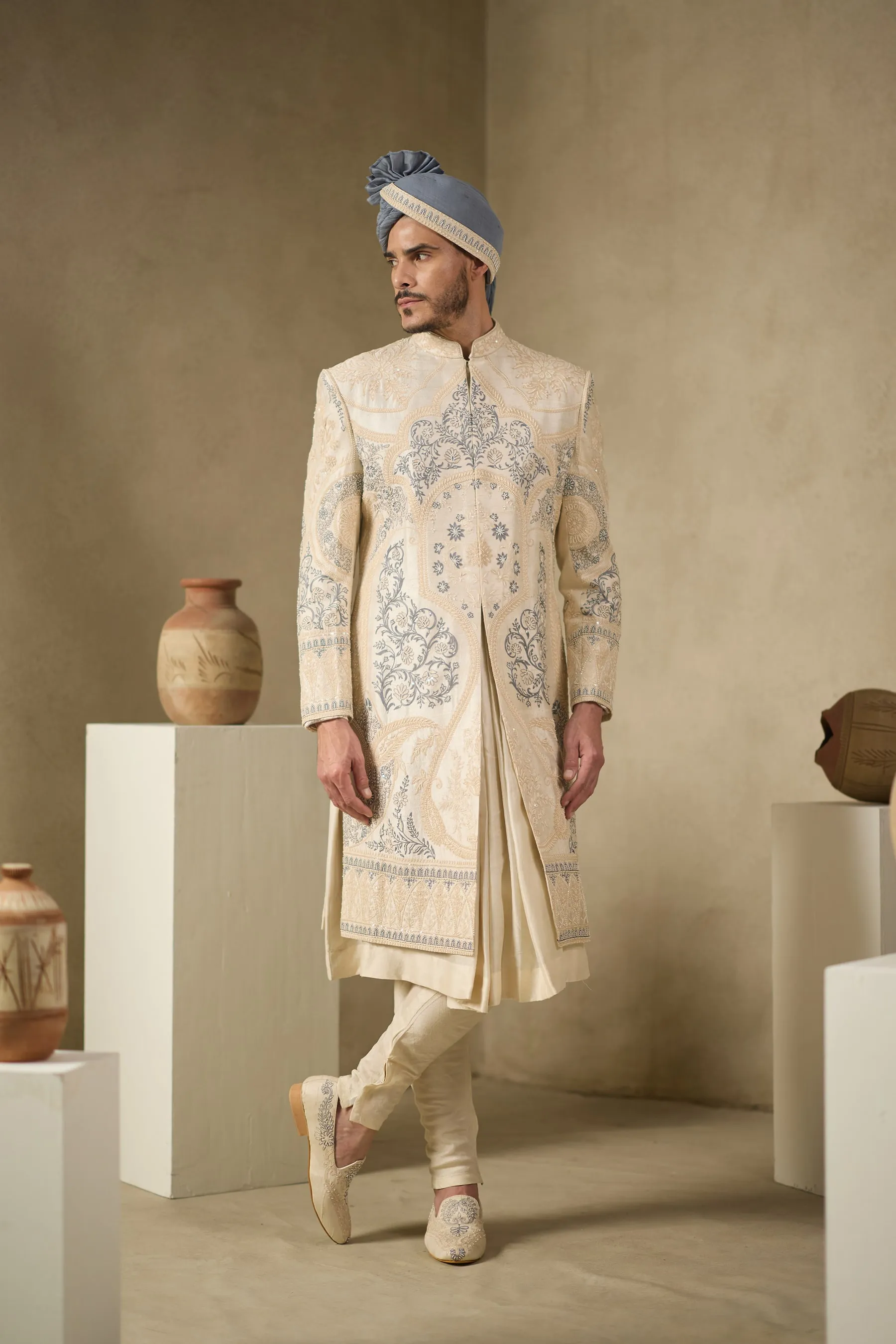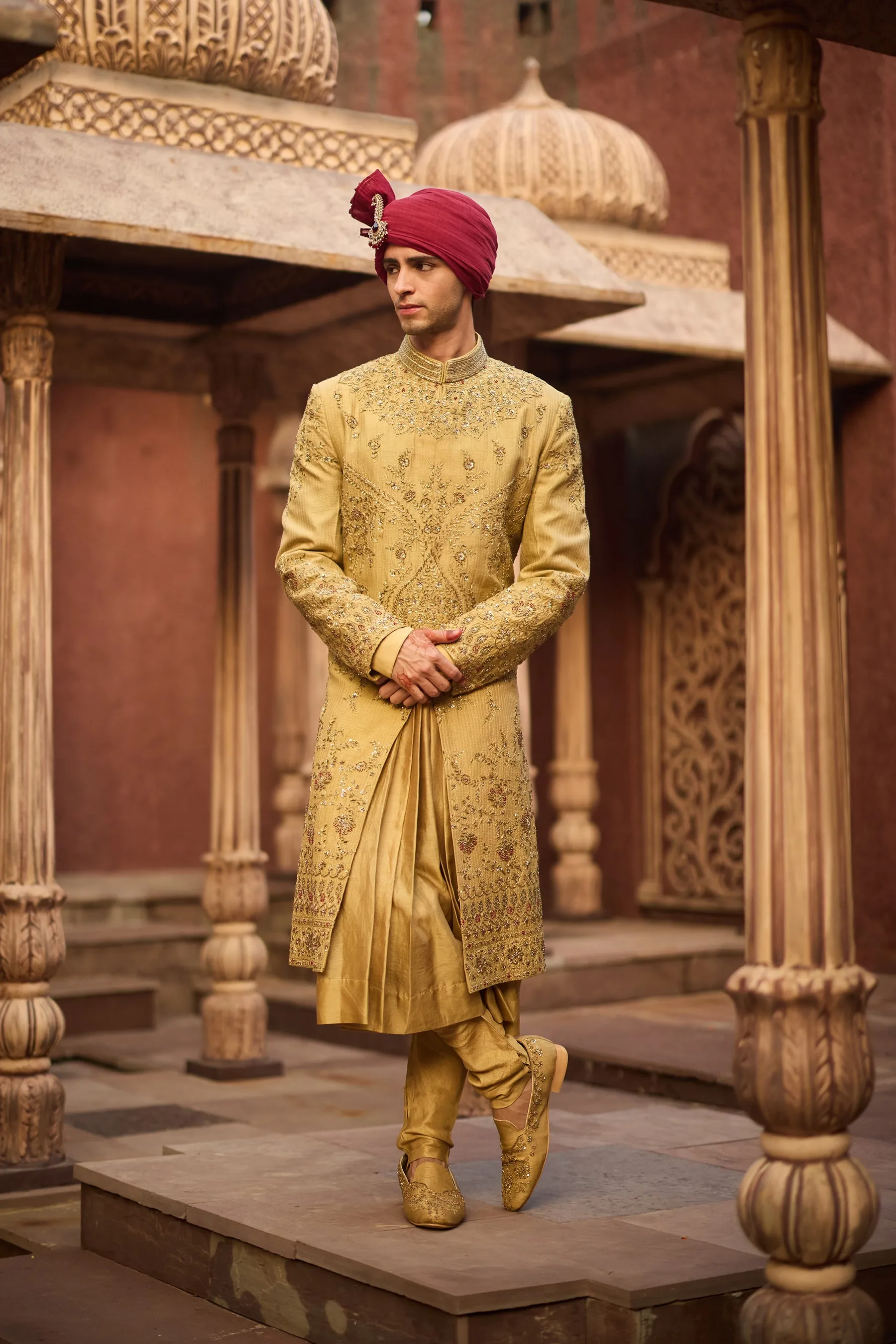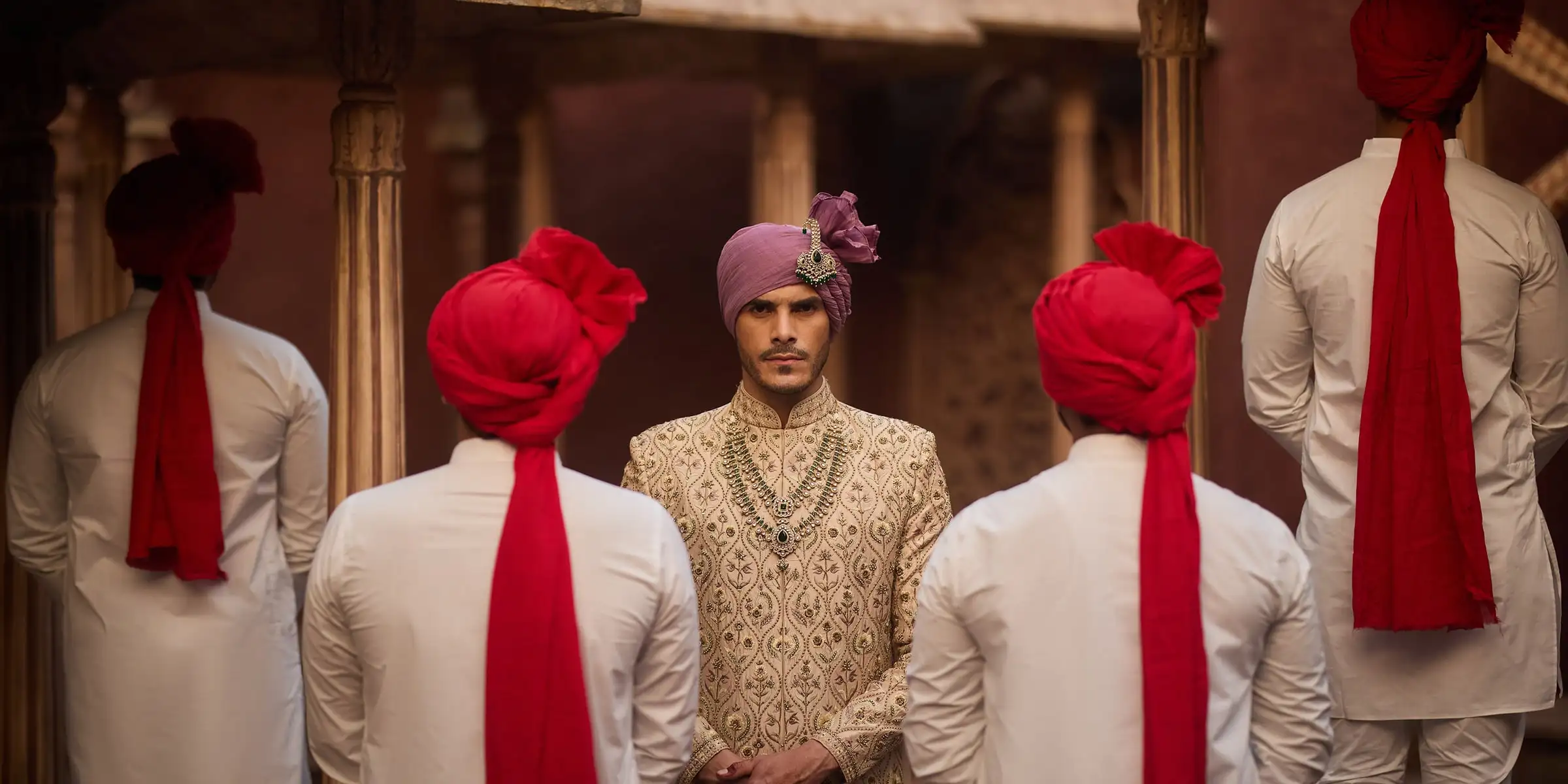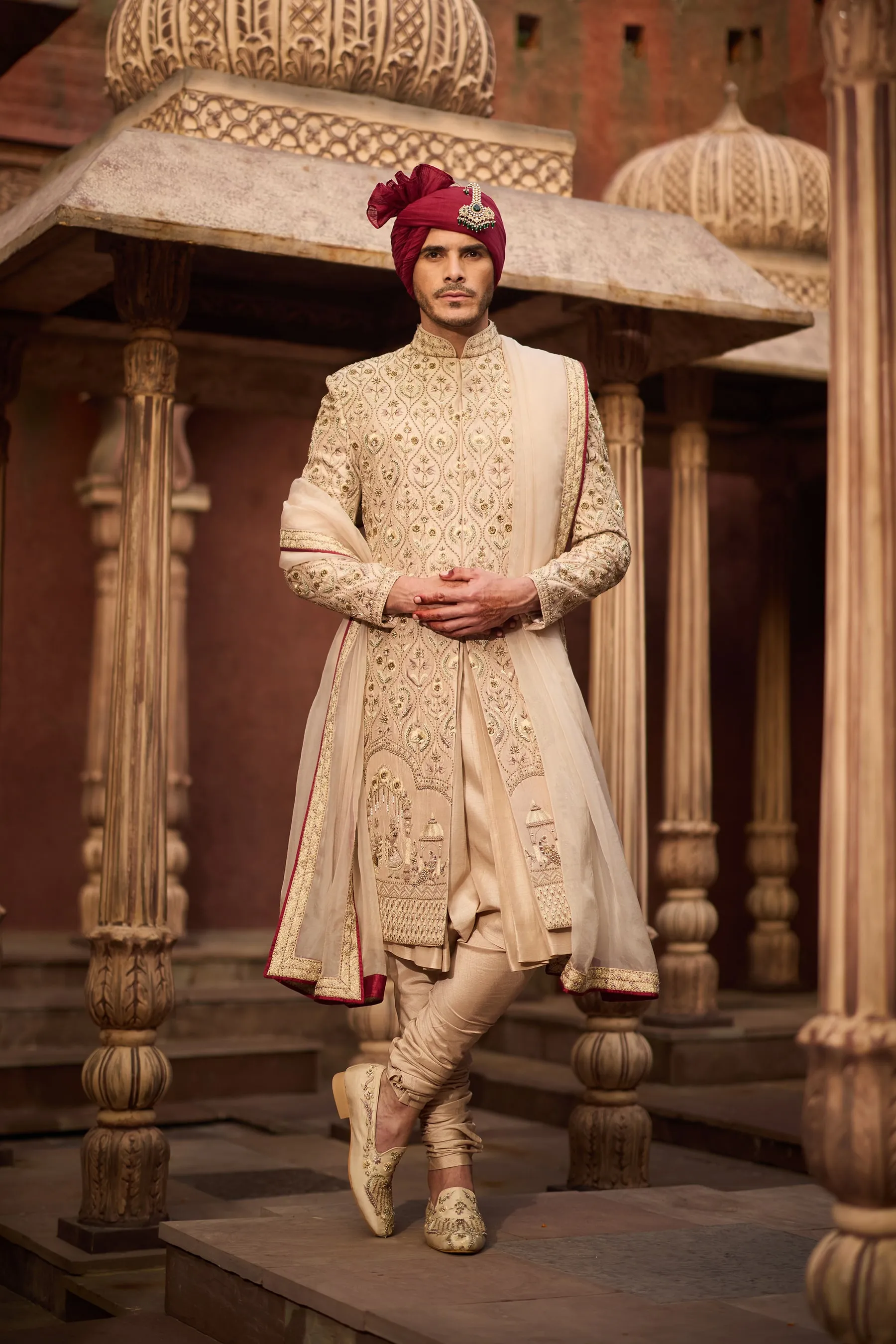
If one outfit has defined the modern Indian groom, it is the ivory sherwani. It is the colour of the heirloom photograph and of the contemporary lifestyle shoot, the colour that goes with every bridal lehenga and every venue, and the colour that makes embroidery sing. It is also unforgiving: pale silk shows every crease and every drop of chai. This guide explains how to choose, style and wear an ivory sherwani, from the shade of ivory to embroidery, accessories, fit and care.
It sits alongside our guides to sherwani vs achkan vs bandhgala, the baraat outfit and the pheras outfit, and the colour guide to wedding colours for the groom.
Why ivory? The case for the pale sherwani
Ivory is popular for good reasons.
- It flatters every skin tone. Unlike stark white, which can look cold, ivory has a gentle warmth that sits well on fair, wheatish and deep skin.
- It works with every bride. Ivory pairs with red, pink, gold, pastel and jewel-toned lehengas. The groom does not clash, whatever the bride wears.
- It shows embroidery beautifully. Zardozi, thread work and pearl detail stand out against a pale ground.
- It suits all seasons. In summer it reflects heat; in winter, with velvet or wool-silk, it glows.
- It is timeless. Photographs from the ivory sherwani will not date.
- It is easy to personalise. A safa, stole, brooch or mojari in a strong colour makes it individual.
- It suits many communities. From the nikah to the Anand Karaj to a Bengali wedding, ivory and cream appear across traditions.
If you are unsure of a colour, ivory is a confident choice. Our sherwani collection includes several ivory pieces: the Parinay, the Leher, the Taraash, the Sahaj, the Parinda in ivory and beige and the Megh in ivory and blue.
Understanding the shades: ivory, cream, white and champagne
“Ivory” covers a range. Knowing the differences helps you choose.
- Pure white is stark and cool. It can look flat on camera and is hard to keep clean.
- Ivory is a soft, warm off-white. It is the most versatile and photographs well.
- Cream is a little deeper and yellower. It suits warm skin tones and golden embroidery.
- Champagne and pale gold are warmer and more metallic, with a festive glow.
- Ecru, sand and beige are earthier, and give a modern, natural feel.
- Ivory with a pastel undertone, such as pink, blue or green, adds subtle colour.
To choose, hold swatches against your face in daylight. Ivory with a yellow undertone suits deeper and wheatish skin; ivory with a pink or cool undertone flatters fairer skin. A good atelier will show you several shades, and you will see the difference at once.
Fabrics: what an ivory sherwani is made from
Fabric determines how the sherwani drapes, shines and ages.
- Raw silk has a gentle texture and body. It is the classic choice and holds embroidery well.
- Silk jacquard and brocade have woven patterns that add depth without embroidery.
- Cotton-silk is lighter and cooler, ideal for summer.
- Wool-silk is warm and elegant for winter.
- Velvet in ivory is rare but dramatic, best for a winter reception.
- Matka and tussar have a textured, natural look in warm ivory tones.
Choose a fabric with a matte or soft sheen. A high-gloss finish can look cheap in photographs. Avoid thin, translucent fabrics, which show lining seams and undergarments.
Embroidery: letting the sherwani speak
Embroidery gives an ivory sherwani its character.
- Tonal embroidery (ivory on ivory) is subtle and refined, and gives texture without colour.
- Gold zardozi adds richness. In moderation, it frames the collar, placket and hem; in density, it makes the sherwani regal.
- Silver and pearl work suits a cooler, contemporary look.
- Coloured thread work in pastel or jewel tones personalises the garment and can echo the bride’s lehenga.
- Chikankari is a fine, white-on-white tradition from Lucknow, light and elegant.
- Resham and kantha add a textured, handmade feel.
Think about proportion. A fully embroidered sherwani is magnificent for a palace baraat but heavy in summer, while a lightly embroidered piece with a rich border suits most weddings. Consider how the embroidery will read from three metres away, as in a group photograph.
Silhouette and fit: the ivory sherwani must be perfectly cut
Because pale colours show every fault, fit is crucial.
- Shoulders. The seam should sit at the edge of the shoulder, without puckering.
- Chest and waist. A close, clean fit with just enough ease for movement. Pale fabrics show pulling.
- Length. Usually to the knee or just below. A longer line looks regal; a shorter one looks modern.
- Sleeves. To the wrist bone, with room to raise your arms.
- Collar. A mandarin collar sitting cleanly at the neck, not too tight.
- Buttons and closure. Neat, consistent and flat. Antique gold, pearl or covered buttons suit ivory.
- Churidar or trousers. A clean line with a slight break at the ankle, in matching or a contrasting tone.
At the fitting, wear the shoes and the kurta you will wear on the day. Sit, stand, raise your arms and walk. Any pulling or bunching shows.
Pairing: safa, stole, kurta and shoes
The accessories turn an ivory sherwani from beautiful to personal.
The safa or turban
A bright or deep safa makes a striking contrast. Saffron, maroon, rose, emerald, mustard and navy all work. A gold or ivory safa gives a tonal, regal look. Match the safa to the bride’s lehenga, the family palette or the décor. Our guide to the baraat outfit covers how to choose and tie a safa.
The stole or dupatta
A stole in a contrasting colour or a rich fabric adds depth. A brocade stole suits a palace; a soft pashmina suits winter; a printed or embroidered one adds personality. Wear it over one shoulder, with a brooch to secure it.
The kurta and churidar
A matching ivory kurta is classic. A kurta in a slightly different tone, such as cream or pale gold, adds subtle contrast. Choose a fine fabric that does not bunch under the sherwani.
Shoes
Mojaris in gold, tan or ivory suit the sherwani. For a modern look, a tan or brown leather loafer works. Avoid black shoes with ivory, which look heavy.
Jewellery and details
A kalgi or brooch on the safa, a mala of pearls or a layered necklace, a ceremonial sword and a fine watch complete the look. Choose a few pieces and wear them well.
Colour pairings that work with ivory
- Ivory and gold: regal, warm and classic.
- Ivory and maroon: traditional, rich and photogenic.
- Ivory and saffron: festive and auspicious.
- Ivory and rose or blush: soft and romantic.
- Ivory and emerald or teal: striking and modern.
- Ivory and navy: crisp and sophisticated.
- Ivory and sage: gentle and contemporary.
For more on choosing a palette, see our guide to wedding colours for the groom.
Ivory by occasion
Baraat and pheras
Ivory is a favourite for the baraat and pheras, especially with a bright safa. See our baraat and pheras edit and the guides to the baraat outfit and pheras outfit.
Nikah and walima
Ivory is traditional for the nikah, with a topi or safa. See our nikah and walima guide.
Reception
An ivory sherwani with a dark stole or a contrasting jacket can serve the reception. See the reception edit and the reception outfit guide.
Engagement and roka
A lighter ivory sherwani or an achkan in a soft embroidery suits an engagement. See the engagement outfit guide.
Photography: how ivory behaves on camera
- Daylight: ivory looks bright and fresh; ask the photographer to expose for the sherwani so it does not blow out.
- Evening and lamplight: ivory takes on a warm glow; embroidery sparkles.
- Flash: can flatten ivory; discuss lighting in advance.
- Backgrounds: ivory stands out against dark backgrounds and blends into pale walls. Choose locations accordingly.
- Colour accuracy: ask for a colour-accurate edit so that the ivory does not appear too yellow or too grey.
A short test shoot during the final fitting can reveal how the outfit looks on camera.
Ivory sherwani styling ideas: six complete looks
Here are six ways to wear an ivory sherwani, each with a different mood.
- The regal classic. An ivory raw-silk sherwani with gold zardozi at the collar and hem, a maroon safa, a brocade stole and gold mojaris. Traditional, warm and photogenic, it suits a palace baraat.
- The modern minimalist. A tonal ivory sherwani with subtle thread work, an ivory safa, a plain stole and tan loafers. Quiet, refined and very current.
- The pastel groom. An ivory sherwani with blush or sage embroidery, a pastel safa and a pearl mala. Soft and romantic, with a garden-wedding feel.
- The jewel contrast. An ivory sherwani with an emerald or navy safa and stole. Bold and crisp, it works well in winter.
- The winter ivory. An ivory wool-silk achkan with a velvet or pashmina shawl in a deep colour, and lined mojaris. Warm and dignified.
- The two-piece reception. An ivory sherwani jacket over a dark kurta and trousers, with a contrasting pocket square. A modern twist that suits a reception or cocktail evening.
Each look can be adapted to the bride’s colours, the venue and your own taste. Bring a photograph of the bride’s outfit to your fitting, and we will show you how the tones sit side by side.
Common questions about ivory and the wedding party
Many grooms ask how ivory affects everyone else. A few answers help.
- Should the groomsmen wear ivory too? Generally no. Dressing them in navy, sage or dusty tones makes the groom stand out, as we explain in our guide to groomsmen outfits.
- What should the groom’s father wear? A deeper tone, such as maroon, navy or emerald, or a lighter achkan in a different shade.
- Can the bride wear ivory too? Some brides choose ivory or champagne lehengas for a modern wedding. In that case, add colour through the groom’s safa and stole so that the couple do not blend into one pale block.
- What should guests wear? Guests are best advised to avoid ivory and white, which is often reserved for the groom.
Ivory across regions and traditions
Ivory carries different associations depending on where and how you marry, and a little awareness avoids missteps.
- In North Indian Hindu weddings, ivory and gold are among the most popular groom colours, often paired with a saffron or red safa. It is considered auspicious when combined with gold.
- In Sikh weddings, cream and ivory are common, with a bright pagri and a contrasting stole.
- In Muslim weddings, ivory and white are traditional for the nikah and are associated with purity and peace.
- In Bengali weddings, cream and off-white panjabis are customary, with gold borders.
- In South Indian weddings, cream and off-white veshtis with gold borders are the norm.
- In some Jain and Gujarati communities, white and cream are often preferred for religious ceremonies, with bright colours added in the safa.
- In Western-style or interfaith weddings, an ivory sherwani is a graceful way of bridging traditions, since it reads as formal in either setting.
Where mourning customs associate white with loss, a few families avoid it for weddings. If you are unsure, ask an elder; a cream or champagne shade usually satisfies every opinion.
One last piece of advice: view your ivory sherwani in the lighting you will actually be photographed in. Ask to see it near a window, under warm indoor light and, if possible, under a flash. Ivory changes character in each, and knowing how it behaves lets you choose the shade, the embroidery and the accessories with confidence.
Keeping ivory clean on the day
Pale colours demand some care.
- Dress last. Put the sherwani on as late as possible.
- Avoid eating and drinking in the outfit, or use a napkin and straw.
- Carry a stain pen and a lint roller.
- Keep it away from perfumes, hair products and sprays, which can stain.
- Sit carefully, on a clean cloth if needed.
- Ask someone to hold the jacket between events.
- Avoid contact with garlands, whose stems and pollen can mark.
If a stain happens, blot, do not rub, and take it to a specialist as soon as possible.
Care after the wedding
Ivory silk needs gentle care.
- Have it cleaned by a specialist soon after the wedding, since perspiration and food stains set over time.
- Store it in a breathable garment bag, not plastic, with acid-free tissue.
- Avoid direct sunlight, which can yellow pale silk.
- Keep it away from damp and moths, with cedar blocks or lavender.
- Re-wear it with new accessories to give it a second life.
Planning and timeline
| When | What to do |
|---|---|
| 12 weeks before | Choose silhouette, shade and embroidery; swatches in daylight. |
| 10 weeks before | Measurements and accessories. |
| 8 weeks before | Place the order. |
| 4 to 5 weeks before | First fitting. |
| 2 weeks before | Second fitting with safa and shoes. |
| 1 week before | Final fitting and steaming. |
See our guide to made-to-measure timelines for more detail.
Coordinating with family
If the groom wears ivory, the father and brother can choose complementary colours: deeper tones such as navy, maroon or emerald. Our guides to the father of the groom’s outfit, groom’s brother’s outfit and groomsmen outfits explain how to coordinate. Guests are advised to avoid ivory and white; see our male guest guide.
Common mistakes to avoid
- Choosing the wrong shade for your skin tone.
- Skipping the fitting in daylight.
- A thin fabric that shows seams.
- Over-embroidering in hot weather.
- Dressing too early.
- Forgetting stain care.
Frequently asked questions
Is ivory a good choice for the groom?
Yes. It flatters every skin tone, suits every bride and photographs beautifully.
What colour safa suits ivory?
Saffron, maroon, rose, emerald, mustard, navy or gold.
How do I keep ivory clean?
Dress last, avoid food, carry a stain pen and have it cleaned promptly after.
Can I re-wear it?
Yes, with different accessories.
Final thoughts
An ivory sherwani is a canvas: it takes on character from the embroidery, the safa, the stole and the person who wears it. Choose a shade that suits you, a fit that is flawless and details that mean something. If you would like to see the shades side by side, book an appointment and we will take you through the swatches in daylight.
Shop the looks
Browse the sherwani collection, including the Parinay, Leher and Taraash, or visit the baraat and pheras edit.