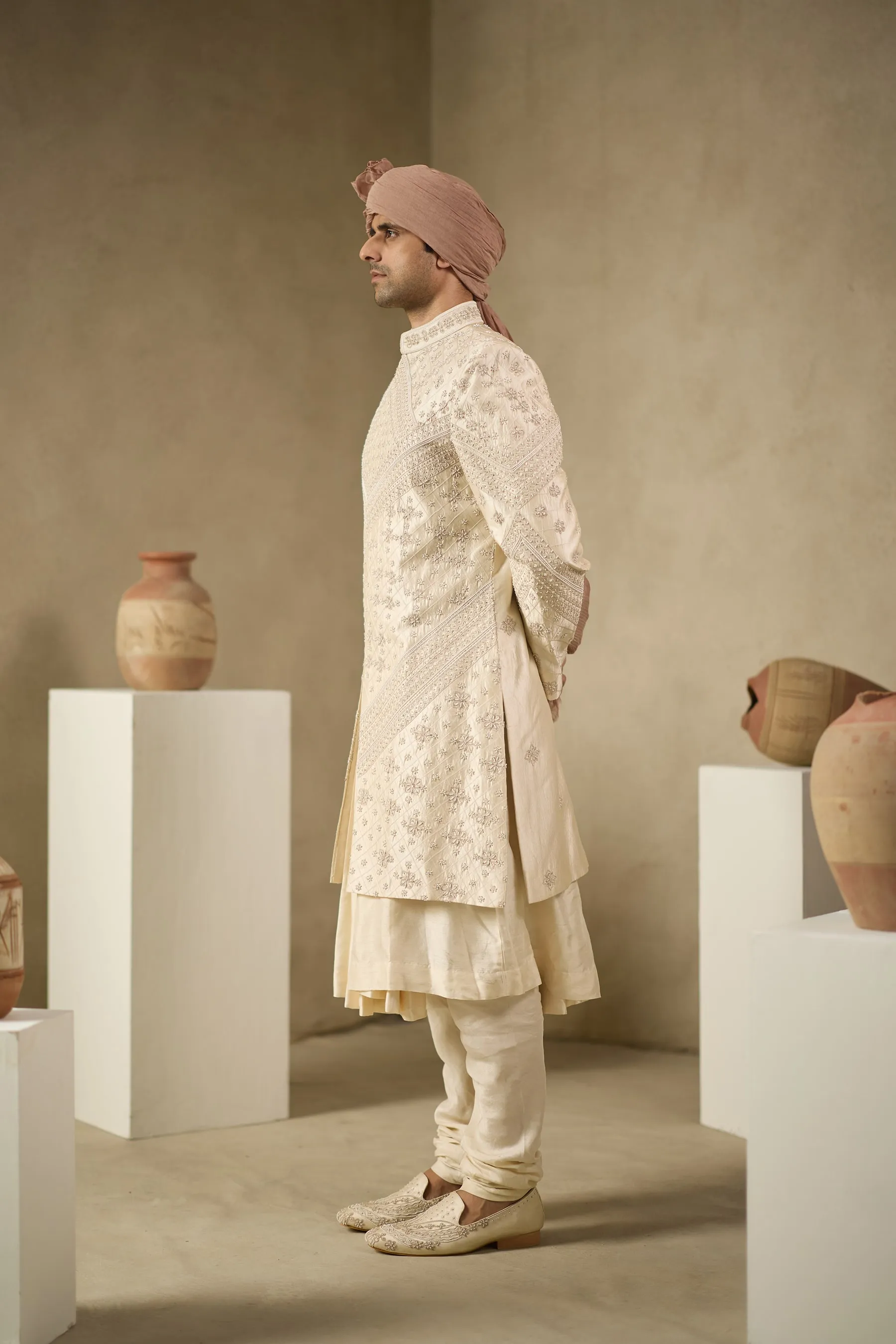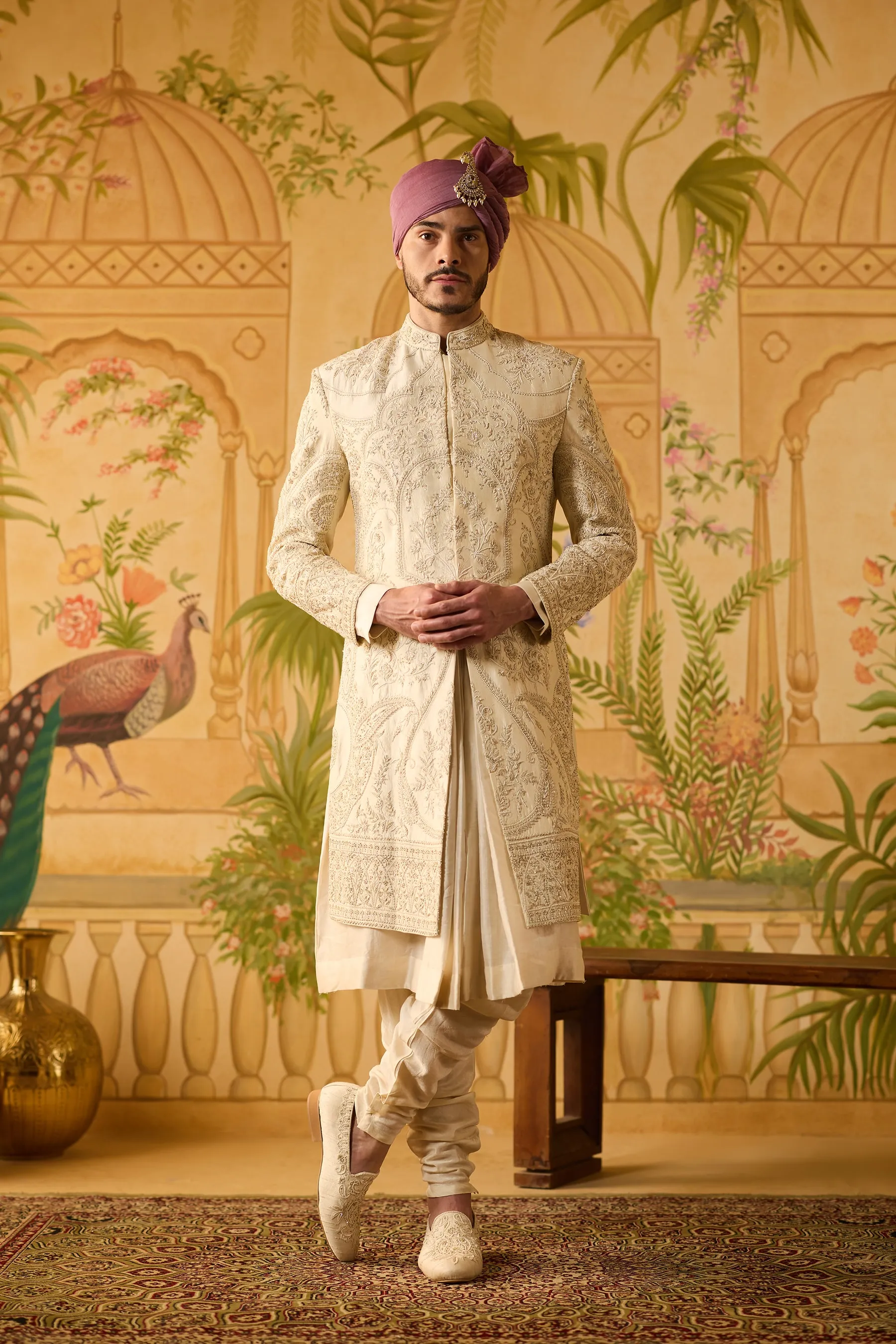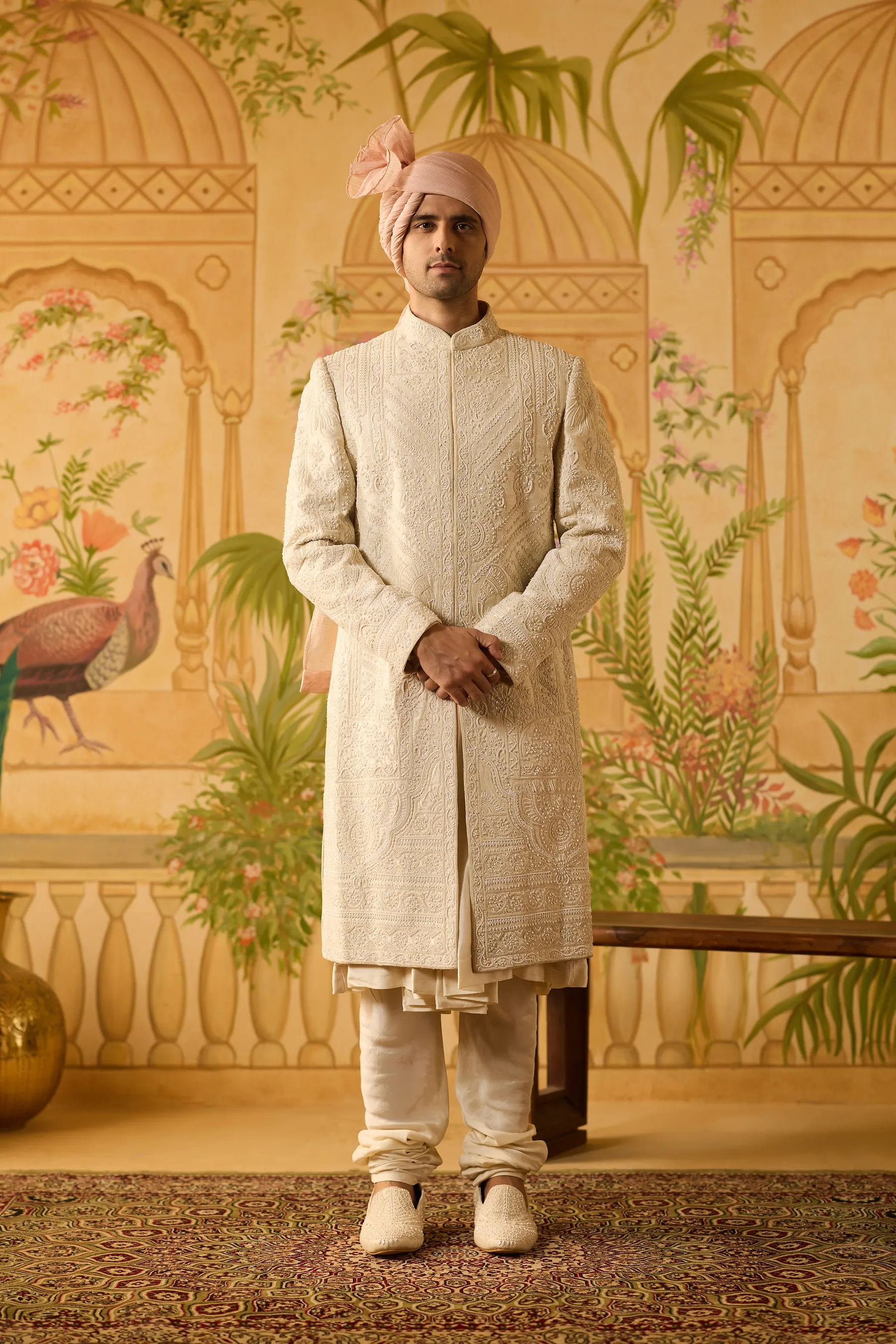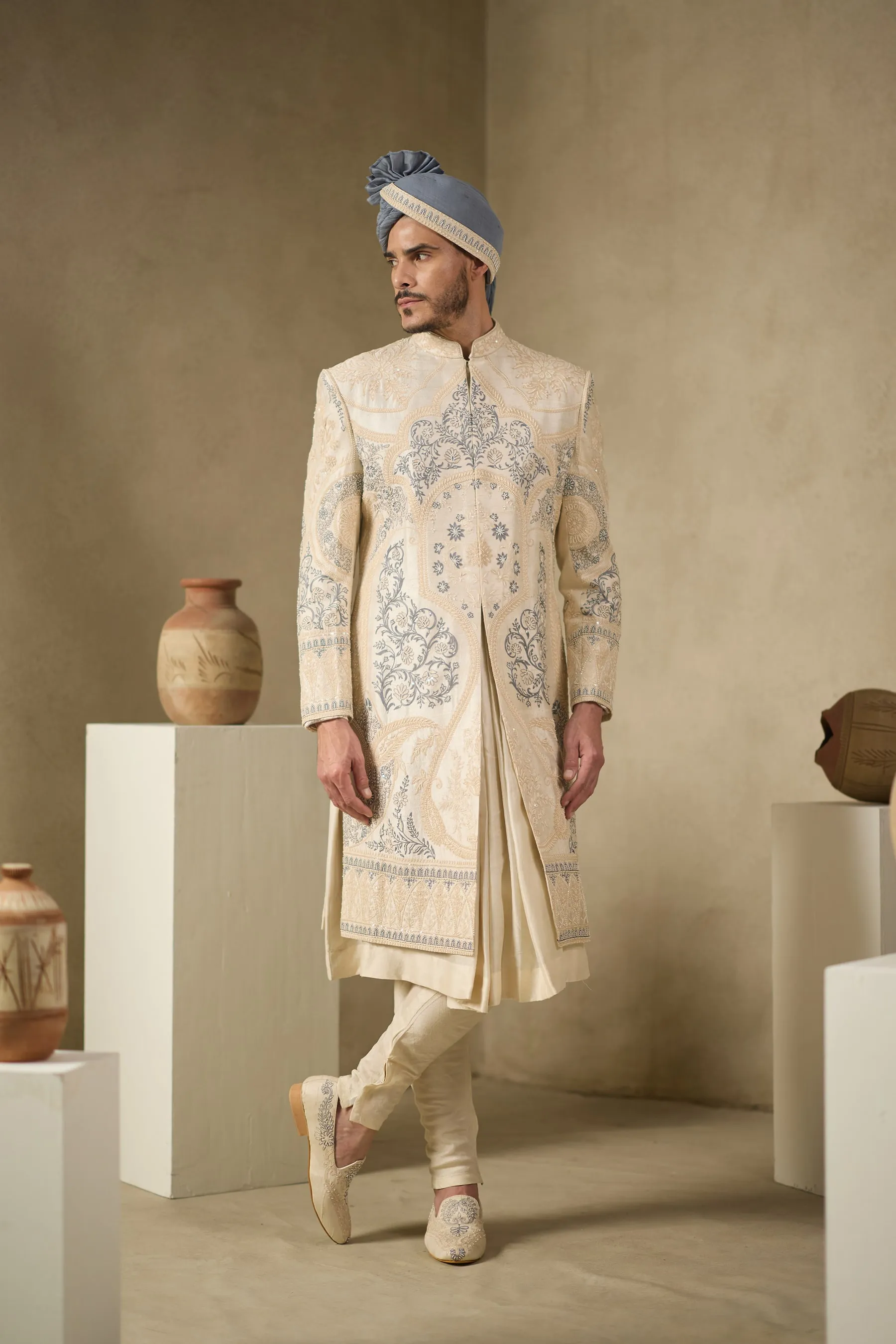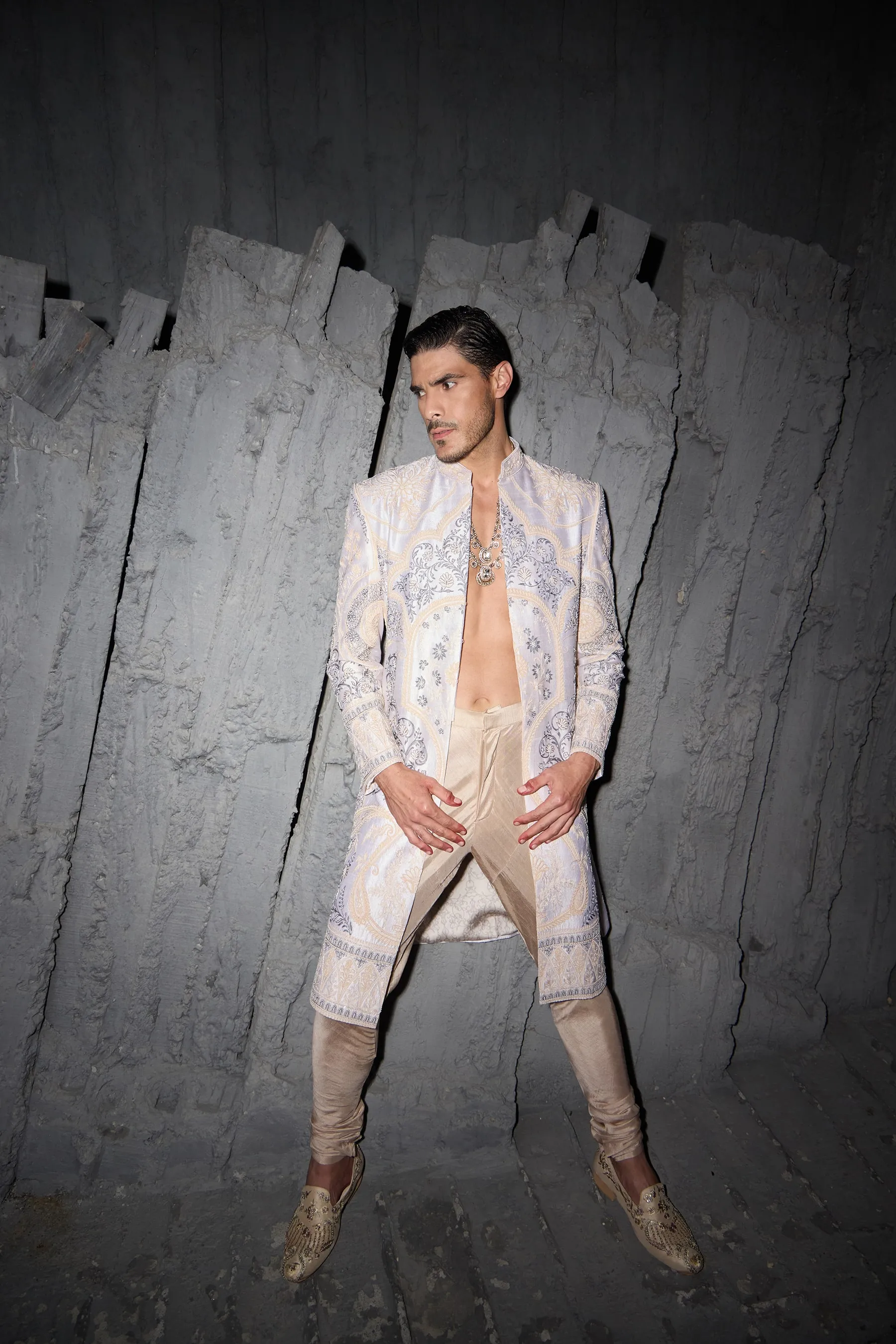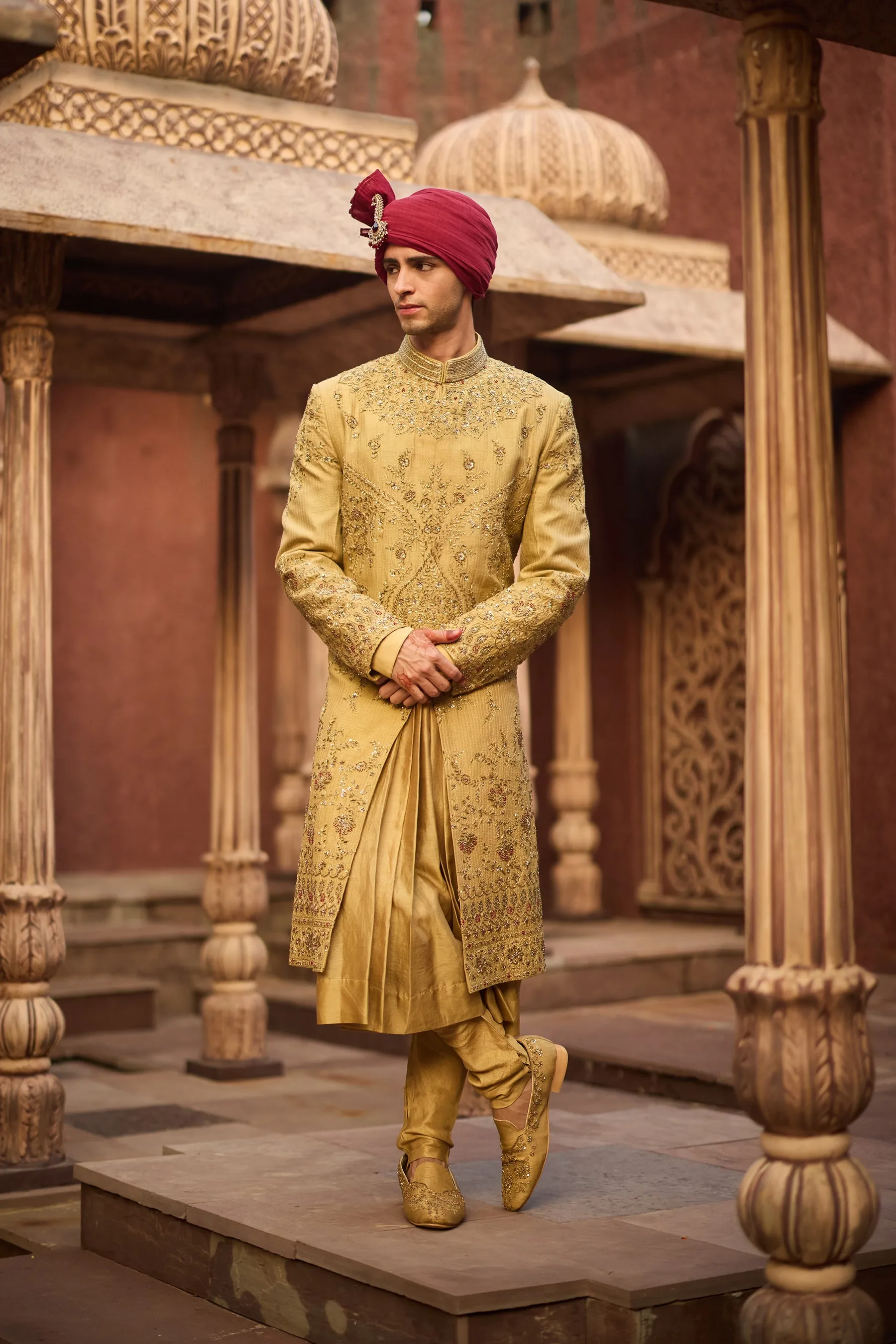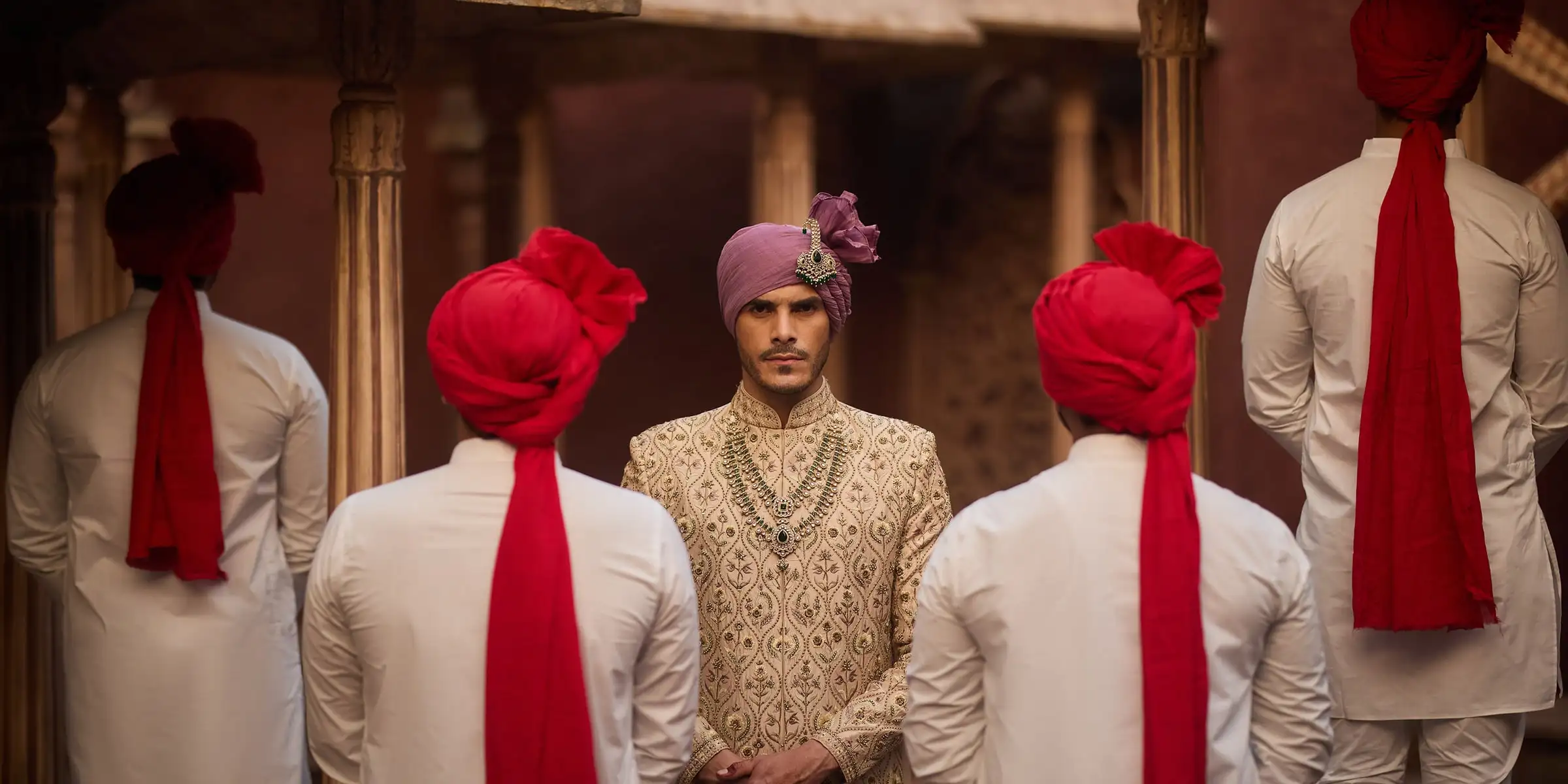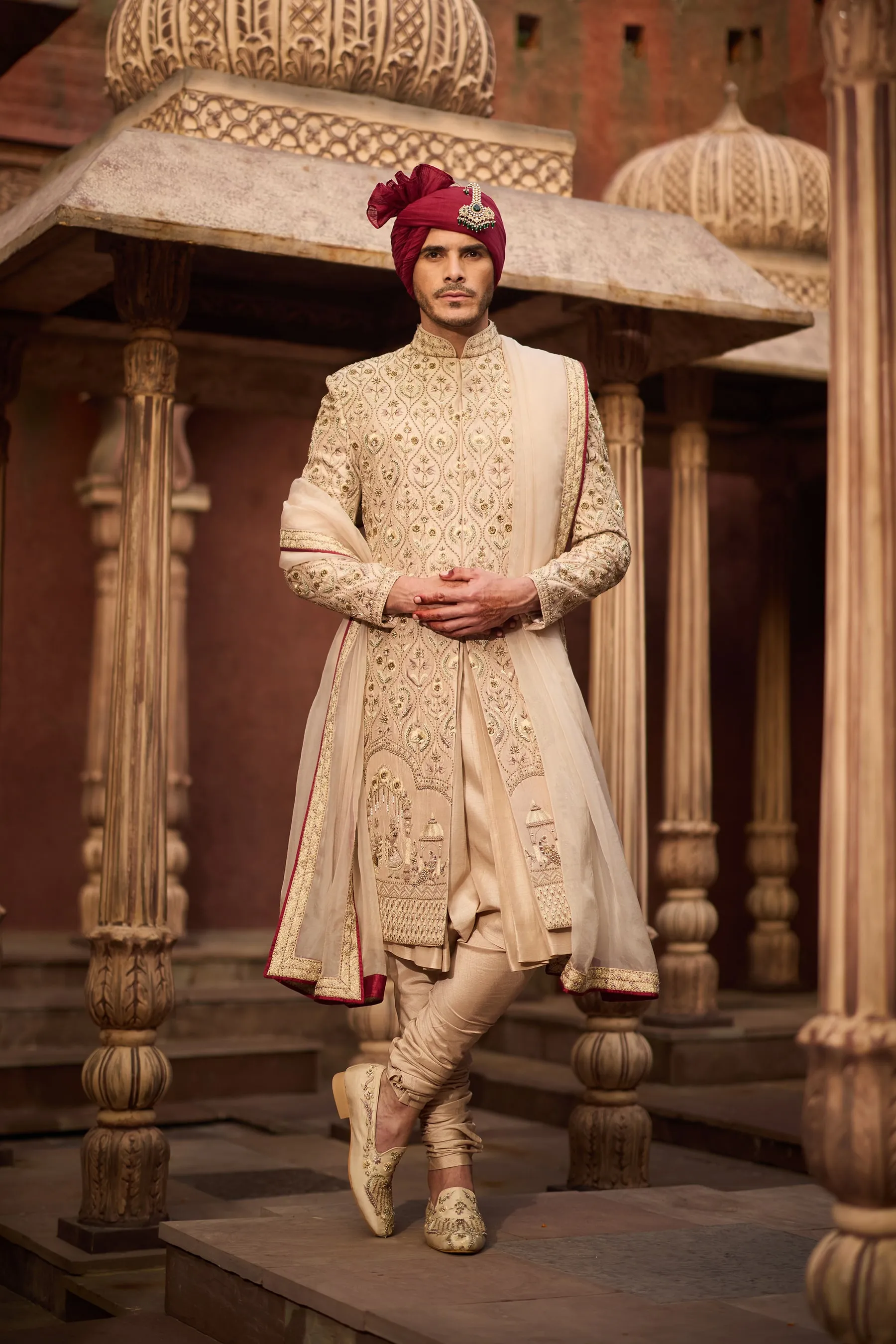
The pheras are the heart of the Hindu wedding. The couple circle the sacred fire together, taking seven vows, with the priest chanting, the families close behind and the photographer within arm’s reach for most of an hour or more. It is the longest and most intimate part of the wedding, and for the groom, it is also the most demanding. You will sit on the floor or a low seat, stand and walk in circles, and be photographed from inches away. The outfit has to be beautiful, refined in detail and comfortable. This guide covers what to wear to the pheras and how to prepare.
For the wider schedule, see our guide to what the groom wears at each ceremony. Our baraat and pheras collection gathers the sherwanis we make for the wedding day.
What the pheras ask of the outfit
The pheras take place at the mandap, a decorated canopy, usually in the evening or at night, though some are held in the morning. They are performed in front of the sacred fire, with an hour or two of rituals, and the groom plays an active role: sitting beside the bride, tying the knot of garments, making offerings and taking the seven rounds.
That leads to four demands:
- Seated comfort. You will sit cross-legged or on a low seat for a long time.
- Fire safety and heat. The fire is close, the mandap is warm and fabrics should be safe and breathable. Avoid very light, synthetic or loose fabrics near flame.
- Close-up detail. Embroidery, buttons, collar and cuffs are seen close up and photographed in detail.
- Harmony with the bride. The couple’s outfits are seen together for the central photographs.
Choosing a sherwani for the pheras
Colour
The mandap is usually decorated in warm tones with flowers, gold and fire, and the lighting is warm. Colours that work well:
- Ivory and cream. The most classic. Our Parinay in ivory, Taraash in ivory and Leher in ivory are cut for the ceremony. See our guide to the ivory sherwani for the groom.
- Gold and champagne. Rich and warm, with a glow that suits the fire and flowers.
- Soft pastels: blush, peach, pistachio, powder blue. Modern and gentle. Our Sahaj in ivory and Megh in ivory and blue show how a touch of colour adds personality without loudness.
- Deep colours: maroon, bottle green, royal blue. Dramatic and rich, best for evening or winter weddings.
Avoid colours that blend into the mandap decor or that look flat under warm light.
Embroidery
At the pheras, the embroidery is close to the camera. Look for fine, well-executed detail: balanced patterns, even stitching and finished edges. Tonal embroidery and subtle zardozi look elegant; heavy, scattered embellishment can look busy up close. See our guide to what makes a sherwani look refined for specific ideas.
Fabric
Raw silk, silk jacquard, brocade and silk blends are all traditional and well suited. Choose a breathable lining. If the ceremony is long or in hot weather, a lighter silk-cotton blend can keep you comfortable. If the ceremony is in winter, a velvet or wool-silk blend adds warmth.
Fit
A pheras sherwani should allow:
- Sitting cross-legged, with room in the thigh and seat of the churidar.
- Raising your arms to offer items into the fire.
- Walking in a circle, with a skirt that does not trip you.
- Bending forward, to touch elders’ feet.
Test all four in your fitting. Our made-to-measure process includes two fittings so that these adjustments can be made. See our guide to planning a made-to-measure wedding outfit.
The stole, mala and accessories
The stole
In many traditions, the groom’s stole is tied to the bride’s dupatta in the gathbandhan, the knot that joins the couple. Choose a stole in a colour that complements the sherwani, in a fabric that is long enough to tie and soft enough to knot. Keep a spare in case of a tear.
The safa and sehra
If you wore a safa for the baraat, you may remove it before the pheras, or keep it for part of the ceremony. A sehra is traditionally removed at a specific point. Ask your family or priest.
Malas and brooches
A pearl or kundan mala adds richness and photographs well. Keep it to one or two. A brooch on the collar or on the stole adds polish.
Rings and watch
A watch is optional; many grooms remove it for the ceremony. Rings and bracelets should be simple.
Footwear
You will remove your shoes before entering the mandap, and you may be barefoot for the entire ritual. Choose juttis or mojaris for the arrival and departure, and make sure they are easy to slip off. Wear clean, intact socks if the family requires them. Keep a pair of comfortable sandals nearby for after the ceremony.
Matching the bride and the mandap
The pheras photograph the couple together, so harmony matters.
- Ask for her colour palette well in advance. An ivory sherwani suits nearly every bridal colour; a gold or pastel sherwani can be coordinated to complement hers.
- Consider the mandap decor. If the mandap is white and gold, a coloured sherwani stands out; if it is rich red and gold, an ivory or champagne sherwani calms it.
- Think about the stole and safa. A contrast stole in a colour that appears in the bride’s outfit ties you together visually.
Practical tips for sitting and staying comfortable
- Practise sitting cross-legged in the outfit before the day.
- Wear a churidar with a little ease at the knee and ankle.
- Keep a small cushion available if you need one; some mandaps provide low seats.
- Sip water between rituals if the priest allows.
- Carry a small handkerchief tucked discreetly.
- Ask a friend to adjust your skirt when you sit and stand.
Fire safety and fabric choices
The fire at the mandap is contained but close. A few precautions are sensible:
- Avoid very loose, flowing, synthetic or net fabrics near the flame.
- Choose natural fibres (silk, cotton, wool) for the sherwani and stole where possible.
- Keep the stole and the skirt neatly arranged when you sit.
- Ask the priest or a family member to keep an eye on trailing fabric.
Most families have conducted these ceremonies for generations without incident; the point is simply to choose well and stay aware.
Dressing on the day: a calm timeline
- Three hours before: a light meal, a shower and grooming.
- Two hours before: dress in the churidar and sherwani, with help.
- Ninety minutes before: add the stole, mala, brooch and safa if needed.
- One hour before: family photographs and last-minute adjustments.
- Thirty minutes before: a quiet moment, water and a final check.
If you wore a sherwani for the baraat and will change for the pheras, allow extra time for the change, and have a steamer on hand.
One outfit or two?
Many grooms wear the same sherwani from baraat to pheras, with accessories changed. Others choose two:
- A lighter, brighter sherwani for the baraat and a richer, more refined one for the pheras.
- An ivory or champagne sherwani for the pheras and a bolder colour for the baraat.
- The same sherwani for both, with a different stole and the safa removed.
If you choose two, make sure they are coordinated and that each suits its setting. For the first outfit, see our guide to the baraat outfit for the groom.
Pheras outfit ideas by style
The classic groom
An ivory sherwani with gold embroidery, an ivory or crimson stole, pearl mala and ivory or gold juttis.
The soft modernist
A pastel sherwani in peach, blush or powder blue, with a tonal stole and a minimalist mala.
The royal groom
A deep gold or maroon sherwani with rich embroidery, a coordinated stole and a kundan mala.
The understated groom
An ivory sherwani with tone-on-tone embroidery, a plain stole and no safa. Quiet, refined and timeless.
Mistakes to avoid
- A skirt that restricts sitting. The most common problem.
- Tight sleeves. You will raise your arms repeatedly.
- Fine, loose fabrics near the fire. Choose firm, natural fibres.
- Clashing with the bride. Coordinate colours in advance.
- Heavy jewellery that snags. Keep it simple and secure.
- Forgetting a spare stole. Knots and tears happen.
After the pheras: the reception and beyond
Once the pheras are complete, the couple usually move to photographs, blessings and a meal. Many grooms change for the reception into a bandhgala, a second sherwani or a tuxedo. For ideas on that look, see our guide to the reception outfit for the groom.
What happens at the pheras, and how the outfit fits each step
Knowing the sequence of the ceremony helps you choose an outfit that works through every part of it. The exact order varies by family and priest, but a typical Hindu ceremony includes:
Arrival and welcome
The groom arrives at the mandap, is welcomed with a tilak and aarti, and takes his seat. You will be standing, greeting and then sitting, so the first few minutes involve movement and the next involve stillness.
Kanyadaan and the exchange of garlands
In many traditions the couple exchange garlands (jaimala) and the bride’s parents perform the kanyadaan. The groom sits quietly for much of this. A collar and cuff that look neat when you are still, and a seat that is comfortable, are the priorities.
Gathbandhan: the knot
The groom’s stole is tied to the bride’s dupatta, symbolising the union. A stole of enough length, in a fabric that holds a knot without slipping, is useful.
Havan and offerings
The couple make offerings into the sacred fire. You will lean forward, extend your arm and sit near the flame. Choose natural fibres and avoid loose sleeves or flowing edges.
Saptapadi: the seven steps
The couple take seven steps or circles around the fire, making a vow at each. The bride and groom walk together, often with the groom leading in the first rounds. You need freedom in the legs, a skirt that does not drag and shoes or bare feet that are stable.
Sindoor and mangalsutra
The groom applies sindoor to the bride’s parting and ties the mangalsutra. These are close, intimate moments in the photographs. A sleeve that does not bunch and a hand that is steady matter most.
Blessings
The couple touch the elders’ feet and receive blessings. Bending forward in a sherwani calls for room in the back and a collar that does not ride up.
Regional variations in the groom’s wedding attire
India’s wedding traditions are diverse, and the groom’s outfit varies with them.
- Punjabi and North Indian Hindu weddings. A sherwani with a safa and stole is the usual outfit. The pheras are held around the fire.
- Gujarati weddings. The groom often wears a sherwani or a kediyu-style garment; the mandap rituals have their own sequence.
- Marwari and Rajasthani weddings. A sherwani with a safa or a regional turban, with rich embroidery, is common.
- Bengali weddings. The groom wears a dhoti and panjabi with a topor (a pith headdress). See our guide to the Bengali groom’s wedding outfit.
- South Indian weddings. The groom wears a veshti with an angavastram, often with a silk shirt or no shirt at all. See our guide to South Indian groom wedding attire.
- Sikh weddings. The Anand Karaj is held in a gurdwara, with the couple circling the Guru Granth Sahib four times (laavan). See our guide to the Sikh wedding groom outfit.
- Muslim weddings. The nikah is a different ceremony from the pheras; see our guide to the nikah and walima groom outfit.
If your wedding follows a particular tradition, make sure the outfit respects it. A good tailor will adapt the cut and the details accordingly.
Looking after the sherwani during the ritual
Several elements of the ceremony can mark a garment: ghee and oil in the havan, kumkum and turmeric on the tilak and sindoor, flowers and petals, ash and smoke. A few ways to keep the sherwani clean:
- Keep the stole draped over the lap while you sit to protect the front of the skirt.
- Ask the priest to apply the tilak with a light touch, and keep a small towel nearby.
- Brush off petals and ash before photographs.
- Avoid sitting on bare floors that may be dusty; ask for a clean mat or cushion.
- Arrange the skirt when you sit and stand so it does not catch the fire or the floor.
- Keep a small stain pen in a bag held by a family member.
After the wedding, store the sherwani in a breathable garment bag, away from direct sun, and take it to a trusted dry cleaner. Silk and heavily embroidered garments should be cleaned by specialists.
A pre-ceremony checklist
- Sherwani, churidar and stole pressed and ready
- Shoes and spare socks
- Mala, brooch and rings
- Handkerchief and a small towel
- Water bottle and a snack for before the ceremony
- Phone left with a family member
- A spare stole and safa pins
- Steamer and lint roller nearby
- A small first-aid kit for blisters or minor needs
How the outfit should look in the photographs
The pheras photographs are often the most formal and enduring of the wedding. A few points help you look your best:
- Even colour. Make sure the sherwani, stole and churidar form a coherent palette.
- Defined collar. A collar that stands neatly frames the face.
- Clean cuffs. The sleeve should show an inch or two of the shirt cuff or end neatly at the wrist.
- No visible creases. Steam the sherwani the evening before and again just before dressing.
- Hands in view. Hands are central at the knot, the garlands and the sindoor; keep them tidy and simple in jewellery.
Shop the pheras look
- Parinay, an ivory sherwani with classic gold embroidery.
- Taraash, an ivory sherwani with a refined, floral pattern.
- Leher, an ivory sherwani with a royal feel.
- Sahaj, an ivory sherwani with peacock-inspired detail.
- Megh, an ivory and blue sherwani for a touch of colour.
- Parinda, an ivory and beige sherwani with subtle pattern.
See the full sherwani collection. Every piece is made to measure, with two fittings and hand finishing.
Final thoughts
The pheras is the part of the wedding that will be remembered longest. Choose a sherwani that is beautiful up close, comfortable sitting and standing and harmonious with the bride’s outfit. Keep the accessories simple, the fabrics natural and the fit exact. When you are ready, book a fitting and we will help you plan the pheras look and the wardrobe around it.