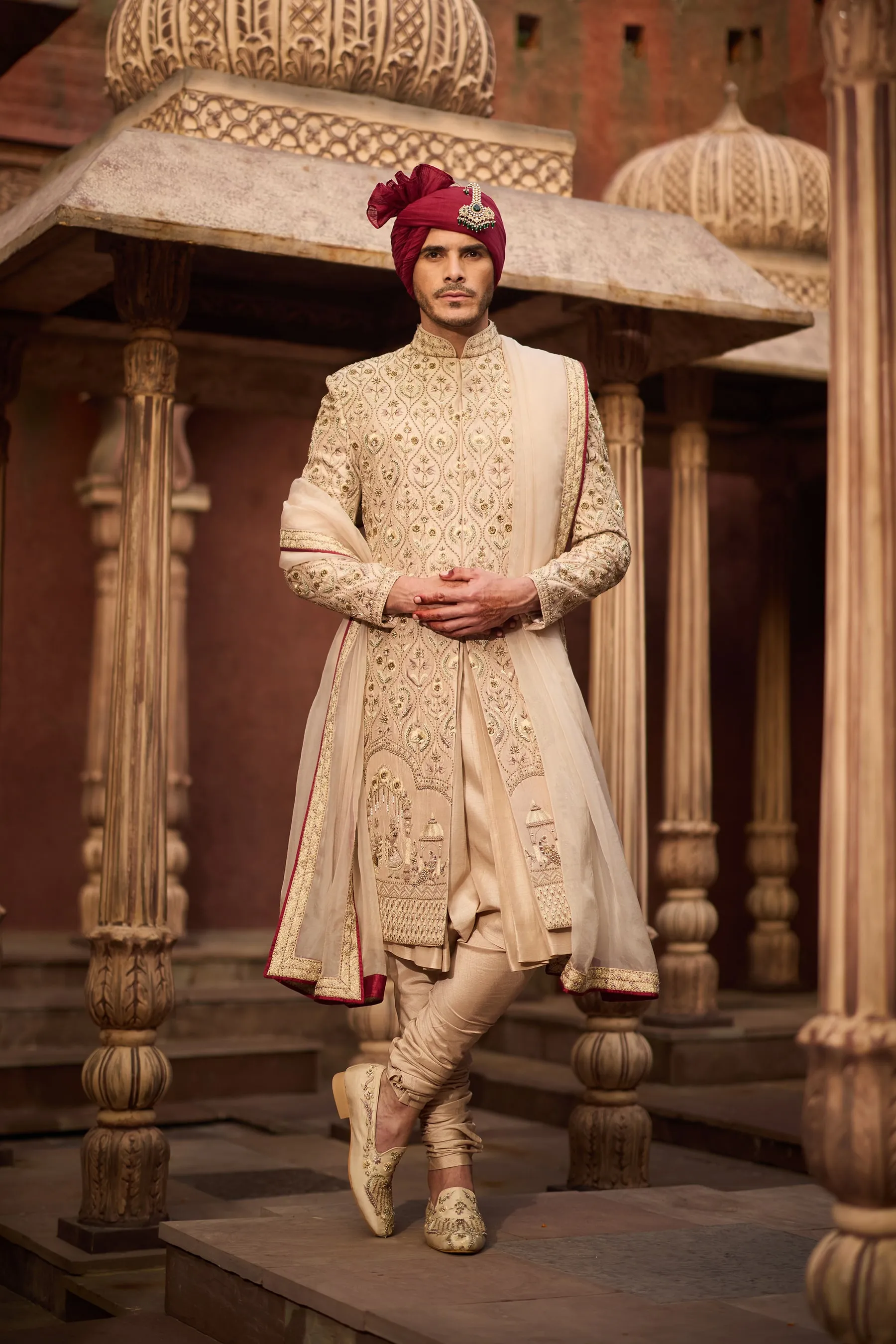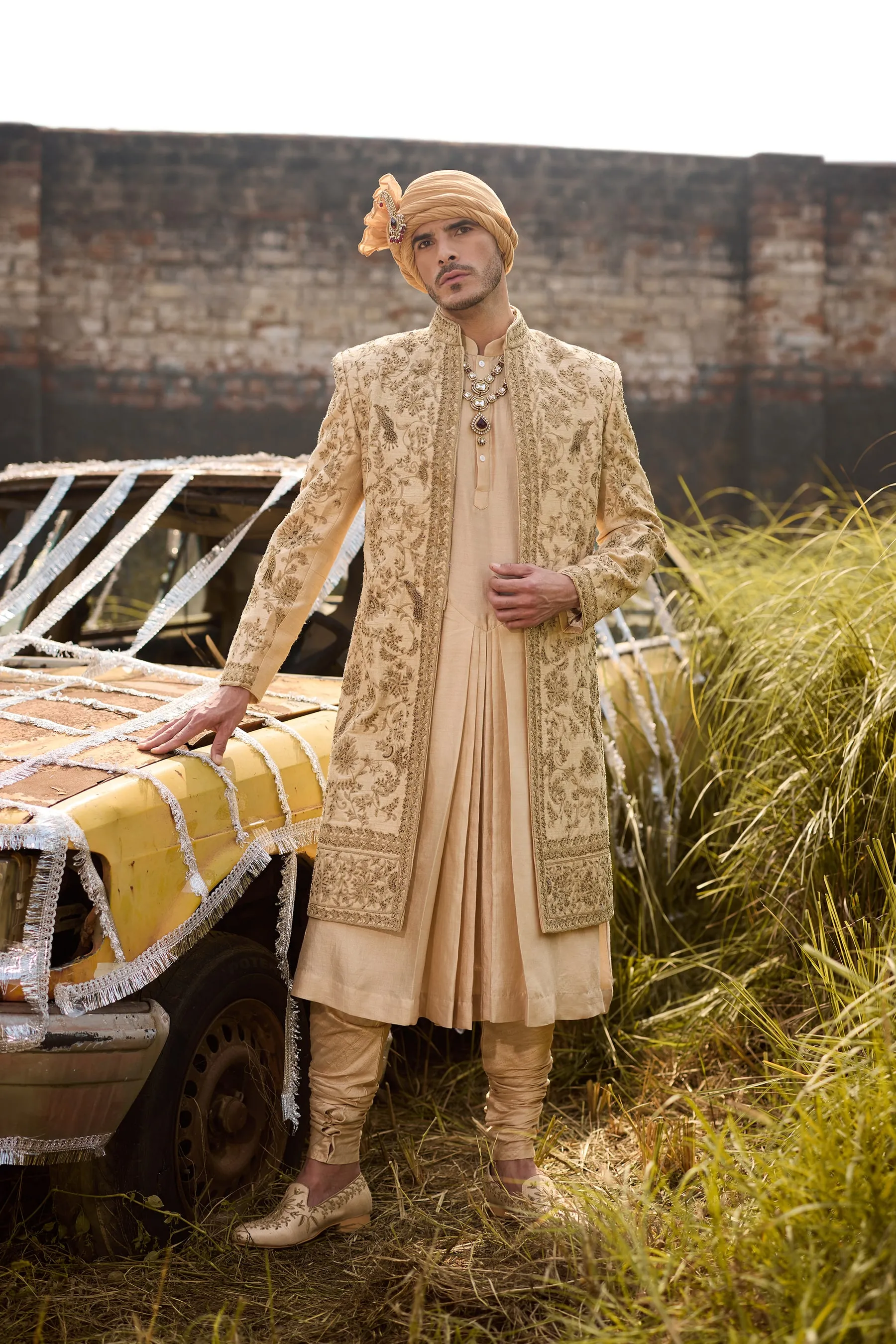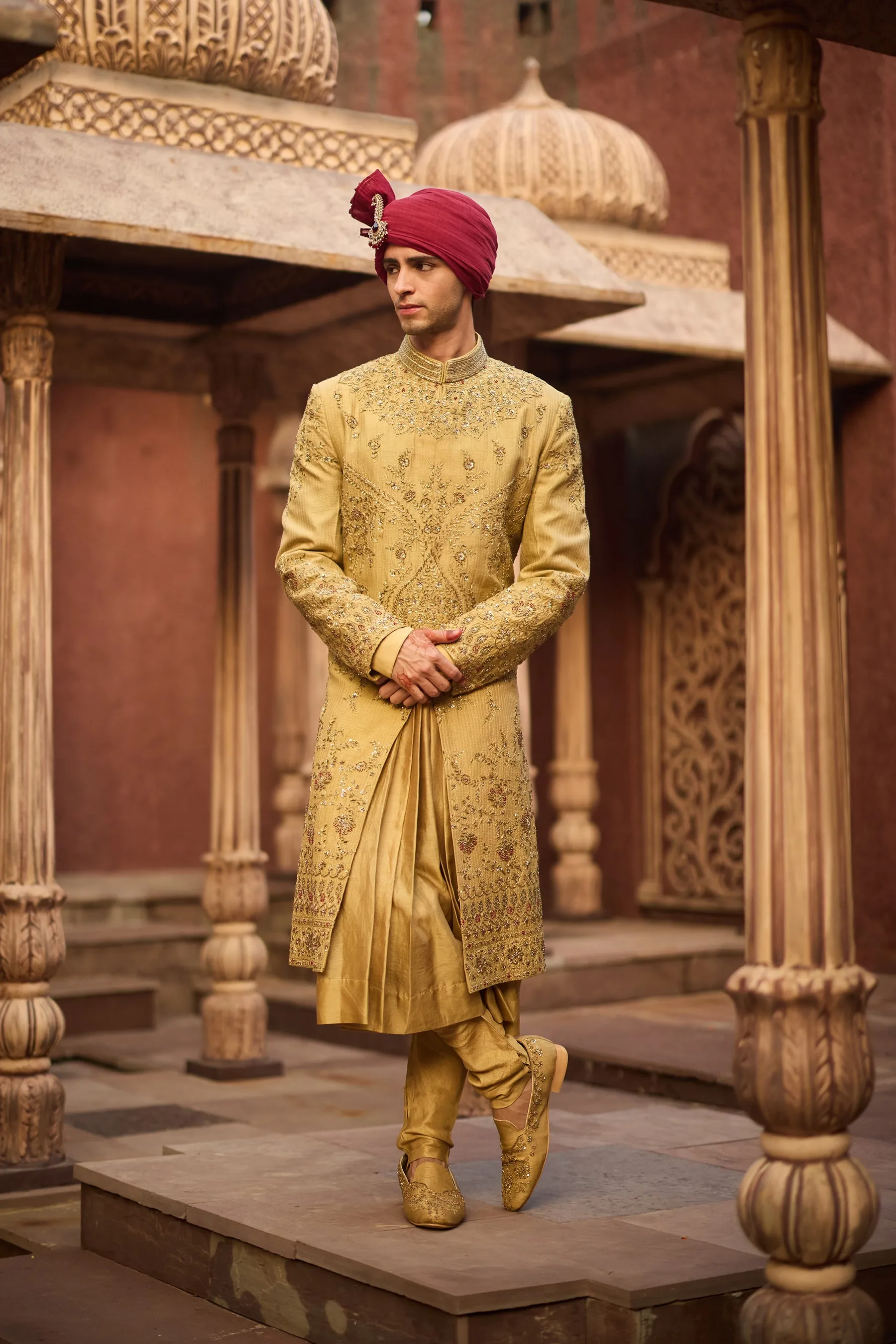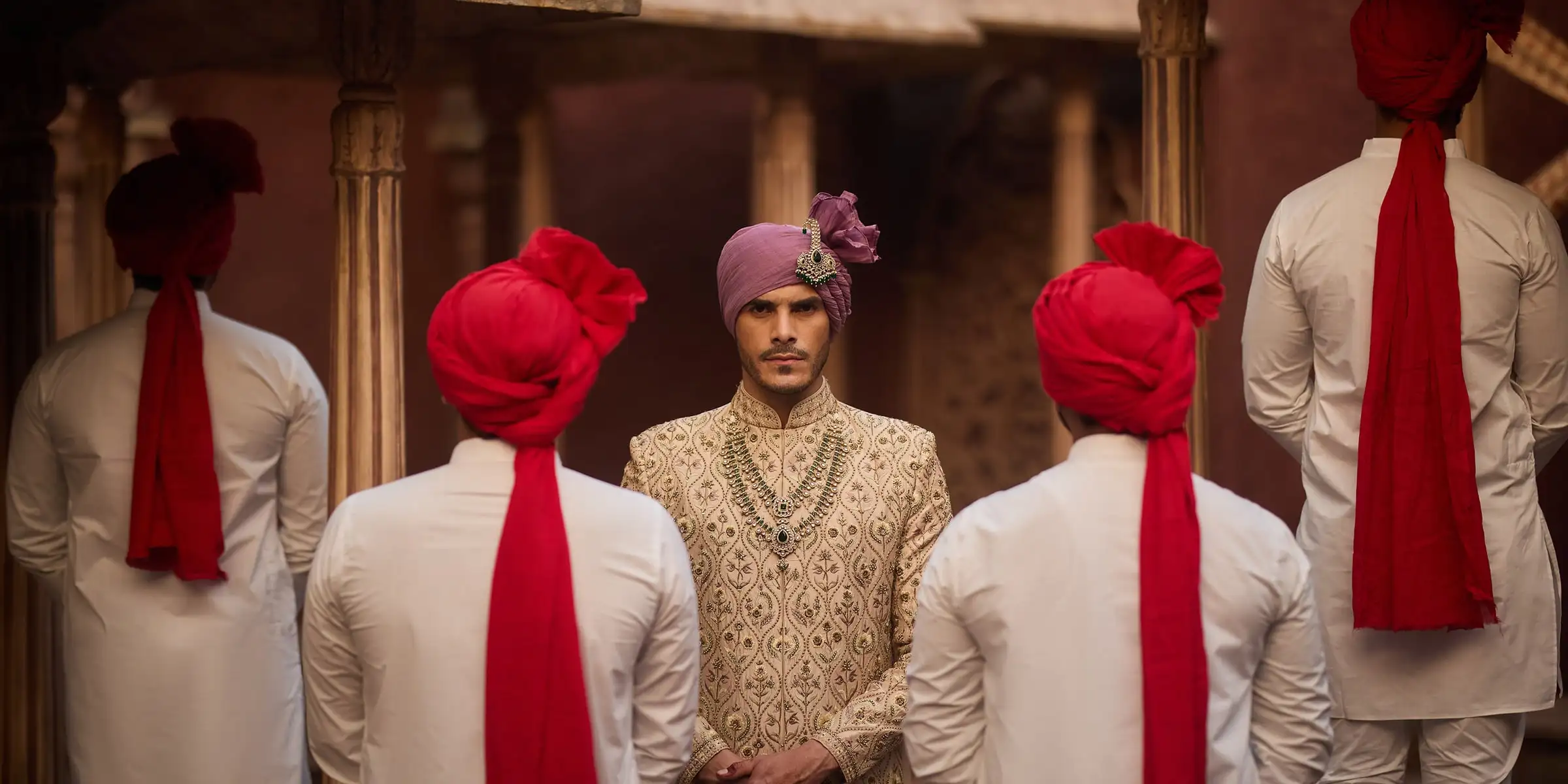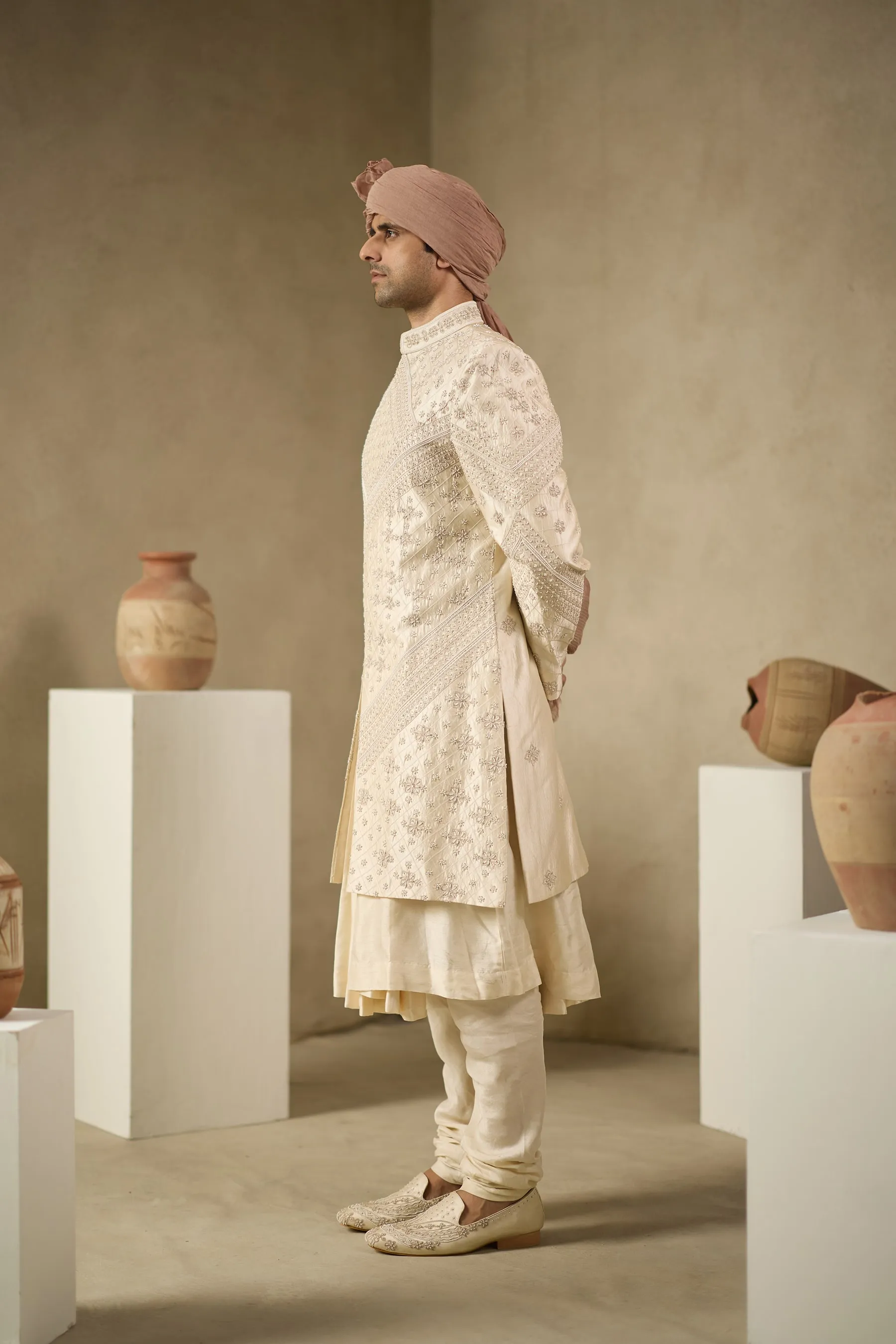
A nikah is a quiet, dignified moment. The marriage contract is read, consent is given, and two families witness the beginning of a marriage. The walima that follows, hosted by the groom’s family, is the public celebration. The groom’s outfit for each is different in spirit: the nikah calls for grace and restraint, and the walima for warmth and a little more splendour. This guide explains what a groom wears to a nikah and walima, covering colours, silhouettes, fabrics, head coverings, accessories and planning, so that you arrive at both looking considered and comfortable.
We write from a tailoring perspective, and customs vary by family, community and country. Treat this as a guide, and speak to the elders in your family about local practice. For other wedding traditions, see our companion guides to the Sikh wedding outfit, Bengali wedding attire and South Indian wedding attire, or the overview of what the groom wears at each ceremony.
The nikah and the walima: two occasions, two moods
The nikah is the religious ceremony in which the marriage is solemnised. It is usually held in a mosque, a family home, a banquet hall or a garden, and it can be attended by a small circle or a large gathering. The groom often sits on the floor or a low seat, facing the officiant (qazi) and the witnesses. The mood is reverent and calm, even when the family is celebrating.
The walima is the wedding feast, traditionally given by the groom’s family after the marriage is consummated or soon after the nikah, in gratitude and to share the news. In modern practice it is often a grand evening reception, with guests, music in some families, a stage and dinner.
Because of these differences, the groom’s outfits should differ:
- Nikah: light, dignified, traditional. Ivory, cream, pastel, soft gold, pale grey. Moderate embroidery. Comfortable for sitting.
- Walima: more festive and more varied. Deeper colours, richer fabrics, a modern bandhgala or a tuxedo if the family is comfortable with it.
What to wear for the nikah
The classic: a sherwani or achkan in a soft colour
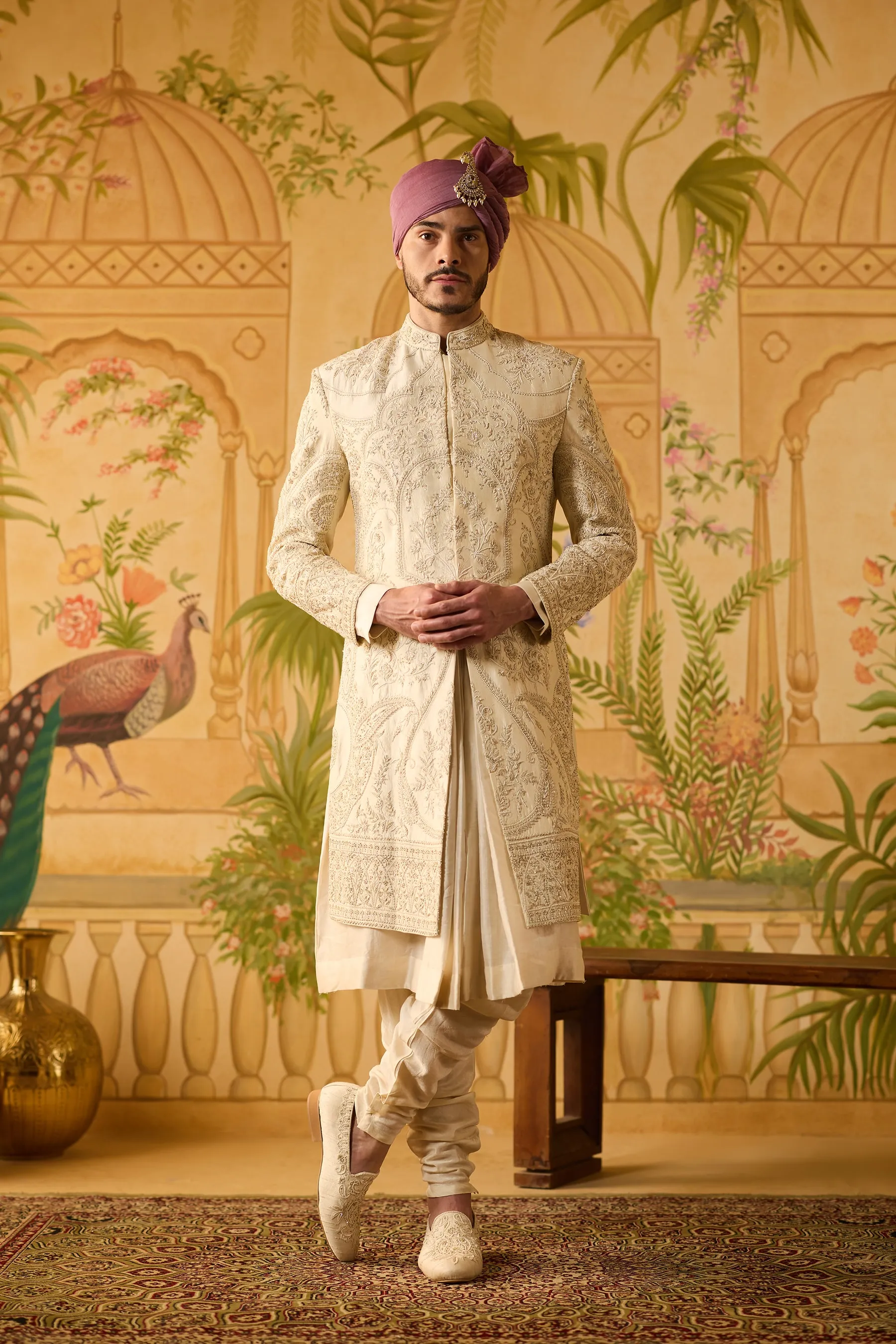
A sherwani or achkan is the traditional choice for a nikah groom. The long coat, usually knee-length, is worn over a kurta with churidar or fitted trousers. For the nikah, choose a colour that feels calm and elegant:
- Ivory and cream: timeless, universal and flattering. Our Taraash sherwani in ivory and Leher in ivory are made for this.
- Ivory and beige: a softer, warmer option, such as the Parinda.
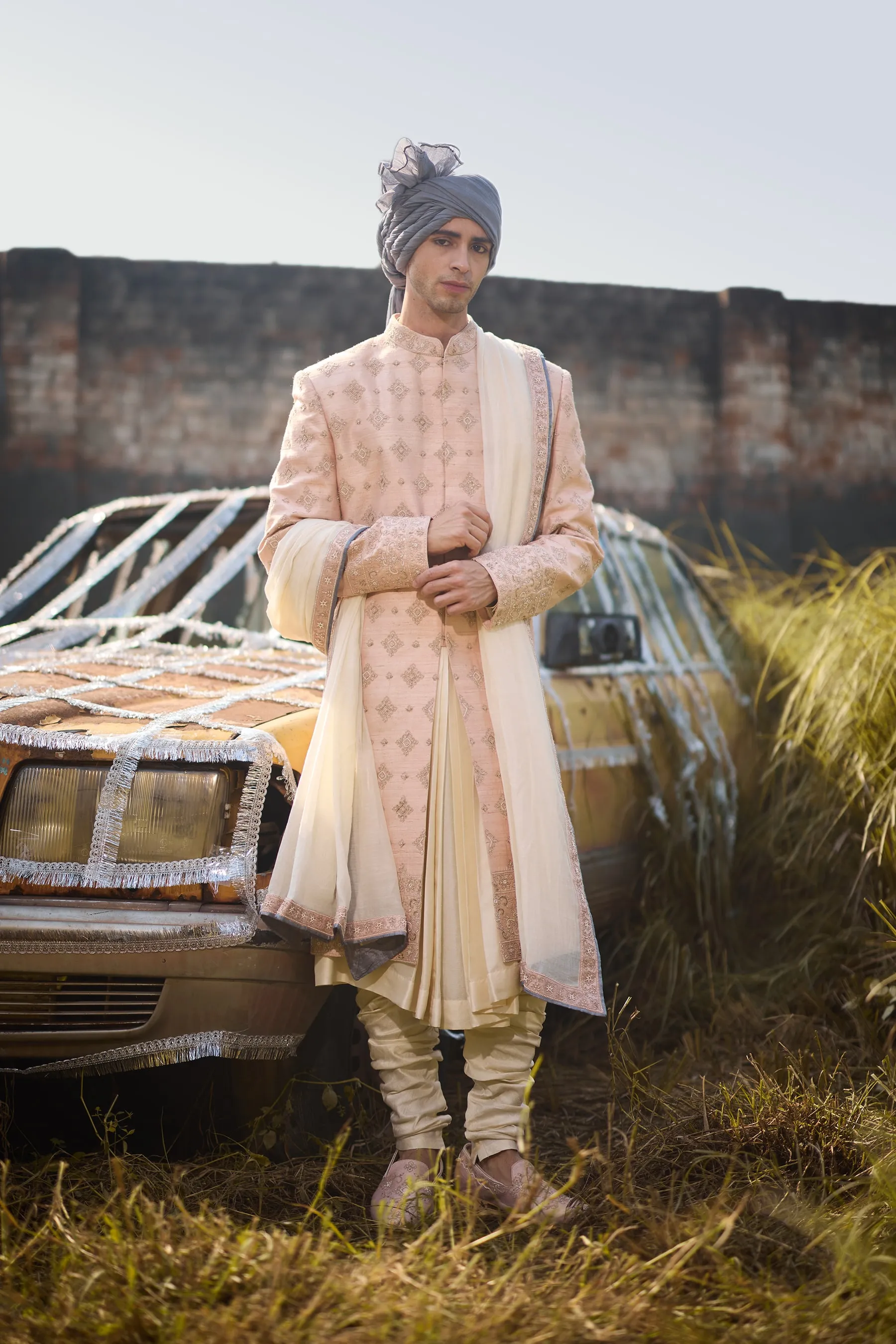
- Blush and rose: modern and gentle; the Kusum in blush is an example.
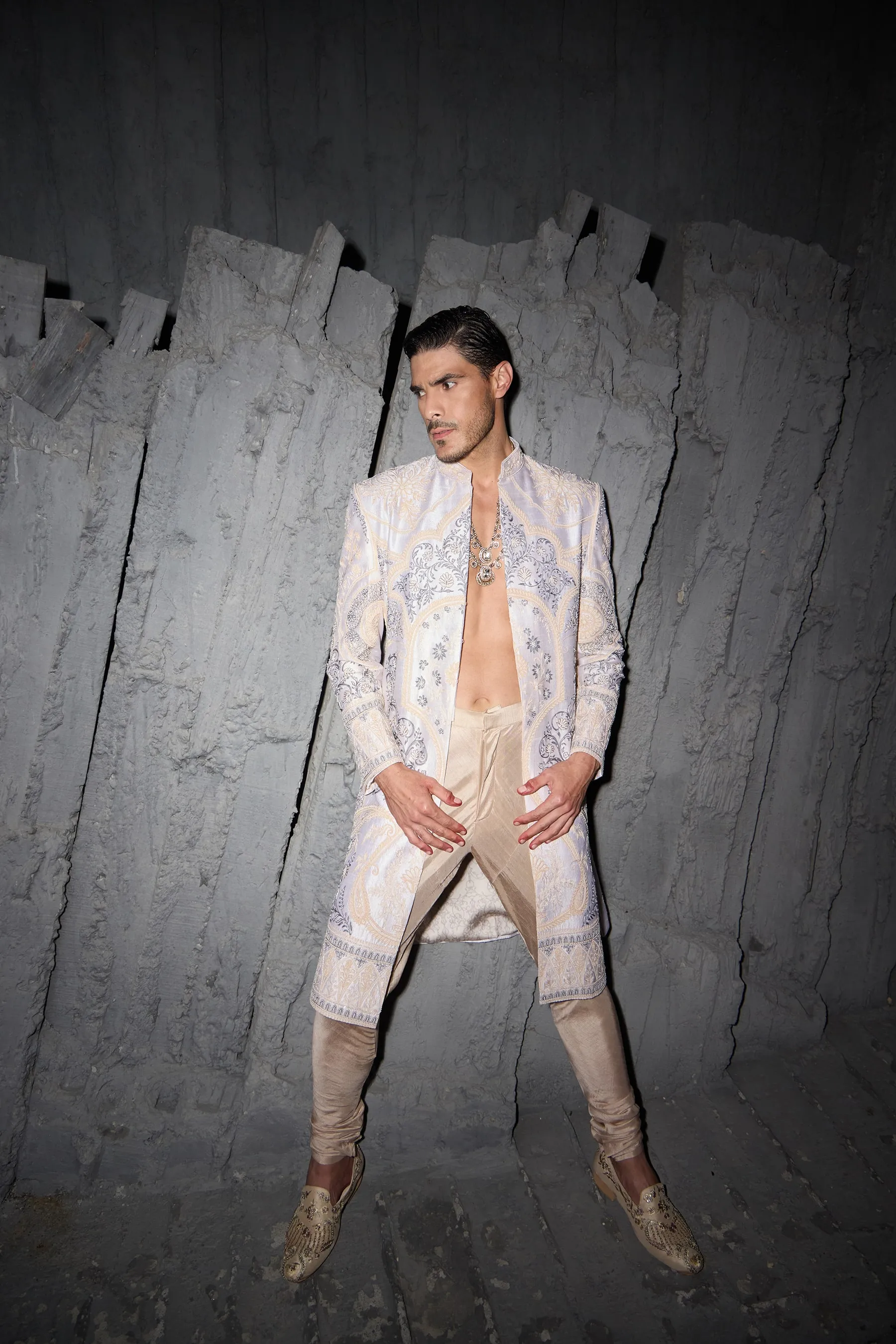
- Pale gold or champagne: festive but restrained.
- Pistachio, powder blue and pale grey: contemporary and photogenic.
Embroidery should be tonal and refined: a dense but quiet pattern in the same shade, or a fine contrasting thread at the collar and cuffs. Avoid heavy zardozi and bright contrasts, which are better kept for a baraat or a walima.
See our sherwani collection and achkan collection for pieces that suit this mood. If you are unsure which silhouette is right, our guide to sherwani vs achkan vs bandhgala explains the differences.
The modest alternative: a kurta set with a jacket
For a smaller or more modest nikah, such as one at home or in a mosque, a kurta set with a Nehru jacket in ivory or a soft colour is entirely appropriate. It is easier to sit in and less formal, and it can be re-worn for Eid, family functions and other celebrations. See the kurta set collection and Nehru jacket collection.
The topi, safa and sehra
Head coverings vary by region and family.
- The topi (a skullcap, often embroidered) is common in many Muslim communities, and a clean white or ivory topi suits most outfits.
- The safa or turban is common in Rajasthani, Hyderabadi and other traditions. It should be well tied and coordinated with the sherwani.
- The sehra (a veil of flowers or beads worn over the face in some regions) is traditional in some communities, and it is removed at the nikah or after.
- A plain kulla or turban with a tail is another option for certain regions.
Whatever you choose, ensure that it is comfortable and that it stays in place while you sit and when you lower your head. Ask your tailor to size it, and practise wearing it before the day.
What to wear for the walima
The walima is the celebration, and the groom’s outfit can show it. Options include:
- A richer sherwani in deeper colours such as wine, emerald, navy or charcoal, or a metallic gold.
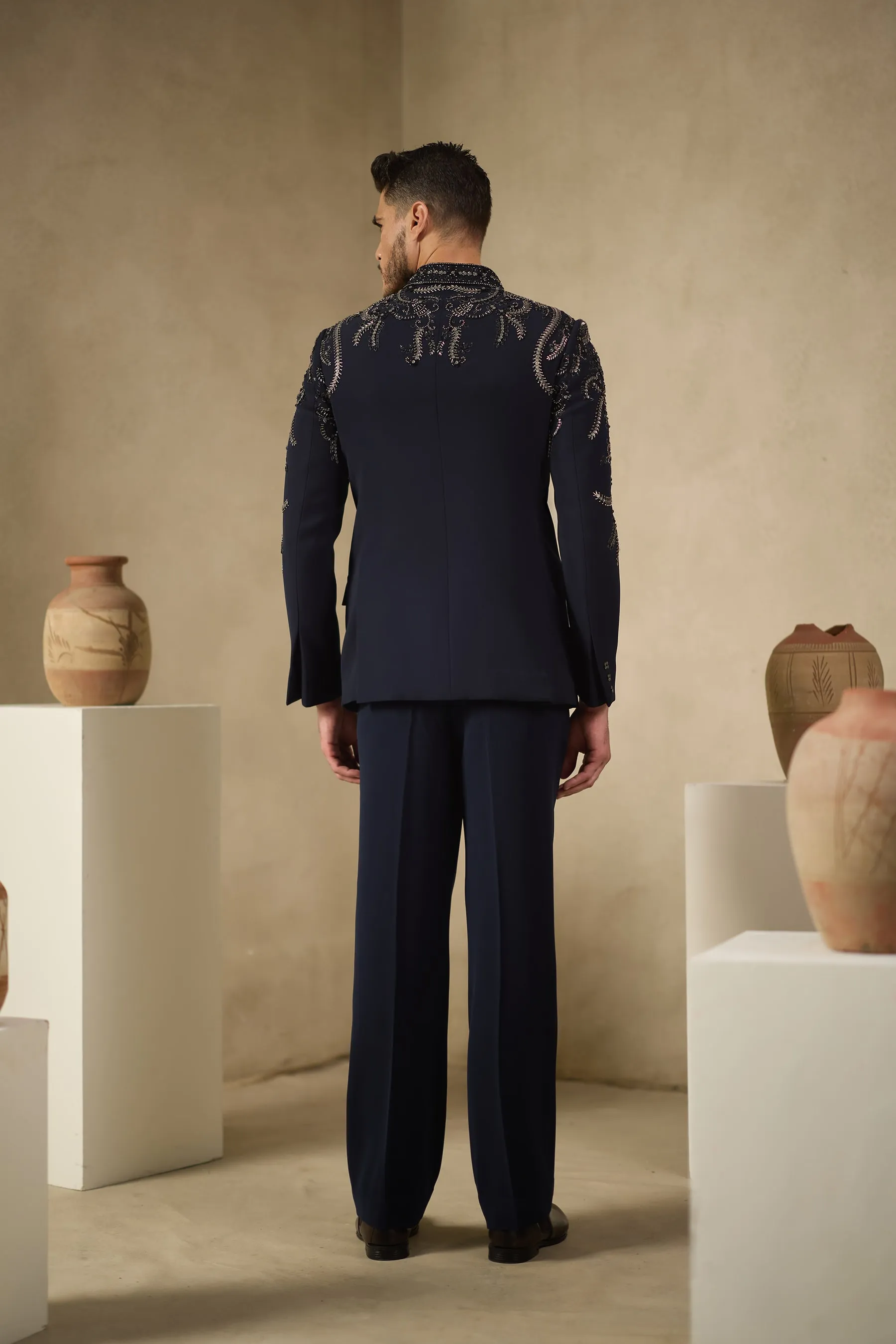
- A bandhgala in midnight navy, black or charcoal: sharp, modern and easy to move in. Our Aftab bandhgala in midnight navy is a good example.
- A tuxedo for a black-tie walima, with a bandhgala or a kurta-style shirt.
- An Indo-Western set for a contemporary family.
- A velvet sherwani or jacket for a winter walima.
For a long evening, comfort and fit matter as much as ornament. Our guides to the reception outfit and the cocktail party outfit discuss fabrics, fit and styling that apply to the walima as well.
Colours and meaning
Colour guidance varies by family, but a few principles hold widely.
- Ivory, white and cream are associated with purity and are common for the nikah. They also show off embroidery and attar beautifully.
- Green holds a special place in many Muslim communities. A green sherwani or a green accent in a stole or safa is well loved, though it should be chosen with care and good taste.
- Gold and champagne suit celebrations without being loud.
- Red is often associated with the bride in many communities; many grooms avoid bright red.
- Black is widely accepted for evening wear, including the walima, but less for the nikah itself.
If the bride’s outfit is known, coordinate softly: an ivory sherwani works with almost any lehenga, while a coloured sherwani can echo an accent in her outfit.
Fabrics, comfort and sitting
The nikah involves sitting for a long time, often on the floor, so fabric and fit matter.
- Choose breathable fabrics: raw silk, cotton-silk, matte silk blends and fine wool for winter.
- Ask for a soft lining, ideally cotton or cupro, that does not trap heat.
- Check the sit. A sherwani should allow you to sit cross-legged without pulling at the seams. Ask your tailor to add ease at the seat and thighs.
- Choose a trouser or churidar that has room. Tight churidars are uncomfortable after an hour.
- Plan for heat. An outdoor nikah in summer needs the lightest fabric you can find.
For weather-specific advice, see our guides to the summer wedding groom outfit and winter wedding groom outfit.
Accessories and finishing touches
- Stole or dupatta: a plain or lightly embroidered stole adds elegance and a sense of occasion. It also helps in the cold.
- Mojaris or juttis: traditional, comfortable and easy to slip off at a mosque. Choose embroidered ones in tan, gold or ivory.
- Brooch or kalgi: a small brooch on the safa or the sherwani adds polish; keep it modest for the nikah.
- Attar (perfume oil): a subtle attar is traditional. Choose a light one.
- Watch and rings: a plain watch is fine. Many families prefer minimal jewellery on the groom for the nikah, so check customs.
- Prayer beads or a small keepsake can be carried by some grooms, if desired.
Planning the two outfits as a pair
If you are having a nikah and walima, plan them together.
- Choose a shared palette. An ivory nikah sherwani and a midnight bandhgala for the walima give contrast without clashing.
- Reuse accessories such as the stole, brooch and shoes, where appropriate.
- Think about photographs. The two events often share albums; a coherent story reads well.
- Consider re-wear. A bandhgala or a kurta set can be worn after the wedding for Eid and family occasions.
If the budget is limited, a single well-made sherwani in ivory can serve for the nikah, and a bandhgala can serve for the walima and later.
Measurements, fittings and timeline
Made-to-measure gives the best fit. Allow eight to ten weeks from the first fitting. The sequence looks like this:
| When | What happens |
|---|---|
| 10 to 12 weeks before | Choose the silhouette, colour and fabric. Book a fitting. |
| 8 to 10 weeks before | First measurements and fabric confirmation. |
| 4 to 5 weeks before | First fitting; adjust shoulders, length and seat. |
| 2 weeks before | Second fitting; check sitting comfort and accessories. |
| 1 week before | Final fitting; steam and pack. |
See our guide to made-to-measure timelines for more detail on each stage.
Family, elders and the groom’s party
The groom’s father, brother and close relatives will also attend, and coordinating colours gives a pleasing picture. Our guides to the father of the groom’s outfit and groom’s brother’s outfit show how to dress family members. For friends who accompany you, read about groomsmen outfits. Guests may find our male guest guide useful.
Regional styles within the nikah tradition
Muslim weddings across South Asia share a core of ritual, but the clothing changes with the region, and knowing the local style helps you choose well.
- Hyderabadi weddings often feature a long, regal sherwani in ivory, cream or gold, worn with a rich stole and sometimes a traditional turban or a kulla-style cap. The look is stately, with fine zari work.
- Lucknowi and Awadhi weddings favour the achkan and the chikankari tradition: delicate white-on-white embroidery, soft silhouettes and a gentle, courtly elegance.
- Kashmiri weddings may include a pheran or a richly embroidered coat, with warm fabrics and a cap suited to the climate.
- Bohra and Memon communities have their own customs, with distinct dress and colours; it is best to follow family guidance.
- Bengali and Bangladeshi Muslim weddings often involve a panjabi in cream or white with a stole, sometimes with a topi, and a more relaxed silhouette.
- Gulf and diaspora weddings frequently mix traditions: a sherwani for the nikah and a tuxedo or bandhgala for the walima, with a more contemporary cut.
- South Indian Muslim weddings may involve a silk kurta with a lungi or pyjama in light colours, and a cap suited to the family’s custom.
If your family belongs to more than one tradition, choose the elements that matter most to the elders and let the rest follow your own taste. A short conversation with a parent or an uncle about what they expect saves much confusion later.
Chikankari, zardozi and embroidery: choosing the right work
Embroidery is where a nikah outfit gains character, and where restraint matters most.
- Chikankari is a fine, white-on-white (or tonal) hand embroidery from Lucknow. It is soft, airy and ideal for a nikah in warm weather, particularly on cotton, muslin and light silk.
- Zardozi and zari work use metallic thread for richness. For the nikah, use it sparingly at the collar, cuffs and placket; for the walima, it can be denser.
- Thread work and resham in tonal colours give texture without shine.
- Pearls and beads add a gentle sparkle. Keep them small and placed with care.
- Buttons and closures matter. Fabric-covered or metal buttons in antique gold read as elegant; oversized, gem-studded buttons can feel heavy.
A useful test: look at the sherwani from three metres away. You should see a refined surface, not a glitter. Up close, the work should reward inspection. Our atelier shows every embroidery in daylight and in evening light so you can judge.
Grooming and presentation
The outfit is only part of the picture. A few details complete the look.
- Beard and hair: schedule a trim or a barber visit two or three days before the wedding, not on the morning of it. Many grooms keep a neat, groomed beard in line with family custom.
- Skin: a gentle facial a week before, and plenty of water, helps.
- Hands and nails: clean, trimmed nails photograph well in ring and handshake shots.
- Attar: a light application on the wrists or the sherwani collar is traditional; apply it before you dress to avoid staining the fabric.
- Shoes: polish or clean them the evening before.
- A calm morning: eat, drink water, and dress with plenty of time. A rushed groom looks rushed.
What to pack for the day
Keep a small bag with you or with a trusted relative. Useful items include a spare handkerchief, safety pins, a lint roller, a small mirror, a comb, breath mints, a stain pen, a phone charger and a spare pair of socks. Include a second shirt or kurta for the walima if you expect to change between the nikah and the evening. Hang the outfits in a cool room and steam them the day before.
Finally, remember that the nikah is above all a moment of commitment. The most memorable grooms are not the most heavily dressed; they are the ones who look settled, comfortable and quietly happy in what they wear.
Common mistakes to avoid
- Overdoing the nikah outfit. The mood is dignified; heavy embroidery and loud colours can feel out of place.
- Ignoring comfort. A tight sherwani is hard to sit in for an hour.
- Wearing a head covering you have not practised with. Tie the safa a few times beforehand.
- Neglecting shoes. You may remove them at the venue, so choose comfortable, clean ones.
- Forgetting the weather. Heat and cold change the best choice of fabric.
- Leaving the walima outfit to the last minute. It deserves its own fitting.
Frequently asked questions
What does a groom wear to a nikah?
An ivory, cream or pastel sherwani or achkan, with a topi or safa depending on custom, and mojaris.
What is the difference between nikah and walima outfits?
The nikah outfit is lighter and more restrained; the walima outfit is richer and more festive.
Can I wear a suit to a nikah?
You can, but a sherwani or achkan is more traditional. Choose a modest colour and a well-fitted cut.
How early should I order?
Eight to ten weeks before the nikah, with two fittings.
Final thoughts
The best nikah outfit is one that lets you focus on the moment: comfortable, well-fitted and quietly beautiful. The best walima outfit is one that lets you enjoy the celebration. If you would like help choosing both, book an appointment and we will build the pair with you.
Shop the looks
Explore the sherwani collection, achkan collection and bandhgala collection, or start with the baraat and pheras edit and the reception edit.